


It was a birthday gift that most children could only dream of — a trip to outer space.
Zainab Azim’s parents bought her a seat on a Virgin Galactic suborbital flight when she turned 11, and now she is on the way to becoming the first hijab-wearing space tourist.
Now 19, the Pakistani-Canadian student is of legal age and eligible to fly on a spacecraft using her $250,000 ticket.
Ms Azim visited Dubai on February 11 to speak on a panel at the International Day for Women and Girls in Science at Expo 2020 Dubai.
Before that, she spoke to The National about her expected journey to space and the need to create more opportunities for women in Stem — science, tech, engineering and maths — fields.
“The ticket was a gift from my parents because I always had an interest in space,” Ms Azim said, who is co-founder of the non-profit Global Initiative and Vision for Education organisation.
More than 600 Virgin Galactic ticket holders around the world are also waiting for a turn on the spaceplane, which flies above 80 kilometres but does not pass the Karman line — the boundary between Earth's atmosphere and the beginning of space.
The first passenger flight, which carried Virgin owner Richard Branson himself, was completed last summer.
But, shortly after, authorities grounded the spaceplane for deviating from its flight path. Virgin Galactic announced that operations would resume at the end of this year.
So it could be a few years until Ms Azim gets her ride to space, but she remains “excited”.
“I am excited, but I know my mum is already scared and we don’t even have a date for it yet,” Ms Azim said, who is currently a university student in Toronto, pursuing a double major in neuroscience and public policy and a minor in psychology and astrophysics.
“I’m her only daughter and I have two brothers younger than me, so I do understand her fear. My dad is also excited, but not more excited than me.”
Ms Azim would be the first hijab-wearing space tourist, but not the first female Muslim to go to space.
In 2006, Iranian-American businesswoman Anousheh Ansari went to the International Space Station on a self-funded mission for which she paid about $20 million.
Also, Emirati engineer Nora Al Matrooshi is the first Arab female to be selected as an astronaut. She is in line to become the first hijab-wearing astronaut on the space station if she gets a chance to go there before the floating laboratory is retired in 2031.
-

The UAE's new astronauts Nora Al Matrooshi and Mohammed Al Mulla at the Address Hotel, Dubai Mall in Dubai. All pictures by Chris Whiteoak -

Emirati astronaut Nora Al Matrooshi said the opportunity to travel into space would be the realisation of a childhood dream -

Mohammed Al Mulla will join an elite list of Emirati astronauts -

Mohammed Al Mulla and Nora Al Matrooshi. Chris Whiteoak/ The National -

Saeed Al Kormastaji, UAE astronaut office manager, speaks during a press conference introducing the country's newest astronauts to the world -

Saeed Al Kormastaji, UAE astronaut office manager, at the press conference in Dubai -

Saeed Al Kormastaji, UAE astronaut office manager (L), Salem Al Marri, UAE Astronaut Programme manager and Yousuf Al Shaibani, director general of MBRSC (M). with the UAE's new astronauts, Nora Al Matrooshi and Mohammed Al Mulla at the Address Hotel, Dubai Mall in Dubai


Apart from feeling enthusiastic about the suborbital flight experience, Ms Azim said she also “feels uncomfortable” about spending such a hefty amount on the ticket.
She hopes that space tourism companies will create programmes that give easier access to those who could not such sums.
“I am excited about it, but ‘I want to go to space’ is not enough for me to spend $250,000 on a ticket,” she said.
“There needs to be a bigger reason and a bigger goal. It has to create an impact for other people. I don't feel comfortable doing that for myself.”
Over the past few years, Ms Azim has participated in many conferences and workshops around the world as a speaker and mentor to encourage young people to pursue their passions in stem.
Last year, the United Nations Office for Outer Space Affairs selected her as a mentor for the Space4Women Network, which runs initiatives to promote gender equality in space fields.
Discrimination against women was rife at Nasa in the 1960s when the space exploration began.
While that gender gap has somewhat narrowed, the space sector continues to be male dominated in some parts of the world.
More than 600 people have flown to space so far, but only 10 per cent of them were women.
Richard Branson through the years — in pictures
-

British businessman Sir Richard Branson during the launch of Virgin Atlantic Airways on April 6, 1984. -

The millionaire entrepreneur founded the Virgin group of companies, which covers a wide range of interests from records to airline travel, on a beach in 1986. -

Sir Richard Branson in the cabin of the 'Virgin Atlantic Flyer' balloon at Gatwick Airport in 1987. -
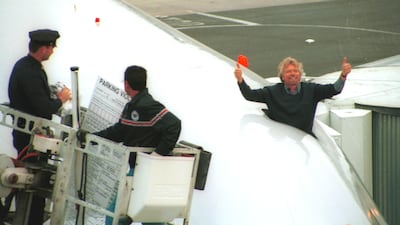
Sir Richard Branson inside the cockpit of a plane in New York in May 2000. -
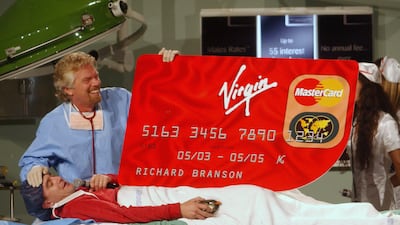
The Virgin founder 'performs surgery' on Australian comedian Jimeoin during a sketch to launch a credit card in Sydney in 2003. -
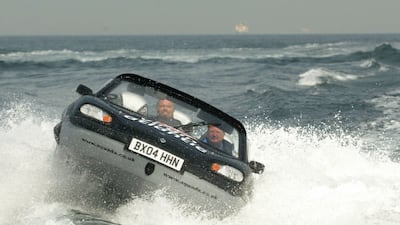
Sir Richard Branson pilots his Gibbs Aquada amphibious car during a record-breaking 2004 crossing of the English Channel. -
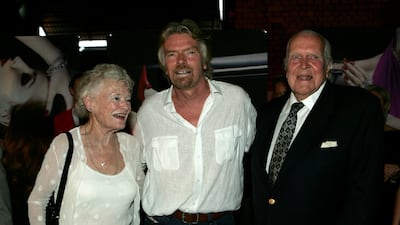
Sir Richard Branson with his father and mother at a party in 2004 in Sydney. -
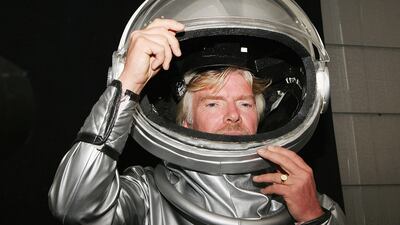
Sir Richard Branson signing up to become an astronaut in Sydney in 2005. -
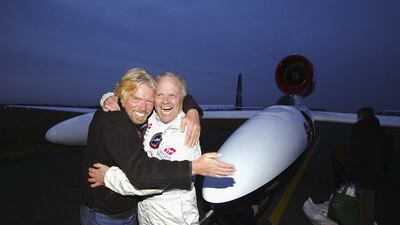
Steve Fossett is hugged by Sir Richard Branson in Bournemouth, England, after making an unscheduled landing due to electrical problems with the Virgin Atlantic GlobalFlyer aircraft in 2006. -

The Virgin Galactic founder next to a British-style red telephone box during a photocall on a man-made island off Dubai in 2006. -

Sir Richard Branson attends a photocall to launch Virgin Media's television channel Virgin 1, in Oxfordshire, England, in 2007. -
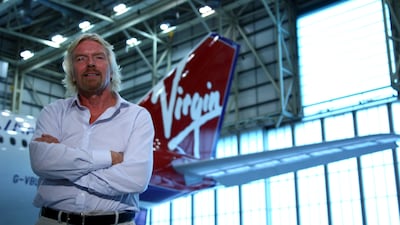
Sir Richard Branson at London's Heathrow Airport in 2008. -
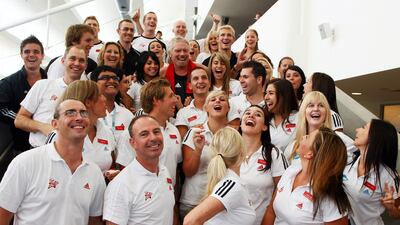
Sir Richard Branson with employees during the official launch of the Virgin Active Health Club in 2009 in Sydney, Australia. -
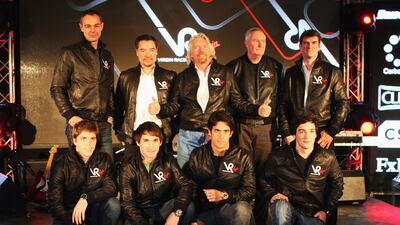
The Virgin Galactic founder attends the media launch for a new Virgin Racing team in Notting Hill, London. -
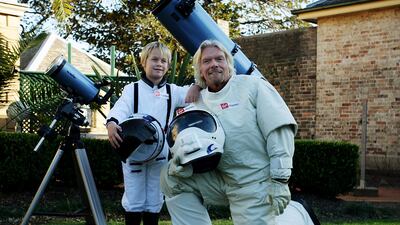
Sir Richard Branson poses alongside Charlie Graham in 2011 in Sydney, Australia. The tycoon announced a competition that would offer the winner a trip to space aboard a Virgin Galactic space plane. -
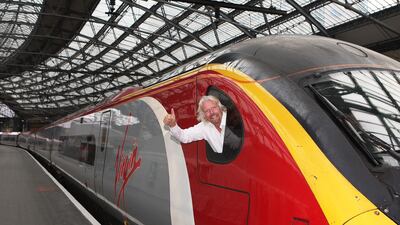
Sir Richard Branson in a Virgin train in Liverpool, England, in 2012. -
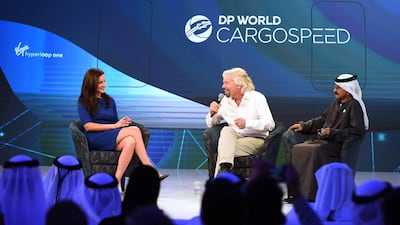
CNBC's Middle East anchor Hadley Gamble, Sir Richard Branson and Sultan bin Sulayem, group chairman and chief executive of DP World, in 2018 in Dubai. -

Sir Richard Branson with Virgin Galactic colleagues on July 1.



