• The first crew to go to the International Space Station included (left to right) Sergei Krikalev, Bill Shepherd and Yuri Gidzenko. Courtesy: Nasa
    The first crew to go to the International Space Station included (left to right) Sergei Krikalev, Bill Shepherd and Yuri Gidzenko. Courtesy: Nasa
  • The new International Space Station after the crew of the Space Shuttle Endeavour captured the Zarya Control Module, left, and mated it with the Unity Node, right, inside the Shuttle's payload bay. This photo was taken after Endeavour undocked from the space station on Dec. 13, 1998, for the return to Earth. Almost two years later, the first crew _ American Bill Shepherd and Russians Sergei Krikalev and Yuri Gidzenko _ blasted off from Kazakhstan on Oct. 31, 2000, en route to the space station. Thus began 20 years of international cooperation and a steady stream of crew from around the world. (NASA via AP)
    The new International Space Station after the crew of the Space Shuttle Endeavour captured the Zarya Control Module, left, and mated it with the Unity Node, right, inside the Shuttle's payload bay. This photo was taken after Endeavour undocked from the space station on Dec. 13, 1998, for the return to Earth. Almost two years later, the first crew _ American Bill Shepherd and Russians Sergei Krikalev and Yuri Gidzenko _ blasted off from Kazakhstan on Oct. 31, 2000, en route to the space station. Thus began 20 years of international cooperation and a steady stream of crew from around the world. (NASA via AP)
  • The ISS as seen from the Space Shuttle Atlantis after the station and shuttle began their post-undocking relative separation on May 23, 2010. Twenty years after the first crew arrived, the space station has hosted 241 residents and grown from three cramped and humid rooms to a complex almost as long as a football field, with six sleeping compartments, three toilets, a domed lookout and three high-tech labs. (NASA via AP)
    The ISS as seen from the Space Shuttle Atlantis after the station and shuttle began their post-undocking relative separation on May 23, 2010. Twenty years after the first crew arrived, the space station has hosted 241 residents and grown from three cramped and humid rooms to a complex almost as long as a football field, with six sleeping compartments, three toilets, a domed lookout and three high-tech labs. (NASA via AP)
  • This Oct. 20, 2000 photo made available by NASA shows the International Space Station after separation of the Space Shuttle Discovery. Backdropped against the blackness of space, the Z1 Truss structure and its antenna, as well as the new pressurized mating adapter (PMA-3), are visible in the foreground. (NASA via AP)
    This Oct. 20, 2000 photo made available by NASA shows the International Space Station after separation of the Space Shuttle Discovery. Backdropped against the blackness of space, the Z1 Truss structure and its antenna, as well as the new pressurized mating adapter (PMA-3), are visible in the foreground. (NASA via AP)
  • On October 31, 2000, a cloud of smoke surrounds the Soyuz rocket seconds before liftoff from the Baikonur Cosmodrome in Kazakstan, carrying the first residents of the International Space Station. Two days later, U.S. astronaut Bill Shepherd, and Russian cosmonauts Sergei Krikalev, and Yuri Gidzenko arrived at the space station. (NASA via AP, File)
    On October 31, 2000, a cloud of smoke surrounds the Soyuz rocket seconds before liftoff from the Baikonur Cosmodrome in Kazakstan, carrying the first residents of the International Space Station. Two days later, U.S. astronaut Bill Shepherd, and Russian cosmonauts Sergei Krikalev, and Yuri Gidzenko arrived at the space station. (NASA via AP, File)
  • The Soyuz booster is transported to the launch pad at the Baikonur Cosmodrome in Kazakstan. Two days later, US astronaut Bill Shepherd, and Russian cosmonauts Sergei Krikalyov and Yuri Gidzenko blasted off to become the first residents on the International Space Station. (AP Photo/Mikhail Metzel, File)
    The Soyuz booster is transported to the launch pad at the Baikonur Cosmodrome in Kazakstan. Two days later, US astronaut Bill Shepherd, and Russian cosmonauts Sergei Krikalyov and Yuri Gidzenko blasted off to become the first residents on the International Space Station. (AP Photo/Mikhail Metzel, File)
  • The International Space Station continues its orbit around the Earth as seen from a Soyuz spacecraft departing with NASA astronauts Andrew Feustel and Ricky Arnold and Roscosmos cosmonaut Oleg Artemyev, who had spent 197 days in space. From the first crew to the most recent, the No. 1 pastime aboard the station is gazing down at Earth. It takes just 90 minutes to circle the world, allowing crews to soak in a staggering 16 sunrises and 16 sunsets every day. (NASA/Roscosmos via AP)
    The International Space Station continues its orbit around the Earth as seen from a Soyuz spacecraft departing with NASA astronauts Andrew Feustel and Ricky Arnold and Roscosmos cosmonaut Oleg Artemyev, who had spent 197 days in space. From the first crew to the most recent, the No. 1 pastime aboard the station is gazing down at Earth. It takes just 90 minutes to circle the world, allowing crews to soak in a staggering 16 sunrises and 16 sunsets every day. (NASA/Roscosmos via AP)
  • Humans on Earth can sometimes spot the ISS because of its large solar panels. (NASA via AP)
    Humans on Earth can sometimes spot the ISS because of its large solar panels. (NASA via AP)
  • A Progress supply ship arrives on Nov. 18, 2000 to link up to the International Space Station, bringing Expedition 1 commander Bill Shepherd, pilot Yuri P. Gidzenko and flight engineer Sergei K. Krikalev two tons of food, clothing, hardware and holiday gifts from their families. (NASA via AP)
    A Progress supply ship arrives on Nov. 18, 2000 to link up to the International Space Station, bringing Expedition 1 commander Bill Shepherd, pilot Yuri P. Gidzenko and flight engineer Sergei K. Krikalev two tons of food, clothing, hardware and holiday gifts from their families. (NASA via AP)
  • In this photo provided by NASA, the International Space Station is seen from the Space Shuttle Atlantis as the two spacecraft perform their relative separation on July 19, 2011. Above and to the right of the space station is the moon far in the distance. (NASA via AP)
    In this photo provided by NASA, the International Space Station is seen from the Space Shuttle Atlantis as the two spacecraft perform their relative separation on July 19, 2011. Above and to the right of the space station is the moon far in the distance. (NASA via AP)

20 years on: Five key moments on the International Space Station


Sarwat Nasir
  • English
  • Arabic

Twenty years ago today, a crew of three American and Russian astronauts cracked open a heavy steel hatch and climbed aboard the International Space Station.

And space exploration was never the same again.

Since then, the football field-sized structure – the brightest object in the sky after the Sun and Moon – has been continuously occupied by a multi-faith and multinational crew of scientists and engineers.

On November 2, 2000, Nasa astronaut Bill Shepherd and two Russian cosmonauts Yuri Gidzenko and Sergei Krikalev arrived. A handful of astronauts had been there before to build the modules, but this was the first resident crew.

Since then, 240 people from 19 countries have visited the station. This includes the first woman, Nasa astronaut Susan Helms in 2001, and the first Arab astronaut Hazza Al Mansouri in 2019.

But there are many memorable moments that have taken place on ISS. Here we look at five of the most memorable.

First space tourist - and a $20 million cheque

Space tourism may be a hot topic now, but the idea was born two decades ago when a private citizen paid to go to space.

American multimillionaire Dennis Tito became the world’s first space tourist on April 28, 2001.

It is said he paid about $20 million to spend eight days on the ISS after the Russians arranged the trip. Nasa refused to take him as he wasn’t a trained astronaut.

Mr Tito was 60-years-old at the time and going to space was his lifelong dream.

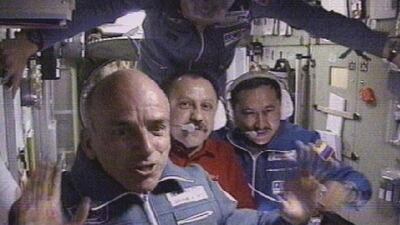
  • The world's first space tourist Dennis Tito waves in front of the International Space Station crew on April 30, 2001. Courtesy: RTV
    The world's first space tourist Dennis Tito waves in front of the International Space Station crew on April 30, 2001. Courtesy: RTV
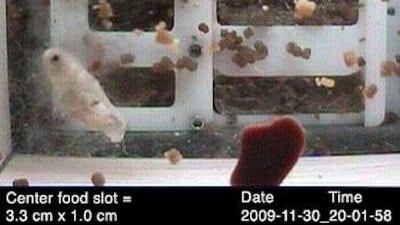
  • Painted Lady butterflies live in their habitat aboard the International Space Station. Courtesy: Nasa
    Painted Lady butterflies live in their habitat aboard the International Space Station. Courtesy: Nasa
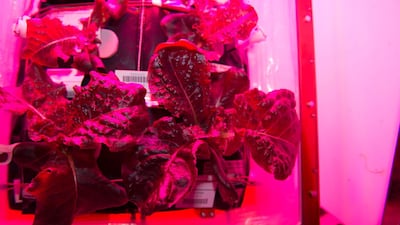
  • Red romaine lettuce was the first vegetable to grow in space in August 2015. Courtesy: Nasa
    Red romaine lettuce was the first vegetable to grow in space in August 2015. Courtesy: Nasa
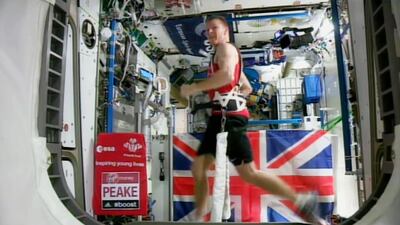
  • In 2016, British astronaut Tim Peake completed the fastest marathon in space. Courtesy: European Space Agency
    In 2016, British astronaut Tim Peake completed the fastest marathon in space. Courtesy: European Space Agency
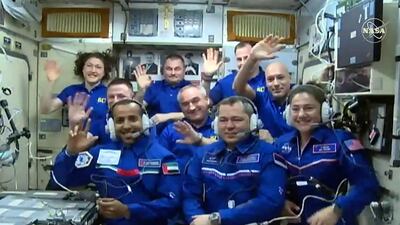
  • Maj Hazza Al Mansouri meets the rest of the team at the International Space Station shortly after docking. Courtesy: Nasa
    Maj Hazza Al Mansouri meets the rest of the team at the International Space Station shortly after docking. Courtesy: Nasa

Since then, about seven similar trips have been arranged for private citizens and astronauts from countries that are not ISS-partners.

SpaceX billionaire Elon Musk and Virgin Galactic hope to make regular space tourism flights a reality, including trips to the Moon, ISS and sub-orbital flights.

Space station's first birth

On November 30, 2009, butterflies were born on the station.

Two types emerged from their cocoons inside a genetic bioprocessing container.

Seven cocoons were taken to space as part of an educational experiment for scientists, pupils and teachers. The butterflies’ birth and growth under microgravity conditions were studied.

They were the first Monarch butterflies in space and the first Painted Lady butterflies to go through all phases of development in microgravity.

Scientists found that the Monarchs’ lifespan on Earth is about two weeks, but they lasted four days in space because of the tight space. It took 15-minutes instead of three to six minutes for them to dry after coming out of their cocoon.

The Painted Lady lives for up to two weeks on Earth, but were alive for about a week in orbit.

Growing the first vegetables

Red romaine lettuce was the first vegetable to been grown in space, in August 2015 and they were a tastier alternative than the odd packaged space food astronauts have to eat.

But, they were grown mainly to study how plants and vegetables can be grown in microgravity and provide astronauts with a sustainable food source in future.

The astronauts ate half of the batch - and the rest were brought back to Earth.

Since then, astronauts have grown three types of lettuce, Chinese cabbage, mizuna mustard, red Russian kale and zinnia flowers.

They are all grown in the Advanced Plant Habitat, a growth chamber on the station used for plant research.

It uses LED lights and a controlled release fertiliser to deliver water, nutrients and oxygen to the plant roots.

The chamber also has cameras and more than 180 sensors, so the ground control team can monitor growth.

Astronauts growing their own food resources is vital to meet goals of establishing a human base on other planets or the Moon.

Running a marathon in space

Two to three hours of exercise daily is required for astronauts to maintain their health, but one astronaut took his workout to another level.

In 2016, British astronaut Tim Peake completed the fastest marathon in space. He gained a Guinness World Record for his efforts, finishing in three hours, 35-minutes and 21-seconds for the London Marathon.

The accomplishment came nine years after Nasa astronaut Sunita Williams ran a marathon in space for the Boston Marathon.

Both of them ran for hours on the space station’s treadmill.

First live Arabic-language tour of the ISS

Tours of the space station have been done in many languages – English, Russian, French, Italian and others.

But, it was only last year when the first Arabic-language tour was done by Emirati astronaut Hazza Al Mansouri.

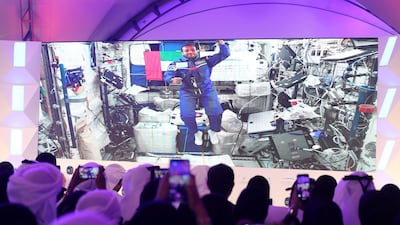
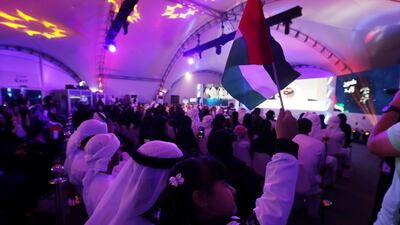
  • The UAE's first astronaut, Maj Hazza Al Mansouri, takes part in a Q&A session from the International Space Station with an audience at the Mohammed bin Rashid Space Centre, Dubai, in 2019. Chris Whiteoak / The National
    The UAE's first astronaut, Maj Hazza Al Mansouri, takes part in a Q&A session from the International Space Station with an audience at the Mohammed bin Rashid Space Centre, Dubai, in 2019. Chris Whiteoak / The National
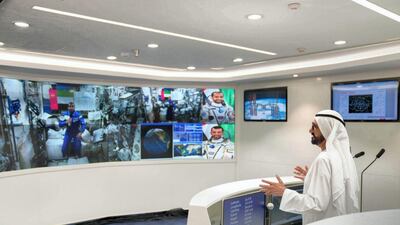
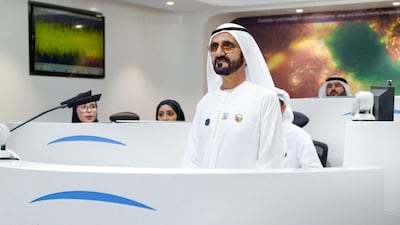
  • Sheikh Mohammed bin Rashid, Vice President and Ruler of Dubai, talks with Emirati astronaut Maj Hazza Al Mansouri, during a live satellite feed from the International Space Station. Courtesy: Dubai Media Office
    Sheikh Mohammed bin Rashid, Vice President and Ruler of Dubai, talks with Emirati astronaut Maj Hazza Al Mansouri, during a live satellite feed from the International Space Station. Courtesy: Dubai Media Office
  • The Emirati astronaut takes questions from the audience gathered at the Mohammed bin Rashid Space Centre. Chris Whiteoak / The National
    The Emirati astronaut takes questions from the audience gathered at the Mohammed bin Rashid Space Centre. Chris Whiteoak / The National
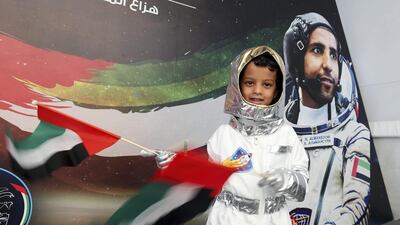
  • An aspiring young astronaut poses in front of a picture of the first Emirati in space, Maj Hazza Al Mansouri. Chris Whiteoak / The National
    An aspiring young astronaut poses in front of a picture of the first Emirati in space, Maj Hazza Al Mansouri. Chris Whiteoak / The National
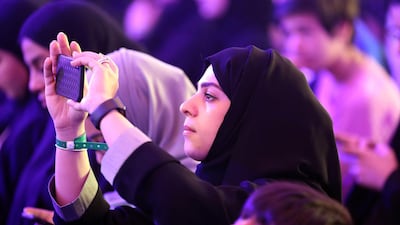
  • A woman films the Q&A session with Maj Hazza Al Mansouri from the International Space Station. Chris Whiteoak / The National
    A woman films the Q&A session with Maj Hazza Al Mansouri from the International Space Station. Chris Whiteoak / The National
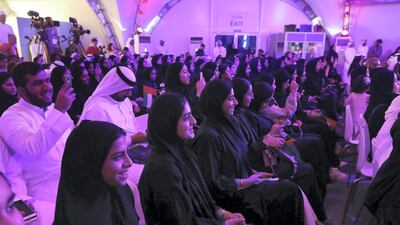
  • The audience at the Mohammed bin Rashid Space Centre are delighted to hear from Maj Hazza Al Mansouri. Chris Whiteoak / The National
    The audience at the Mohammed bin Rashid Space Centre are delighted to hear from Maj Hazza Al Mansouri. Chris Whiteoak / The National
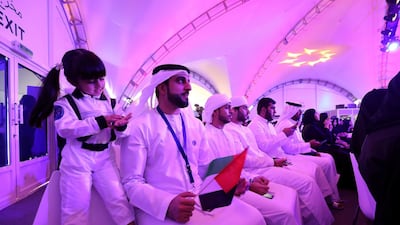
  • An aspiring young astronaut and her family at the Mohammed bin Rashid Space Centre event. Chris Whiteoak / The National
    An aspiring young astronaut and her family at the Mohammed bin Rashid Space Centre event. Chris Whiteoak / The National
  • A young audience member celebrates the first Emirati in space. Chris Whiteoak / The National
    A young audience member celebrates the first Emirati in space. Chris Whiteoak / The National
  • Sheikh Mohammed bin Rashid talks to Maj Hazza Al Mansouri. Courtesy Dubai Media Office
    Sheikh Mohammed bin Rashid talks to Maj Hazza Al Mansouri. Courtesy Dubai Media Office
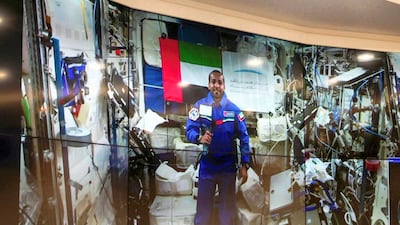
  • Emirati astronaut Hazza Al Mansouri, during a live satellite feed from the International Space Station. Courtesy Dubai Media Office
    Emirati astronaut Hazza Al Mansouri, during a live satellite feed from the International Space Station. Courtesy Dubai Media Office
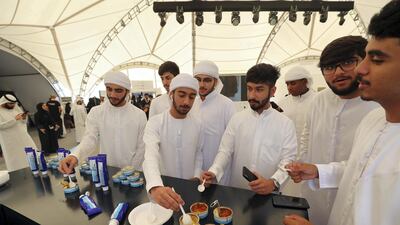
  • Audience members at the Mohammed bin Rashid Space Centre event sample space food. Chris Whiteoak / The National
    Audience members at the Mohammed bin Rashid Space Centre event sample space food. Chris Whiteoak / The National
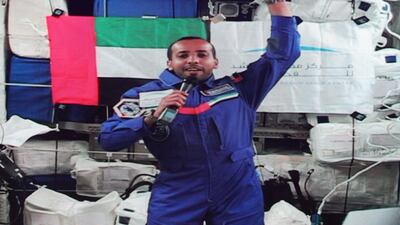
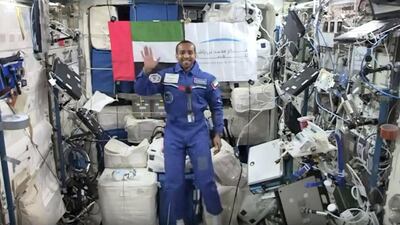
  • Emirati astronaut Maj Hazza Al Mansouri gives his audience on Earth a tour of the International Space Station. Screengrab via Youtube Live
    Emirati astronaut Maj Hazza Al Mansouri gives his audience on Earth a tour of the International Space Station. Screengrab via Youtube Live
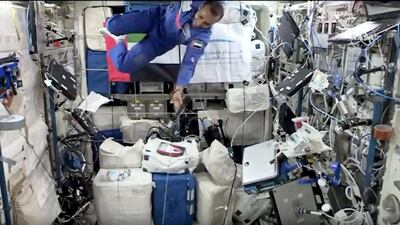
  • Maj Hazza Al Mansouri demonstrates the effects of weightlessness. Screengrab via Youtube Live
    Maj Hazza Al Mansouri demonstrates the effects of weightlessness. Screengrab via Youtube Live
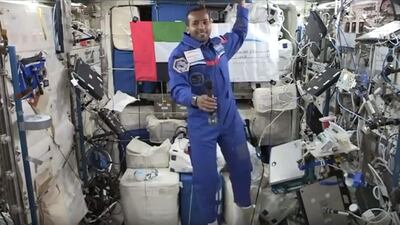
  • Hazza Al Mansouri takes a live Q&A from space. He spent eight days on the International Space Station, in a mission from September 25 to October 3, 2019. Screengrab via Youtube Live
    Hazza Al Mansouri takes a live Q&A from space. He spent eight days on the International Space Station, in a mission from September 25 to October 3, 2019. Screengrab via Youtube Live
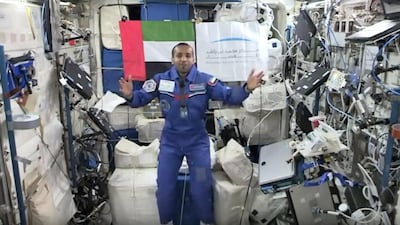
  • Emirati astronaut, Hazza Al Mansouri, takes live Q&A from space and gives a station tour. Screengrab via Youtube Live
    Emirati astronaut, Hazza Al Mansouri, takes live Q&A from space and gives a station tour. Screengrab via Youtube Live

The 36-year-old was the first Arab on the space station and went there for eight days.

The full video of his tour was released more than a month after he landed back on Earth.

Five more facts about ISS:

  • ISS can accommodate three to six astronauts comfortably, but it has held nine people at times - and once 13 during a crew changeover in 2009.
  • It travels fast, orbiting Earth 16 times in 24 hours
  • The station is often visible to humans on Earth because of its large solar panels
  • Astronauts have carried out more than 230 spacewalks, often to repair parts of the station
  • In 2019, Nasa astronaut Anne McClain was the first person accused of committing a crime in space, when her estranged spouse, Summer Worden, accused her of accessing a bank account without permission. It was later found to be a false claim

Racecard
%3Cp%3E%0D5pm%3A%20Al%20Maha%20Stables%20%E2%80%93%20Maiden%20(PA)%20Dh80%2C000%20(Turf)%201%2C400m%0D%3Cbr%3E5.30pm%3A%20Al%20Anoud%20Stables%20%E2%80%93%20Handicap%20(PA)%20Dh80%2C000%20(T)%201%2C200m%0D%3Cbr%3E6pm%3A%20Wathba%20Stallions%20Cup%20%E2%80%93%20Handicap%20(PA)%20Dh70%2C000%20(T)%201%2C400m%0D%3Cbr%3E6.30pm%3A%20Arabian%20Triple%20Crown%20Round%202%20%E2%80%93%20Group%203%20(PA)%20Dh%20300%2C000%20(T)%202%2C200m%0D%3Cbr%3E7pm%3A%20Liwa%20Oasis%20%E2%80%93%20Group%202%20(PA)%20Dh300%2C000%20(T)%201%2C400m%0D%3Cbr%3E7.30pm%3A%20Dames%20Stables%20%E2%80%93%20Handicap%20(TB)%20Dh80%2C000%20(T)%201%2C400m%3C%2Fp%3E%0A
England World Cup squad

Eoin Morgan (capt), Moeen Ali, Jofra Archer, Jonny Bairstow, Jos Buttler (wkt), Tom Curran, Liam Dawson, Liam Plunkett, Adil Rashid, Joe Root, Jason Roy, Ben Stokes, James Vince, Chris Woakes, Mark Wood

THE NEW BATCH'S FOCUS SECTORS

AiFlux – renewables, oil and gas

DevisionX – manufacturing

Event Gates – security and manufacturing

Farmdar – agriculture

Farmin – smart cities

Greener Crop – agriculture

Ipera.ai – space digitisation

Lune Technologies – fibre-optics

Monak – delivery

NutzenTech – environment

Nybl – machine learning

Occicor – shelf management

Olymon Solutions – smart automation

Pivony – user-generated data

PowerDev – energy big data

Sav – finance

Searover – renewables

Swftbox – delivery

Trade Capital Partners – FinTech

Valorafutbol – sports and entertainment

Workfam – employee engagement

INVESTMENT PLEDGES

Cartlow: $13.4m

Rabbitmart: $14m

Smileneo: $5.8m

Soum: $4m

imVentures: $100m

Plug and Play: $25m

TO A LAND UNKNOWN

Director: Mahdi Fleifel

Starring: Mahmoud Bakri, Aram Sabbah, Mohammad Alsurafa

Rating: 4.5/5

Company%20profile
%3Cp%3E%3Cstrong%3ECompany%20name%3A%3C%2Fstrong%3E%20FinFlx%3C%2Fp%3E%0A%3Cp%3E%3Cstrong%3EStarted%3A%3C%2Fstrong%3E%20January%202021%3C%2Fp%3E%0A%3Cp%3E%3Cstrong%3EFounders%3A%3C%2Fstrong%3E%20Amr%20Yussif%20(co-founder%20and%20CEO)%2C%20Mattieu%20Capelle%20(co-founder%20and%20CTO)%3C%2Fp%3E%0A%3Cp%3E%3Cstrong%3EBased%20in%3A%3C%2Fstrong%3E%20Dubai%3C%2Fp%3E%0A%3Cp%3E%3Cstrong%3EIndustry%3A%3C%2Fstrong%3E%20FinTech%3C%2Fp%3E%0A%3Cp%3E%3Cstrong%3EFunding%20size%3A%3C%2Fstrong%3E%20%241.5m%20pre-seed%3C%2Fp%3E%0A%3Cp%3E%3Cstrong%3EInvestors%3A%3C%2Fstrong%3E%20Venture%20capital%20-%20Y%20Combinator%2C%20500%20Global%2C%20Dubai%20Future%20District%20Fund%2C%20Fox%20Ventures%2C%20Vector%20Fintech.%20Also%20a%20number%20of%20angel%20investors%3C%2Fp%3E%0A
WHAT IS GRAPHENE?

It was discovered in 2004, when Russian-born Manchester scientists Andrei Geim and Kostya Novoselov were experimenting with sticky tape and graphite, the material used as lead in pencils.

Placing the tape on the graphite and peeling it, they managed to rip off thin flakes of carbon. In the beginning they got flakes consisting of many layers of graphene. But when they repeated the process many times, the flakes got thinner.

By separating the graphite fragments repeatedly, they managed to create flakes that were just one atom thick. Their experiment led to graphene being isolated for the very first time.

In 2010, Geim and Novoselov were awarded the Nobel Prize for Physics. 

HUNGARIAN GRAND PRIX RESULT

1. Sebastian Vettel, Ferrari 1:39:46.713
2. Kimi Raikkonen, Ferrari 00:00.908
3. Valtteri Bottas, Mercedes-GP 00:12.462
4. Lewis Hamilton, Mercedes-GP 00:12.885
5. Max Verstappen, Red Bull Racing 00:13.276
6. Fernando Alonso, McLaren 01:11.223
7. Carlos Sainz Jr, Toro Rosso 1 lap
8. Sergio Perez, Force India 1 lap
9. Esteban Ocon, Force India  1 lap
10. Stoffel Vandoorne, McLaren 1 lap
11. Daniil Kvyat, Toro Rosso 1 lap
12. Jolyon Palmer, Renault 1 lap
13. Kevin Magnussen, Haas 1 lap
14. Lance Stroll, Williams 1 lap
15. Pascal Wehrlein, Sauber 2 laps
16. Marcus Ericsson, Sauber 2 laps
17r. Nico Huelkenberg, Renault 3 laps
r. Paul Di Resta, Williams 10 laps
r. Romain Grosjean, Haas 50 laps
r. Daniel Ricciardo, Red Bull Racing 70 laps

Super Bowl LIII schedule

What Super Bowl LIII

Who is playing New England Patriots v Los Angeles Rams

Where Mercedes-Benz Stadium in Atlanta, United States

When Sunday (start time is 3.30am on Monday UAE time)


Defence review at a glance

• Increase defence spending to 2.5% of GDP by 2027 but given “turbulent times it may be necessary to go faster”

• Prioritise a shift towards working with AI and autonomous systems

• Invest in the resilience of military space systems.

• Number of active reserves should be increased by 20%

• More F-35 fighter jets required in the next decade

• New “hybrid Navy” with AUKUS submarines and autonomous vessels

COMPANY PROFILE
Name: ARDH Collective
Based: Dubai
Founders: Alhaan Ahmed, Alyina Ahmed and Maximo Tettamanzi
Sector: Sustainability
Total funding: Self funded
Number of employees: 4

White hydrogen: Naturally occurring hydrogenChromite: Hard, metallic mineral containing iron oxide and chromium oxideUltramafic rocks: Dark-coloured rocks rich in magnesium or iron with very low silica contentOphiolite: A section of the earth’s crust, which is oceanic in nature that has since been uplifted and exposed on landOlivine: A commonly occurring magnesium iron silicate mineral that derives its name for its olive-green yellow-green colour

Company%20Profile
%3Cp%3E%3Cstrong%3EName%3A%20%3C%2Fstrong%3ENadeera%3Cbr%3E%3Cstrong%3EBased%3A%3C%2Fstrong%3E%20Abu%20Dhabi%2C%20UAE%3Cbr%3E%3Cstrong%3EFounders%3A%20%3C%2Fstrong%3ERabih%20El%20Chaar%20and%20Reem%20Khattar%3Cbr%3E%3Cstrong%3ESector%3A%20%3C%2Fstrong%3ECleanTech%3Cbr%3E%3Cstrong%3ETotal%20funding%3A%3C%2Fstrong%3E%20About%20%241%20million%3Cbr%3E%3Cstrong%3EInvestors%3A%20%3C%2Fstrong%3EHope%20Ventures%2C%20Rasameel%20Investments%20and%20support%20from%20accelerator%20programmes%20%3Cbr%3E%3Cstrong%3ENumber%20of%20employees%3A%3C%2Fstrong%3E%2012%3C%2Fp%3E%0A
The specs: 2018 Maserati GranTurismo/GranCabrio

Price, base Dh485,000 (GranTurismo) and Dh575,000 (GranCabrio)

Engine 4.7L V8

Transmission Six-speed automatic

Power 460hp @ 7,000rpm

Torque 520Nm @ 4,750rpm

Fuel economy, combined 14.3L (GranTurismo) and 14.5L (GranCabrio) / 100km

Mercer, the investment consulting arm of US services company Marsh & McLennan, expects its wealth division to at least double its assets under management (AUM) in the Middle East as wealth in the region continues to grow despite economic headwinds, a company official said.

Mercer Wealth, which globally has $160 billion in AUM, plans to boost its AUM in the region to $2-$3bn in the next 2-3 years from the present $1bn, said Yasir AbuShaban, a Dubai-based principal with Mercer Wealth.

Within the next two to three years, we are looking at reaching $2 to $3 billion as a conservative estimate and we do see an opportunity to do so,” said Mr AbuShaban.

Mercer does not directly make investments, but allocates clients’ money they have discretion to, to professional asset managers. They also provide advice to clients.

“We have buying power. We can negotiate on their (client’s) behalf with asset managers to provide them lower fees than they otherwise would have to get on their own,” he added.

Mercer Wealth’s clients include sovereign wealth funds, family offices, and insurance companies among others.

From its office in Dubai, Mercer also looks after Africa, India and Turkey, where they also see opportunity for growth.

Wealth creation in Middle East and Africa (MEA) grew 8.5 per cent to $8.1 trillion last year from $7.5tn in 2015, higher than last year’s global average of 6 per cent and the second-highest growth in a region after Asia-Pacific which grew 9.9 per cent, according to consultancy Boston Consulting Group (BCG). In the region, where wealth grew just 1.9 per cent in 2015 compared with 2014, a pickup in oil prices has helped in wealth generation.

BCG is forecasting MEA wealth will rise to $12tn by 2021, growing at an annual average of 8 per cent.

Drivers of wealth generation in the region will be split evenly between new wealth creation and growth of performance of existing assets, according to BCG.

Another general trend in the region is clients’ looking for a comprehensive approach to investing, according to Mr AbuShaban.

“Institutional investors or some of the families are seeing a slowdown in the available capital they have to invest and in that sense they are looking at optimizing the way they manage their portfolios and making sure they are not investing haphazardly and different parts of their investment are working together,” said Mr AbuShaban.

Some clients also have a higher appetite for risk, given the low interest-rate environment that does not provide enough yield for some institutional investors. These clients are keen to invest in illiquid assets, such as private equity and infrastructure.

“What we have seen is a desire for higher returns in what has been a low-return environment specifically in various fixed income or bonds,” he said.

“In this environment, we have seen a de facto increase in the risk that clients are taking in things like illiquid investments, private equity investments, infrastructure and private debt, those kind of investments were higher illiquidity results in incrementally higher returns.”

The Abu Dhabi Investment Authority, one of the largest sovereign wealth funds, said in its 2016 report that has gradually increased its exposure in direct private equity and private credit transactions, mainly in Asian markets and especially in China and India. The authority’s private equity department focused on structured equities owing to “their defensive characteristics.”

Company Fact Box

Company name/date started: Abwaab Technologies / September 2019

Founders: Hamdi Tabbaa, co-founder and CEO. Hussein Alsarabi, co-founder and CTO

Based: Amman, Jordan

Sector: Education Technology

Size (employees/revenue): Total team size: 65. Full-time employees: 25. Revenue undisclosed

Stage: early-stage startup 

Investors: Adam Tech Ventures, Endure Capital, Equitrust, the World Bank-backed Innovative Startups SMEs Fund, a London investment fund, a number of former and current executives from Uber and Netflix, among others.

The specs
 
Engine: 3.0-litre six-cylinder turbo
Power: 398hp from 5,250rpm
Torque: 580Nm at 1,900-4,800rpm
Transmission: Eight-speed auto
Fuel economy, combined: 6.5L/100km
On sale: December
Price: From Dh330,000 (estimate)
FFP EXPLAINED

What is Financial Fair Play?
Introduced in 2011 by Uefa, European football’s governing body, it demands that clubs live within their means. Chiefly, spend within their income and not make substantial losses.

What the rules dictate? 
The second phase of its implementation limits losses to €30 million (Dh136m) over three seasons. Extra expenditure is permitted for investment in sustainable areas (youth academies, stadium development, etc). Money provided by owners is not viewed as income. Revenue from “related parties” to those owners is assessed by Uefa's “financial control body” to be sure it is a fair value, or in line with market prices.

What are the penalties? 
There are a number of punishments, including fines, a loss of prize money or having to reduce squad size for European competition – as happened to PSG in 2014. There is even the threat of a competition ban, which could in theory lead to PSG’s suspension from the Uefa Champions League.

UAE squad

Men's draw: Victor Scvortov and Khalifa Al Hosani, (both 73 kilograms), Sergiu Toma and Mihail Marchitan (90kg), Ivan Remarenco (100kg), Ahmed Al Naqbi (60kg), Musabah Al Shamsi and Ahmed Al Hosani (66kg)

Women’s draw: Maitha Al Neyadi (57kg)