The Indian Air Force flew three empty liquid oxygen tanks to the UAE on Monday.
They will be refilled with 60 tonnes and shipped back to India for use in the country's coronavirus fight.
India's Defence Ministry said transporting the empty containers on an Ilyushin IL-76 military plane was the quickest way to deliver the tanks to the UAE from Jamnagar, in Gujarat, western India.
They arrived at Al Maktoum International Airport in Dubai.
Pavan Kapoor, India’s ambassador to the UAE, said the tanks would be refilled and shipped back on an Indian Navy ship on Wednesday.
In the next rounds we will continue sending oxygen containers also through normal shipping lines and the facilities of DP World
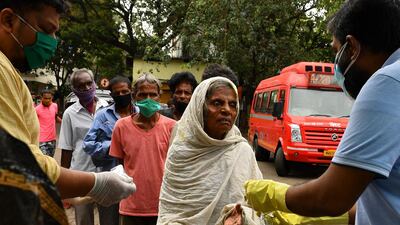
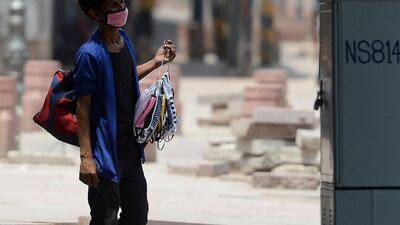
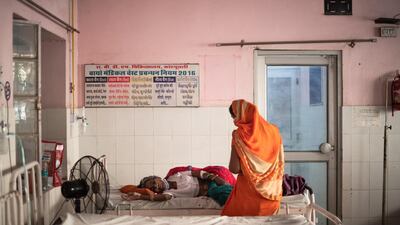
Oxygen is a critical requirement in India's struggle against Covid-19, with hospitals running out of supplies and turning away patients as a result.
"These are three containers that Adnoc had given us that were sent to India with liquid oxygen earlier," Mr Kapoor told The National, referring to Abu Dhabi National Oil Company.
“These have been brought back for a refill. The idea is to save some time on the refill, so they were flown to the UAE.
“Once refilled, the containers will be sent off in a naval ship.”
The embassy obtained 200 tonnes of liquid oxygen for India from the UAE this month.
This cycle will be repeated over the next few weeks, with the empty tanks returning to the Emirates to be refilled.
“In the next rounds we will also continue sending oxygen containers through normal shipping lines and the facilities of DP World,” he said, referring to the logistics company in Dubai.
“We will definitely need this for the next few weeks, maybe longer, depending on the situation in India.”
The embassy sent seven tanks containing a total of 140 tonnes of liquid oxygen to India on May 1.
Indians living abroad, and community associations in the UAE and elsewhere have also sent medicine, ventilators and oxygen concentrators and cylinders to help.
They sent supplies by air courier directly to relatives in need or shipped them to India.
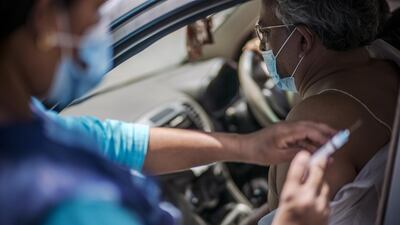
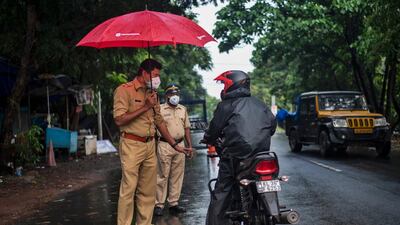
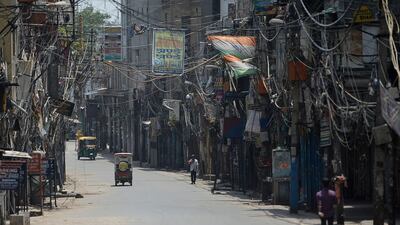
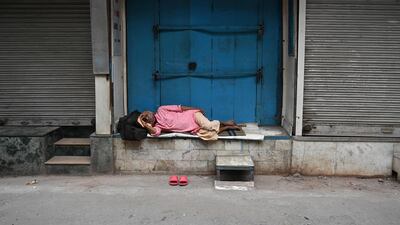
Several states in the country have introduced stay-at-home restrictions in attempts to contain the disease, which has killed at least 4,106 people in the past 24 hours.
A total of 274,390 people have died of Covid-19, according to Indian government figures.
India recorded 281,386 new Covid-19 cases on Monday – the first time the daily count has dropped below 300,000 since April.
Experts said it was too early to declare a turnaround in the nation's caseload.
India grapples with Covid-19 crisis:
Winners
Ballon d’Or (Men’s)
Ousmane Dembélé (Paris Saint-Germain / France)
Ballon d’Or Féminin (Women’s)
Aitana Bonmatí (Barcelona / Spain)
Kopa Trophy (Best player under 21 – Men’s)
Lamine Yamal (Barcelona / Spain)
Best Young Women’s Player
Vicky López (Barcelona / Spain)
Yashin Trophy (Best Goalkeeper – Men’s)
Gianluigi Donnarumma (Paris Saint-Germain and Manchester City / Italy)
Best Women’s Goalkeeper
Hannah Hampton (England / Aston Villa and Chelsea)
Men’s Coach of the Year
Luis Enrique (Paris Saint-Germain)
Women’s Coach of the Year
Sarina Wiegman (England)
Who was Alfred Nobel?
The Nobel Prize was created by wealthy Swedish chemist and entrepreneur Alfred Nobel.
- In his will he dictated that the bulk of his estate should be used to fund "prizes to those who, during the preceding year, have conferred the greatest benefit to humankind".
- Nobel is best known as the inventor of dynamite, but also wrote poetry and drama and could speak Russian, French, English and German by the age of 17. The five original prize categories reflect the interests closest to his heart.
- Nobel died in 1896 but it took until 1901, following a legal battle over his will, before the first prizes were awarded.
KEY HIGHLIGHTS
Healthcare spending to double to $2.2 trillion rupees
Launched a 641billion-rupee federal health scheme
Allotted 200 billion rupees for the recapitalisation of state-run banks
Around 1.75 trillion rupees allotted for privatisation and stake sales in state-owned assets
Disposing of non-recycleable masks
- Use your ‘black bag’ bin at home
- Do not put them in a recycling bin
- Take them home with you if there is no litter bin
- No need to bag the mask
WOMAN AND CHILD
Director: Saeed Roustaee
Starring: Parinaz Izadyar, Payman Maadi
Rating: 4/5
Timeline
2012-2015
The company offers payments/bribes to win key contracts in the Middle East
May 2017
The UK SFO officially opens investigation into Petrofac’s use of agents, corruption, and potential bribery to secure contracts
September 2021
Petrofac pleads guilty to seven counts of failing to prevent bribery under the UK Bribery Act
October 2021
Court fines Petrofac £77 million for bribery. Former executive receives a two-year suspended sentence
December 2024
Petrofac enters into comprehensive restructuring to strengthen the financial position of the group
May 2025
The High Court of England and Wales approves the company’s restructuring plan
July 2025
The Court of Appeal issues a judgment challenging parts of the restructuring plan
August 2025
Petrofac issues a business update to execute the restructuring and confirms it will appeal the Court of Appeal decision
October 2025
Petrofac loses a major TenneT offshore wind contract worth €13 billion. Holding company files for administration in the UK. Petrofac delisted from the London Stock Exchange
November 2025
180 Petrofac employees laid off in the UAE
Classification of skills
A worker is categorised as skilled by the MOHRE based on nine levels given in the International Standard Classification of Occupations (ISCO) issued by the International Labour Organisation.
A skilled worker would be someone at a professional level (levels 1 – 5) which includes managers, professionals, technicians and associate professionals, clerical support workers, and service and sales workers.
The worker must also have an attested educational certificate higher than secondary or an equivalent certification, and earn a monthly salary of at least Dh4,000.
A timeline of the Historical Dictionary of the Arabic Language
- 2018: Formal work begins
- November 2021: First 17 volumes launched
- November 2022: Additional 19 volumes released
- October 2023: Another 31 volumes released
- November 2024: All 127 volumes completed
500 People from Gaza enter France
115 Special programme for artists
25 Evacuation of injured and sick
Other must-tries
Tomato and walnut salad
A lesson in simple, seasonal eating. Wedges of tomato, chunks of cucumber, thinly sliced red onion, coriander or parsley leaves, and perhaps some fresh dill are drizzled with a crushed walnut and garlic dressing. Do consider yourself warned: if you eat this salad in Georgia during the summer months, the tomatoes will be so ripe and flavourful that every tomato you eat from that day forth will taste lacklustre in comparison.
Badrijani nigvzit
A delicious vegetarian snack or starter. It consists of thinly sliced, fried then cooled aubergine smothered with a thick and creamy walnut sauce and folded or rolled. Take note, even though it seems like you should be able to pick these morsels up with your hands, they’re not as durable as they look. A knife and fork is the way to go.
Pkhali
This healthy little dish (a nice antidote to the khachapuri) is usually made with steamed then chopped cabbage, spinach, beetroot or green beans, combined with walnuts, garlic and herbs to make a vegetable pâté or paste. The mix is then often formed into rounds, chilled in the fridge and topped with pomegranate seeds before being served.
Email sent to Uber team from chief executive Dara Khosrowshahi
From: Dara
To: Team@
Date: March 25, 2019 at 11:45pm PT
Subj: Accelerating in the Middle East
Five years ago, Uber launched in the Middle East. It was the start of an incredible journey, with millions of riders and drivers finding new ways to move and work in a dynamic region that’s become so important to Uber. Now Pakistan is one of our fastest-growing markets in the world, women are driving with Uber across Saudi Arabia, and we chose Cairo to launch our first Uber Bus product late last year.
Today we are taking the next step in this journey—well, it’s more like a leap, and a big one: in a few minutes, we’ll announce that we’ve agreed to acquire Careem. Importantly, we intend to operate Careem independently, under the leadership of co-founder and current CEO Mudassir Sheikha. I’ve gotten to know both co-founders, Mudassir and Magnus Olsson, and what they have built is truly extraordinary. They are first-class entrepreneurs who share our platform vision and, like us, have launched a wide range of products—from digital payments to food delivery—to serve consumers.
I expect many of you will ask how we arrived at this structure, meaning allowing Careem to maintain an independent brand and operate separately. After careful consideration, we decided that this framework has the advantage of letting us build new products and try new ideas across not one, but two, strong brands, with strong operators within each. Over time, by integrating parts of our networks, we can operate more efficiently, achieve even lower wait times, expand new products like high-capacity vehicles and payments, and quicken the already remarkable pace of innovation in the region.
This acquisition is subject to regulatory approval in various countries, which we don’t expect before Q1 2020. Until then, nothing changes. And since both companies will continue to largely operate separately after the acquisition, very little will change in either teams’ day-to-day operations post-close. Today’s news is a testament to the incredible business our team has worked so hard to build.
It’s a great day for the Middle East, for the region’s thriving tech sector, for Careem, and for Uber.
Uber on,
Dara
Semi-final fixtures
Portugal v Chile, 7pm, today
Germany v Mexico, 7pm, tomorrow