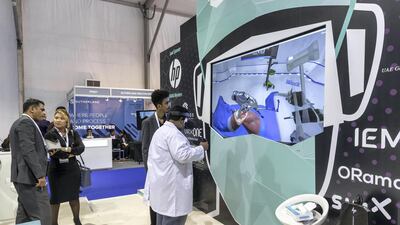
Our lives will resemble scenes from a science fiction film by the year 2050 as microchip implants carry out tasks we use our mobile phones for, a Dubai conference has heard.
Mobiles will be history and we will have MRI scans in our showers, a health expert said during the final day of the Arab Health trade exhibition at Dubai’s World Trade Centre.
Healthcare will be completely digital in less than 30 years, with trips to the doctor becoming unnecessary, said Reenita Das, senior vice president with consultants Frost and Sullivan.
The National takes a look at Ms Dias' vision for the future.
A microchip inside us will record everything
Microchips are the way of the future, according to Ms Das, and will record our every move.
“You will be able to have a microchip implanted into you and it will act as a passport for your life,” she said.
“It’s going to record your life, your work, your health and everything you do.”
Our bodies will be scanned every morning at home
“After you wake up you will have a full MRI in the shower that records all your vitals,” she said.
“This information is then sent to a medical care them who will use it to decide what vitamins or drugs you need to take for the day ahead.”
She said this will rule out misdiagnosis and taking the wrong medication.
“Your blood pressure and weight, and other statistics, will all be displayed on the bathroom mirror within a split-second.”
End of mobile phones
The mobile phone will be no more, according to Ms Das.
The majority of the tasks a phone is used for will be performed by the microchip embedded into our bodies.
“You will still be able to view the news of the day, look at appointments or anything else you want but it will be transported either neurologically or ocularly by the implant inside you,” she said.
“The chip will also wake us up calmly rather than having to be woken up by the sound of a blaring alarm.”
In good news for coffee lovers, Ms Dias predicted the microchip would send a signal to a coffee machine – read by AI –to ensure the perfect morning brew is ready.
No more trips to the doctor
Another change that will occur by the mid-21st century will be no more trips to visit the doctor for a consultation, Ms Das said.
“AI will prescribe the best possible cocktail of medication or vitamins you need to run your day.”
“You will never have to make an appointment to go and see a doctor again.”
Data will be big business
Ms Das said healthcare data would become one of the most valuable commodities of the future world.
“Thirty per cent of the world’s data already comes from healthcare,” she said.
“The personal digital data market is expected to be worth $500 million by 2025 but by 2028 it is predicted to grow to $5 billion.”

In numbers: China in Dubai
The number of Chinese people living in Dubai: An estimated 200,000
Number of Chinese people in International City: Almost 50,000
Daily visitors to Dragon Mart in 2018/19: 120,000
Daily visitors to Dragon Mart in 2010: 20,000
Percentage increase in visitors in eight years: 500 per cent
SPEC SHEET
Display: 10.4-inch IPS LCD, 400 nits, toughened glass
CPU: Unisoc T610; Mali G52 GPU
Memory: 4GB
Storage: 64GB, up to 512GB microSD
Camera: 8MP rear, 5MP front
Connectivity: Wi-Fi, Bluetooth 5.0, USB-C, 3.5mm audio
Battery: 8200mAh, up to 10 hours video
Platform: Android 11
Audio: Stereo speakers, 2 mics
Durability: IP52
Biometrics: Face unlock
Price: Dh849
Veil (Object Lessons)
Rafia Zakaria
Bloomsbury Academic
The National photo project
Chris Whiteoak, a photographer at The National, spent months taking some of Jacqui Allan's props around the UAE, positioning them perfectly in front of some of the country's most recognisable landmarks. He placed a pirate on Kite Beach, in front of the Burj Al Arab, the Cheshire Cat from Alice in Wonderland at the Burj Khalifa, and brought one of Allan's snails (Freddie, which represents her grandfather) to the Dubai Frame. In Abu Dhabi, a dinosaur went to Al Ain's Jebel Hafeet. And a flamingo was taken all the way to the Hatta Mountains. This special project suitably brings to life the quirky nature of Allan's prop shop (and Allan herself!).
The bio
Favourite vegetable: Broccoli
Favourite food: Seafood
Favourite thing to cook: Duck l'orange
Favourite book: Give and Take by Adam Grant, one of his professors at University of Pennsylvania
Favourite place to travel: Home in Kuwait.
Favourite place in the UAE: Al Qudra lakes
If you go
Flights
Emirates flies from Dubai to Phnom Penh with a stop in Yangon from Dh3,075, and Etihad flies from Abu Dhabi to Phnom Penh with its partner Bangkok Airlines from Dh2,763. These trips take about nine hours each and both include taxes. From there, a road transfer takes at least four hours; airlines including KC Airlines (www.kcairlines.com) offer quick connecting flights from Phnom Penh to Sihanoukville from about $100 (Dh367) return including taxes. Air Asia, Malindo Air and Malaysian Airlines fly direct from Kuala Lumpur to Sihanoukville from $54 each way. Next year, direct flights are due to launch between Bangkok and Sihanoukville, which will cut the journey time by a third.
The stay
Rooms at Alila Villas Koh Russey (www.alilahotels.com/ kohrussey) cost from $385 per night including taxes.
Company%C2%A0profile
%3Cp%3E%3Cstrong%3ECompany%20name%3A%20%3C%2Fstrong%3ELeap%0D%3Cbr%3E%3Cstrong%3EStarted%3A%20%3C%2Fstrong%3EMarch%202021%0D%3Cbr%3E%3Cstrong%3EFounders%3A%3C%2Fstrong%3E%20Ziad%20Toqan%20and%20Jamil%20Khammu%0D%3Cbr%3E%3Cstrong%3EBased%3A%3C%2Fstrong%3E%20Dubai%0D%3Cbr%3E%3Cstrong%3ESector%3A%20%3C%2Fstrong%3EFinTech%0D%3Cbr%3E%3Cstrong%3EInvestment%20stage%3A%20%3C%2Fstrong%3EPre-seed%0D%3Cbr%3E%3Cstrong%3EFunds%20raised%3A%3C%2Fstrong%3E%20Undisclosed%0D%3Cbr%3E%3Cstrong%3ECurrent%20number%20of%20staff%3A%20%3C%2Fstrong%3ESeven%3C%2Fp%3E%0A
Ten tax points to be aware of in 2026
1. Domestic VAT refund amendments: request your refund within five years
If a business does not apply for the refund on time, they lose their credit.
2. E-invoicing in the UAE
Businesses should continue preparing for the implementation of e-invoicing in the UAE, with 2026 a preparation and transition period ahead of phased mandatory adoption.
3. More tax audits
Tax authorities are increasingly using data already available across multiple filings to identify audit risks.
4. More beneficial VAT and excise tax penalty regime
Tax disputes are expected to become more frequent and more structured, with clearer administrative objection and appeal processes. The UAE has adopted a new penalty regime for VAT and excise disputes, which now mirrors the penalty regime for corporate tax.
5. Greater emphasis on statutory audit
There is a greater need for the accuracy of financial statements. The International Financial Reporting Standards standards need to be strictly adhered to and, as a result, the quality of the audits will need to increase.
6. Further transfer pricing enforcement
Transfer pricing enforcement, which refers to the practice of establishing prices for internal transactions between related entities, is expected to broaden in scope. The UAE will shortly open the possibility to negotiate advance pricing agreements, or essentially rulings for transfer pricing purposes.
7. Limited time periods for audits
Recent amendments also introduce a default five-year limitation period for tax audits and assessments, subject to specific statutory exceptions. While the standard audit and assessment period is five years, this may be extended to up to 15 years in cases involving fraud or tax evasion.
8. Pillar 2 implementation
Many multinational groups will begin to feel the practical effect of the Domestic Minimum Top-Up Tax (DMTT), the UAE's implementation of the OECD’s global minimum tax under Pillar 2. While the rules apply for financial years starting on or after January 1, 2025, it is 2026 that marks the transition to an operational phase.
9. Reduced compliance obligations for imported goods and services
Businesses that apply the reverse-charge mechanism for VAT purposes in the UAE may benefit from reduced compliance obligations.
10. Substance and CbC reporting focus
Tax authorities are expected to continue strengthening the enforcement of economic substance and Country-by-Country (CbC) reporting frameworks. In the UAE, these regimes are increasingly being used as risk-assessment tools, providing tax authorities with a comprehensive view of multinational groups’ global footprints and enabling them to assess whether profits are aligned with real economic activity.
Contributed by Thomas Vanhee and Hend Rashwan, Aurifer