

The coronavirus pandemic led to a reduction in serious crimes and a smaller prison population, the UAE Minister of Interior said.
Only 34 "worrying crimes" were recorded last year, compared with 49 in 2019, 78 in 2018 and 89 in 2016. These could include offences such as murder, rape and drug-dealing.
He did not include figures for minor crimes.
Sheikh Saif bin Zayed spoke on Tuesday at the Federal National Council, where members asked how police and prisons had handled the pandemic.
“In the beginning of the pandemic everybody expected crime to rise – however, the UAE managed to maintain a low rate,” said Sheikh Saif, who is also Deputy Prime Minister.
“During lockdown, we expected fires to increase since people were spending more time at home.
"But, thank God, and due to the public’s high level of awareness, we were surprised that fires dropped from 700 in 2019 to 381 in 2020.”
-

Prison staff monitor inmates from a control room at Dubai Central Prison in these images from July 2020. A recent legal overhaul changes the way detention suspects are processed and treated, with police legally required to provide an able translator. Reem Mohammed / The National -

Investigating officers must ensure charges are clearly communicated to a suspect and his translator. Both judges and defence lawyers said the long-awaited changes were a major development. Reem Mohammed / The National -

A prison staff officer sits behind glass at the main visitor reception. Suspects have the right to remain silent without the presumption that doing so is a sign of guilt. Reem Mohammed / The National -

Two inmates play table tennis in the prison's recreation area, in this series of photos shot in July 2020 to look at how the pandemic affected prison life. Reem Mohammed / The National -

The large plant nursery in the prison compound is part of the recreation facilities. Reem Mohammed / The National -
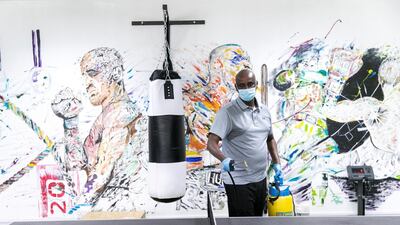
Gym equipment is sanitised between uses. Reem Mohammed / The National -

Inmates read at the prison library. Reem Mohammed / The National -

A new medical centre was constructed on the prison grounds to help prevent the spread of Covid-19. Reem Mohammed / The National -

The large facility is fully staffed with doctors and nurses, ensuring inmates do not have to leave the prison for treatment or tests. Reem Mohammed / The National -

Staff at the eye clinic speak to an inmate. Reem Mohammed / The National -

Nurses wheel medication between buildings in the prison compound. Reem Mohammed / The National -

Bayan Kimamao, a nursing supervisor, gives The National a tour of the new clinic. Reem Mohammed / The National -

Regular classes are held for inmates. Reem Mohammed / The National -

An inmate speaks to his wife via a video call. Reem Mohammed / The National


There were also fewer road casualties.
The minister, who oversees all the UAE's police forces and jails, said only 4 per cent of the prison population caught Covid-19.
In contrast, about 20 per cent of inmates in the US were estimated to have caught the virus, a result of serious overcrowding.
"Soon we will celebrate reaching zero cases” among inmates, Sheikh Saif said.
As police revealed last year, hundreds of prisoners were released early and returned home to cut prison numbers.
Sheikh Saif did not give a figure for the total prison population, but said the number of prisoners fell 21.6 per cent.
He said 6,039 prisoners were pardoned and others left on the completion of their sentences.
A total of 10,394 airline tickets were donated by the Ministry of Interior, the General Civil Aviation Authority and the Emirates Red Crescent. These allowed former inmates of 98 nationalities to return to their home countries.
Other measures that helped achieve such a low rate of infections in prison included placing new inmates in quarantine for 15 days before admitting them to the general cells.
Deep sanitisation was carried out regularly inside prisons and guidance on how to avoid the virus was circulated among inmates in many languages.
In addition, more than 5,500 inmates were vaccinated against Covid-19.
Inmates also helped in the country's fight against the pandemic, producing 17,600 face masks and 30,000 face shields that were distributed free of charge to labourers.
“We made the inmates feel they are productive in the fight against Covid-19, and we did not disrupt procedures," Sheikh Saif said.
Trials and visits were held online to allow inmates access to lawyers, court proceedings and their families.

