
Behind a sound-proof door, an inmate at Dubai Central Prison in Al Aweer struggled to contain his emotions as he spoke to his wife via a video call.
It was the first time that he had seen her since the pandemic struck. For now, in-person meetings are on hold as part of efforts to prevent the spread of Covid-19.
The outbreak of the virus has changed much for prisoners who are well used to a rigid routine.
The National was granted rare access inside the prison doors to see how day-to-day life has evolved amid a public health crisis impacting all sections of society across the globe.
Instead of meeting face to face, inmates can now speak with their families for 15 minutes every week using Skype.
“Don’t cry. Please don’t cry,” the Nigerian citizen tried to console his wife even as he himself broke down.
The new service has allowed Dubai inmates to connect with their loved ones, inside and outside the country.
It enables them to lodge a request to speak with their families. Once approved, relatives will receive a text message with a link of the specific date and time for the call.
Another inmate waited outside the room for his turn.
"Before the pandemic I used to meet my wife and daughter twice a week," he told The National.
"Now they are in Cairo, and they have not been able to come back because of travel restrictions related to the pandemic.
"I miss them more than words could ever describe, especially since my daughter was born in the same month I was arrested and she's four years old right now. So I have not been able to really spend any time with her.”
-

Prison staff monitor inmates from a control room at Dubai Central Prison in these images from July 2020. A recent legal overhaul changes the way detention suspects are processed and treated, with police legally required to provide an able translator. Reem Mohammed / The National -

Investigating officers must ensure charges are clearly communicated to a suspect and his translator. Both judges and defence lawyers said the long-awaited changes were a major development. Reem Mohammed / The National -

A prison staff officer sits behind glass at the main visitor reception. Suspects have the right to remain silent without the presumption that doing so is a sign of guilt. Reem Mohammed / The National -

Two inmates play table tennis in the prison's recreation area, in this series of photos shot in July 2020 to look at how the pandemic affected prison life. Reem Mohammed / The National -

The large plant nursery in the prison compound is part of the recreation facilities. Reem Mohammed / The National -
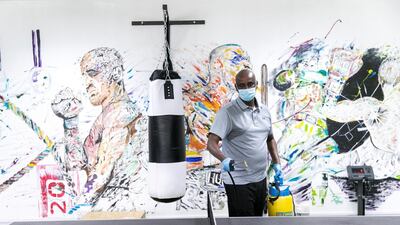
Gym equipment is sanitised between uses. Reem Mohammed / The National -

Inmates read at the prison library. Reem Mohammed / The National -

A new medical centre was constructed on the prison grounds to help prevent the spread of Covid-19. Reem Mohammed / The National -

The large facility is fully staffed with doctors and nurses, ensuring inmates do not have to leave the prison for treatment or tests. Reem Mohammed / The National -

Staff at the eye clinic speak to an inmate. Reem Mohammed / The National -

Nurses wheel medication between buildings in the prison compound. Reem Mohammed / The National -

Bayan Kimamao, a nursing supervisor, gives The National a tour of the new clinic. Reem Mohammed / The National -

Regular classes are held for inmates. Reem Mohammed / The National -

An inmate speaks to his wife via a video call. Reem Mohammed / The National


The 44-year-old was imprisoned in August 2016 for financial crimes.
He said he was grateful for the opportunity to remain in contact with those closest to him, even though they remain far away.
“During the Covid-19 crisis, the way the facilities here have allowed us to see them on Skype, has really helped keep us comforted and happy,” he said.
Another inmate, whose family lives in the UK, said before the pandemic he would rarely see his wife and children.
“The jail started using Skype and for me, that was the best thing that happened. I see them once a week now. I see my wife and six children and it is amazing.”

Medical centre to test all inmates
Prison chiefs have stepped up safety measures to protect inmates and staff alike.
A medical centre fully equipped with test rooms, lab, resting and X-ray rooms has been set up.
“We have put a mechanism in place to protect inmates from being infected with Covid-19," said Brig Ali Mohammed Al Shamali, director of the general department of correctional institutions at Dubai Police.
"We started by installing thermal scanners at all department entrances to ensure there were no coronavirus infections.
"We increased the number of doctors in the jail and all inmates were tested. If there’s a need to quarantine any infected person, we will do it.
"We have quarantine sections for both men and women.”
All staff get their temperatures checked before entering the premises.
They are given gloves, a face mask and a face shield, and made to pass through a sterilisation gate.
Those in close contact with inmates are tested for the virus every two weeks. Inmates can consult doctors remotely as part of social distancing measures.
“All inmates are tested regularly whether they are old or new inmates. We always check for vital signs, symptoms or diseases that require medical attention," Brig Al Shamali said.
"We would refer them to a doctor online. If the inmates condition requires a visit to the clinic, the inmate is sent to the clinic to be examined by a doctor face to face. In case any infection occurs and which requires a hospital visit, we will summon the ambulance to transport them to the hospital.”
New inmates are screened and allowed admission only after they test negative for the virus.
An Australian citizen, who has been in jail since 2018, said he feels safe inside the prison.
“In my opinion, the way things are handled here are as good, or probably even better than outside," the inmate said.
"We are kept segregated. We are always looked after and given medical treatment. In addition, during the pandemic, there was no crossing over.
Distancing is key
The Al Aweer facility can hold more than 4,000 inmates.
During the pandemic, however, about 30 per cent of the prison population were released to reduce crowding, Brig Al Shamali said.
"Presence in the lecture rooms has been reduced. Formerly, inmates used to eat inside cafeterias.

"Then we started delivering food to their cells in disposable packaging. However, we have now allowed inmates to visit the cafeterias with a maximum limit of 30 inmates each time.”
Social distancing measures are followed in all offices, buildings and inmates' facilities such as lecture and art rooms, the library and the gym.
“There's a gym here that we all use. There's also an outdoor area where we can train and exercise and get some sunlight. So that was still available to us," said a prisoner.
But obviously, it had to be shared between the different sections at different times. So, we're not there at the same time.”
Another inmate, who teaches jiu-jitsu at the prison, said he used to train four hours a day before the coronavirus outbreak.
“I trained a group of about 12 guys. When the crisis first came about, obviously, we could not conduct the jiu-jitsu classes because they involve very close contact," he said.
"Jiu-jitsu is a big part of my life, and I miss it very much. However, as things are progressively getting better, I see that we will definitely be able to do it again.”

