

In 711, Arab commander Tariq ibn Ziyad led his victorious Berber army across the narrow strait between North Africa and Spain, where he took the first step towards founding what would become the Muslim state of Al Andulus.
To honour his achievement, the mountain where the army had first landed was named after him. They called it Jabal Tariq – Mount Tariq.
More than 1,000 years later, we now call it Gibraltar, the name evolving with the centuries that saw the peak regained by Spain, only to later become a British territory.
It is a reminder that Arab influence is often visible in plain sight, sometimes far from the boundaries of the Middle East.
The Mexican city of Guadalajara is known for mariachi music and two football World Cups. It has little to do with river beds or stones, yet that is the origin of its name: Wadi Al Hajarah, translated as the Valley of Stone from Arabic, or possibly the fortified valley.
-

The Rock of Gibraltar and Spanish town La Linea at night. The name Gibraltar comes from Jabal Tariq, or Mount Tariq. Getty Images -

Ramatuelle, France. While it was ruled by the Moors, it was known as Rahmatallah, meaning 'mercy of God'. Getty Images -

N'Gouja Beach, on the island of Mayotte in the Comoro Islands, which takes its name from the Arabic word 'qamar', meaning 'moon'. Getty Images -

The statue of Admiral Lord Nelson stands in Trafalgar Square, London. Named for the Battle of Trafalgar, the word Trafalgar comes from the Arabic Tarif Al Ghar, meaning Cape of the Cave. -
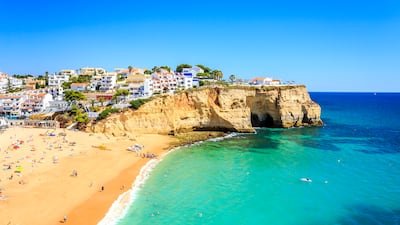
Algarve, Portugal. Algarve comes from the Arabic Al Gharb, meaning The West. Getty Images -

Independence Square in Maputo, Mozambique. The country's name is derived from Mussa Bin Bique, the Arab trader who ruled the island before the Portuguese took over in 1544. Getty Images -

The famous Alhambra palace, Granada, Spain. Alhambra comes from 'Al Hamra', the Arabic word for 'Red One' after the colours of its walls. Getty Images -

The Mexican city Guadalajara was named after this Spanish one. It comes from the Arabic 'Wadi Al Hajarah', meaning the 'Valley of Stone'. Getty Images


Guadalajara in Mexico is also a product of conquest. In the 15th century, it was founded by a conquistador who named it in honour of his boss Nuno de Guzman, who had been born in the Spanish city Guadalajara, which once fitted the description. The city in Spain was named during the Muslim rule over the Iberian Peninsula.
The South Pacific island of Guadalcanal, more than 16,000 kilometres from Spain, was the scene of one of the bloodiest battles of the Second World War, with more than 30,000 Japanese and American soldiers killed in six months of fighting.
Guadalcanal was part of the British Solomon Islands, now independent, but had been colonised by Spain in 1568 and named after a town near Seville, one of the country's biggest cities in the south. Seville was originally founded by Arabs as Wadi Al Qanal.
These names mark the rise and fall of empires – Arab, Spanish and British – and the conflicts that shaped our world, from the creation of the Caliphates, which once stretched from Afghanistan to Portugal, to the British Empire, on which it was said the sun never set.
London’s Trafalgar Square honours one of that empire’s great heroes, Admiral Lord Nelson, who defeated the combined might of the French and Spanish naval fleets in 1805.
The square and the column that carries Nelson’s statue take their name from the Cape of Trafalgar, where the famed battle of the same name took place offshore. It was first known as Tarif Al Ghar or Tarif Al Gharb, thought to mean either Cape of the Cave or the West, respectively, in the original Arabic.

It is estimated at least 4,000 Spanish words have their origins in Arabic. Benacazon, another city in Spain, was originally Bani Qasum, or the Sons of Qasum. El Burgo, in Malaga, is simply "the tower", or "al burj". In neighbouring Portugal, the popular holiday destination the Algarve was once Al Gharb, or The West.
Granada, the city at the heart of Islamic Spain, was first Garnata to the Arabs, although the meaning of the name is unclear and may be much older. Its famous palace, the Alhambra, comes from the Arabic "al hamra", or "red one", after the colour of its walls.
Arab reach in Europe stretched beyond Spain. The Italian island of Sicily was an emirate between 831 and 1091, with the city of Marsala, famous for its wine, probably either Marsa Ali – Ali’s harbour or anchorage – or Marsa Allah. Many smaller towns begin with the prefix "cala", evolving from the Arabic word "qalat", or fortification.
In France, the small town of Ramatuelle, close to Saint-Tropez, was once ruled by the Moors, who raided the Rhone Valley in the ninth and 10th centuries. At that period, it was called Rahmatallah, an Arabic phrase meaning "mercy of God".
The Bosnian town of Gornji Vakuf-Uskoplje derives the second part of its name from the Islamic word "waqf", meaning a charitable gift.
Thousands of kilometres away, and on another continent, the Comoro Islands in the Indian Ocean, owe their name to the Arabic "qamar", or moon. The population converted to Islam as far back as the 7th century.

In East Africa, Mozambique was named by Portuguese colonisers after the offshore island of the same name. That Mozambique is actually derived from Mussa Bin Bique, the Arab trader who ruled the island before the Portuguese took over in 1544.
In the Middle East, though, many place names are derived from languages other than Arabic. Baghdad comes from Farsi for “God’s gift”; Byblos is Greek, as is Alexandria in Egypt, which is named for Alexander the Great.
The city of Aleppo is called Halab, which is originally Aramaic, the language of the Hebrew Bible. Beirut is unclear but possibly a Phoenician word for a "well".
And Amman, the capital of Jordan? This shows how complex the origin of place names can be. Three thousand years ago it was founded as Rabbath Ammon by the Ammonites, who spoke a Semitic language. Rabbath, originally used to mean "king", but was dropped as the city eventually became Amman.
For around 50 years though, in the 3rd century, it was part of the kingdom of the Pharaoh Ptolemy II, who renamed it using a combination of the Greek words "brotherly" and "love" – "phileo" and "adelphos" – or Philadelphia.
Nearly 2,000 years later, the Quaker William Penn named a new town he was building in the American colony of Pennsylvania. Inspired by the sentiments of Ptolemy, he also called it Philadelphia in a state which, incidentally, also includes a Damascus, Hebron and Bethlehem.

