
UAE authorities have issued a yellow weather alert, as rain and thunder are expected across the country on Monday and Tuesday.
The National Centre of Meteorology issued alerts for some parts of the Emirates and urged people to “be aware” of the wet weather.
Al Falah, Bani Yas and the area around the international airport in the capital, parts of Al Ain and Al Dhafra region received light showers on Monday morning.
Temperatures are set to reach 32ºC in Dubai and 35ºC in Abu Dhabi on Monday but it will be cloudy at times, the NCM said. It has predicted rain on Monday and Tuesday.
It will be dusty and cloudy at times, accompanied by some convective clouds, the forecaster said in its weekly bulletin.
There is a chance of rainfall over scattered areas of the country, especially northern, eastern and coastal areas.
Light to moderate winds are expected, along with dust and sand. The sea will be slight to moderate, becoming rough at times, especially with clouds over the Arabian Gulf and in the Gulf of Oman.
Similar weather is expected on Tuesday, with a significant decrease in temperatures, especially over coastal areas.
The rain will subside by Wednesday. In Dubai, the temperature will be 27ºC on Wednesday and Thursday, and 29ºC on Friday. Weather will be similar in the capital.
Earlier last week, light showers, accompanied by thunder at times, fell on Dubai, Sharjah, Ras Al Khaimah, Masafi, Al Ain, Ghantoot and some parts of Abu Dhabi city.
Cloud seeding in the UAE — in pictures
-

Hygroscopic (water-attracting) salt flares are attached to an aircraft at Al Ain International Airport before a cloud-seeding flight operated by the National Centre of Meteorology. The UAE has been leading the effort to seed clouds and increase precipitation, which remains at less than 100 millimetres a year on average. All photos by Reuters -
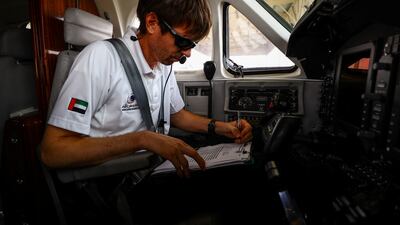
Pilot Michael Anstis writes a weather report before the cloud-seeding flight from Al Ain. -

An airport employee closes an aircraft door, with hygroscopic salt flares seen in the background, before the cloud-seeding flight. -
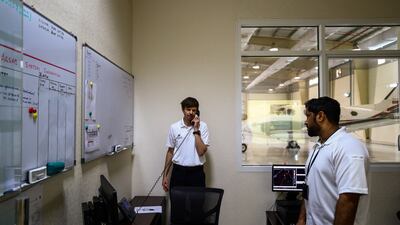
Pilots Michael Anstis and Ahmed Al Jaberi receive instructions before the flight. -

The control room at the National Centre of Meteorology in Abu Dhabi. -
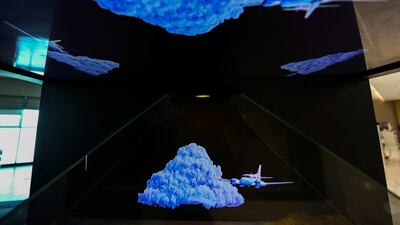
An explanatory hologram of the cloud-seeding process in the National Centre of Meteorology control room in Abu Dhabi. -
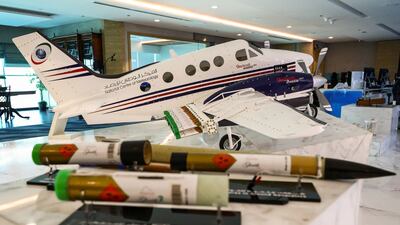
Cloud-seeding flares in the National Centre of Meteorology control room. -

Hygroscopic salt flares are attached to an aircraft during a cloud-seeding flight between Al Ain and Al Hayer. At 9,000 feet above sea level, the plane releases the flares into the most promising white clouds, hoping to trigger rainfall. -

Hygroscopic salt flares are attached to an aircraft during a cloud-seeding flight. Scientists in Abu Dhabi combine shooting the flares with releasing salt nanoparticles, a newer technology, into the clouds to stimulate and accelerate the condensation process and hopefully produce droplets big enough to then fall as rain. -

Flares are released during a cloud-seeding flight between Al Ain and Al Hayer. -
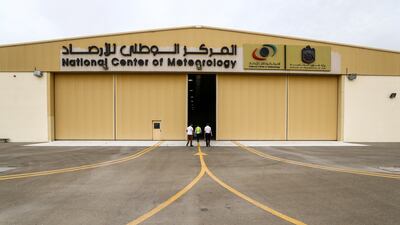
Employees walk towards a hangar at Al Ain International Airport after a cloud-seeding flight.



