

Tremors were felt in Abu Dhabi and Dubai after two earthquakes rocked Iran in the space of a minute on Sunday.
The impact was also experienced in the Northern Emirates.
A 6.2-magnitude earthquake was recorded in southern Iran at 4.07pm, followed by one measuring 6.7 a minute later, the National Meteorology Centre posted on Twitter.
The NCM said the impact was “slightly felt in the northern and eastern side of the country without effect".
Residents in Downtown Dubai as well as in Dubai Media City and Dubai Sports City reported buildings shaking.
“I felt the ground shake and the lights were moving,” said Varsha Vasant, who works in the D3 area of Dubai.
Residents posted videos on Twitter of items in their flats being shaken by the quake roughly 1,000km away.
They told how some buildings and offices were evacuated as a precaution.
A number of countries across the region have been affected by the two quakes.

It was the third earthquake to strike Iran in 24 hours.
The NCM had recorded tremors hitting 4.7-magnitude in the early hours of Sunday, however there were no reports of it being felt in the Emirates.
"The stations of the National Seismic Monitoring Network of the National Center of Meteorology recorded a tremor of magnitude 4.7 in southern Iran at 12:52am, corresponding to November 14," the NCM had posted on Twitter.
The UAE has previously dealt with the after-effects of earthquakes in Iran.
Such earthquakes do not typically have a significant effect on life in the Emirates, but can sometimes make their presence known if of sufficient strength.
Tremors were felt in the Emirates after a 5.1-magnitude earthquake struck Iran last June.
Last February, residents across the UAE felt the ground shake after a 5.8-magnitude quake struck Iran's Qeshm Island.
Buildings swayed in Abu Dhabi, Dubai and the Northern Emirates, causing computer monitors to shake.
The country has also been hit by earthquakes, albeit on a smaller scale.
A 'micro-earthquake' — of 1.9-magnitude — struck Dibba on the UAE's east coast last month.
In pictures: UAE residents evacuated after Iran earthquake tremors in 2013
-

Buildings in Dubai Media City are evacuated following an earthquake in Dubai, April 16, 2013. Sarah Dea / The National -
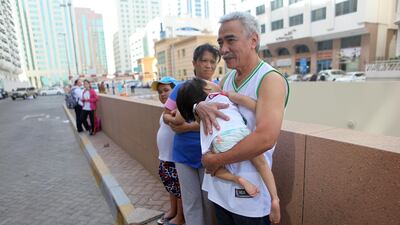
Rolando Banzon holds his daughter Alyssa, 3, after evacuating his Abu Dhabi residential building with his wife Analissa and son Ali, 6. Sammy Dallal / The National -

People stand outside Mushrif Mall in Abu Dhabi. The quake, 86 kilometres southeast of Khasah, Iran and less than 100 kilometres west of the Pakistan border, struck at a depth of 15.2km, the US Geological survey said. Delores Johnson / The National -
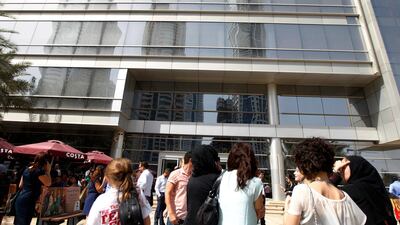
People wait outside after evacuating offices in Dubai Media City. Jumana El Heloueh / Reuters -
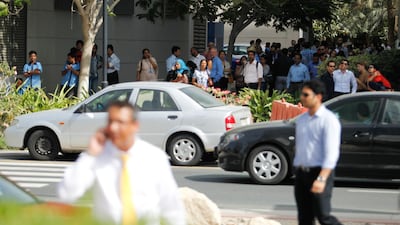
Buildings in Dubai, such as in Media City, pictured, Sharjah and Ras Al Khaimah were evacuated and residents reported tremors from Fujairah to Al Ruwais. Sarah Dea / The National -

Workers wait to re-enter their buildings in Dubai Media City. Sarah Dea / The National -
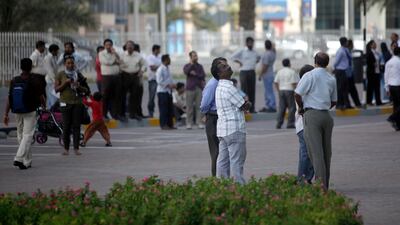
Abu Dhabi residents. Residents should remain calm and avoid panic spread through social media, officials advised. Sammy Dallal / The National -

April 16, 2012 (Abu Dhabi) People evacuate near by buildings after a 7.8 magnitude earthquake originating in Iran was also felt in Abu Dhabi April 16, 2013. (Sammy Dallal / The National)



