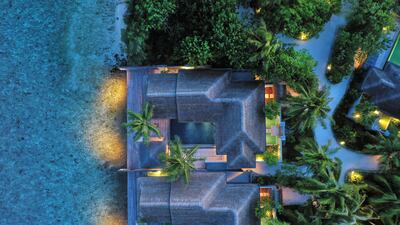
• The design of Maldives Floating City is inspired by brain coral, a type of marine organism resembling the human brain. All photos: Waterstudio/Dutch Docklands Maldives
    The design of Maldives Floating City is inspired by brain coral, a type of marine organism resembling the human brain. All photos: Waterstudio/Dutch Docklands Maldives
  • Each residence will measure 100 square metres and have its own jetty and roof terrace.
    Each residence will measure 100 square metres and have its own jetty and roof terrace.
  • Up to 20,000 people will live in the floating city.
    Up to 20,000 people will live in the floating city.
  • Maldives Floating City will be a car-free zone.
    Maldives Floating City will be a car-free zone.

Maldives to build one of the world's first floating cities as response to climate change


Selina Denman
  • English
  • Arabic

The Maldives will soon be home to one of the world’s first floating cities.

Set in a warm-water lagoon close to the capital, Male, the new district will feature thousands of waterfront residences built across a flexible, functional grid. Up to 20,000 people will inhabit the development, which will consist of a series of hexagonal-shaped floating structures.

Inspired by traditional Maldivian seafaring culture, Maldives Floating City will also eventually be home to hotels, restaurants, boutiques and a world-class marina.

The project has been under research since 2009 and is due to be fully completed by 2027. It was conceptualised by Dutch architecture firm Waterstudio, in partnership with the government of the Maldives and Netherlands-based developer Dutch Docklands.

It is believed to be the first floating city in the world to be built as an island, with similar projects testing the waters in South Korea and the Netherlands. Smaller floating communities can also be seen around the globe from Peru to Vietnam.

Dubbed “a next-generation sea urban development" that can withstand rising sea levels, the island will be able to respond to the effects of climate change. It is particularly important given that 80 per cent of the Maldives sits less than one metre above sea level and it is predicted much of the archipelago will be uninhabitable by 2100 due to rising sea levels.

Each residence will measure 100 square metres and have its own jetty and roof terrace. Photo: Waterstudio/Dutch Docklands Maldives

Safety and stability are key considerations when it comes to creating a floating structure of this size. “Forces of nature, waves, extreme weather and sea-level rise for a 100-year prediction must be engineered in advance,” reads the Waterstudio website.

“Rigidity versus flexibility and a mooring system that can divert all the extreme forces are the base of a floating city design. Single-structure city foundations act as huge mega ships, which have to handle enormous forces. By dividing the city in elements these forces can be handled in a more effective way with minimal risks.”

The design is inspired by brain coral, a type of marine organism that, due to its spherical shape and grooved surface, resembles a human brain. The project intentionally takes its design cues from nature and is respectful of its marine environment. Artificial coral banks will be attached to the underside of the floating city to stimulate natural coral growth. Meanwhile, submerged and protected coral reefs will provide a natural wave breaker.

“Maldives Floating City does not require any land reclamation, therefore has a minimal impact on the coral reefs,” explains Mohamed Nasheed, who was president of the Maldives from 2008 to 2012.

“What’s more, giant, new reefs will be grown to act as water breakers. Our adaption to climate change mustn’t destroy nature but work with it, as the Maldives Floating City proposes. In the Maldives we cannot stop the waves, but we can rise with them.”

The island is envisaged as a boating community, with canals acting as the primary transportation infrastructure and providing several access points. No cars will be allowed on the island’s white sandy roads — only bicycles and electric, noise-free buggies and scooters.

Sales of properties will begin soon and it is anticipated that the first residents will be able to move on to the island in 2024. Each residence will measure 100 square metres and have its own jetty and roof terrace. They will be priced from $250,000.

The project also offers “a world-class ownership structure that is transparent, value-driven and legally-binding”, according to Waterstudio, allowing international buyers to live here permanently.

Supreme seclusion at Naladhu Private Island in the Maldives — in pictures

  • The island is small and intimate. All photos: Naladhu Private Island
    The island is small and intimate. All photos: Naladhu Private Island
  • Freestanding bathtubs look out over the swimming pool and open sea.
    Freestanding bathtubs look out over the swimming pool and open sea.
  • Dedicated butlers are on hand to look after guests.
    Dedicated butlers are on hand to look after guests.
  • The property's two-bedroom Beach Pool Residence.
    The property's two-bedroom Beach Pool Residence.
  • A suspended day bed on the terrace of an Ocean House.
    A suspended day bed on the terrace of an Ocean House.
  • Bathrooms lead out on to a private pool.
    Bathrooms lead out on to a private pool.
  • An Ocean House.
    An Ocean House.
  • The property's beach villas.
    The property's beach villas.
  • The Beach Pool Residence sits on a 20-metre private beach.
    The Beach Pool Residence sits on a 20-metre private beach.
  • Villas are flanked by lush greenery.
    Villas are flanked by lush greenery.
COMPANY%20PROFILE
%3Cp%3E%3Cstrong%3EName%3A%20%3C%2Fstrong%3ESmartCrowd%0D%3Cbr%3E%3Cstrong%3EStarted%3A%20%3C%2Fstrong%3E2018%0D%3Cbr%3E%3Cstrong%3EFounder%3A%20%3C%2Fstrong%3ESiddiq%20Farid%20and%20Musfique%20Ahmed%0D%3Cbr%3E%3Cstrong%3EBased%3A%20%3C%2Fstrong%3EDubai%0D%3Cbr%3E%3Cstrong%3ESector%3A%20%3C%2Fstrong%3EFinTech%20%2F%20PropTech%0D%3Cbr%3E%3Cstrong%3EInitial%20investment%3A%20%3C%2Fstrong%3E%24650%2C000%0D%3Cbr%3E%3Cstrong%3ECurrent%20number%20of%20staff%3A%3C%2Fstrong%3E%2035%0D%3Cbr%3E%3Cstrong%3EInvestment%20stage%3A%20%3C%2Fstrong%3ESeries%20A%0D%3Cbr%3E%3Cstrong%3EInvestors%3A%20%3C%2Fstrong%3EVarious%20institutional%20investors%20and%20notable%20angel%20investors%20(500%20MENA%2C%20Shurooq%2C%20Mada%2C%20Seedstar%2C%20Tricap)%3C%2Fp%3E%0A
MATCH INFO

Cricket World Cup League Two
Oman, UAE, Namibia
Al Amerat, Muscat
 
Results
Oman beat UAE by five wickets
UAE beat Namibia by eight runs
Namibia beat Oman by 52 runs
UAE beat Namibia by eight wickets
UAE v Oman - abandoned
Oman v Namibia - abandoned

French business

France has organised a delegation of leading businesses to travel to Syria. The group was led by French shipping giant CMA CGM, which struck a 30-year contract in May with the Syrian government to develop and run Latakia port. Also present were water and waste management company Suez, defence multinational Thales, and Ellipse Group, which is currently looking into rehabilitating Syrian hospitals.

COMPANY%20PROFILE
%3Cp%3E%3Cstrong%3ECompany%3A%20%3C%2Fstrong%3EGrowdash%0D%3Cbr%3E%3Cstrong%3EStarted%3A%20%3C%2Fstrong%3EJuly%202022%0D%3Cbr%3E%3Cstrong%3EFounders%3A%20%3C%2Fstrong%3ESean%20Trevaskis%20and%20Enver%20Sorkun%0D%3Cbr%3E%3Cstrong%3EBased%3A%20%3C%2Fstrong%3EDubai%2C%20UAE%0D%3Cbr%3E%3Cstrong%3EIndustry%3A%20%3C%2Fstrong%3ERestaurant%20technology%0D%3Cbr%3E%3Cstrong%3EFunding%20so%20far%3A%3C%2Fstrong%3E%20%24750%2C000%0D%3Cbr%3E%3Cstrong%3EInvestors%3A%20%3C%2Fstrong%3EFlat6Labs%2C%20Plus%20VC%2C%20Judah%20VC%2C%20TPN%20Investments%20and%20angel%20investors%2C%20including%20former%20Talabat%20chief%20executive%20Abdulhamid%20Alomar%2C%20and%20entrepreneur%20Zeid%20Husban%3C%2Fp%3E%0A
What is graphene?

Graphene is a single layer of carbon atoms arranged like honeycomb.

It was discovered in 2004, when Russian-born Manchester scientists Andrei Geim and Kostya Novoselov were "playing about" with sticky tape and graphite - the material used as "lead" in pencils.

Placing the tape on the graphite and peeling it, they managed to rip off thin flakes of carbon. In the beginning they got flakes consisting of many layers of graphene. But as they repeated the process many times, the flakes got thinner.

By separating the graphite fragments repeatedly, they managed to create flakes that were just one atom thick. Their experiment had led to graphene being isolated for the very first time.

At the time, many believed it was impossible for such thin crystalline materials to be stable. But examined under a microscope, the material remained stable, and when tested was found to have incredible properties.

It is many times times stronger than steel, yet incredibly lightweight and flexible. It is electrically and thermally conductive but also transparent. The world's first 2D material, it is one million times thinner than the diameter of a single human hair.

But the 'sticky tape' method would not work on an industrial scale. Since then, scientists have been working on manufacturing graphene, to make use of its incredible properties.

In 2010, Geim and Novoselov were awarded the Nobel Prize for Physics. Their discovery meant physicists could study a new class of two-dimensional materials with unique properties. 


Updated: June 29, 2022, 5:00 AM