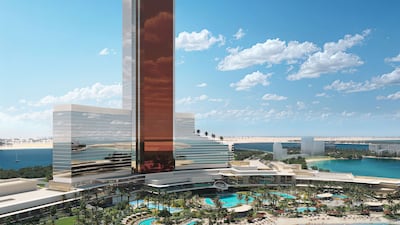

For Ras Al Khaimah, the arrival of Wynn Al Marjan Island is about more than a new luxury resort.
The $5 billion-plus development is expected to be one of the biggest tourism openings in the region when it welcomes guests in September 2027, and is set to bring a new level of international attention to the emirate.
But for Phillipa Harrison, chief executive of Ras Al Khaimah Tourism Development Authority, Wynn is one piece of a much bigger development story.

“As a $5 billion-plus investment, it is the biggest piece of tourism infrastructure in a long time in this region,” Harrison tells The National, speaking at Arabian Travel Market in Dubai this week. “But it is part of a wider story.”
The former Tourism Australia managing director joined RAKTDA last August at a pivotal moment for the emirate, which is targeting 3.5 million visitors a year by 2030.
Her first impressions were of a destination with considerable room to grow.
“It was just an absolute hidden gem from my point of view. I didn't even know it was here, really,” she says.
“I knew Dubai, I knew Abu Dhabi, but Ras Al Khaimah, while it is somewhere that's really well loved regionally, it is not that well known on the international stage.”

This year, despite regional instability, Ras Al Khaimah welcomed more than 670,000 visitors in the first half of 2026, its strongest first-half performance to date. And Harrison credits the domestic travel market for the record visitation.
But the hopes its international recognition will change rapidly, with Wynn forming the centrepiece of an expanding hospitality and entertainment pipeline. But she describes the emirate’s development as the result of a long-term strategy rather than a sudden transformation.
“People talk about being overnight successes, but for Ras Al Khaimah the overnight success started 10 years ago when leadership decided that they were going to go after one brand. That brand was Wynn and this is all coming to fruition now,” she says.
However, Harrison stresses she is keen to avoid Ras Al Khaimah becoming synonymous with the resort. Wynn will be joined by a growing roster of international names, including Nobu, Janu, The Unexpected and Four Seasons, while two new marinas are also being developed.
“We're developing two world-class marinas so there's going to be a real focus on yachting for the emirate,” Harrison says.
The challenge for RAKTDA, however, is ensuring the growth in hotel rooms and attractions is matched by visitor demand.
“You have to be really clear on what makes you distinctive and different, and then you need to go and appeal to people in a really interesting, creative way,” she says. “I think there is a lot of sameness in destination marketing.”

For Harrison, Ras Al Khaimah’s point of difference is not a single attraction but the ability to offer very different forms of escape within one destination.
“We want Ras Al Khaimah to be a place where people can come and take a breath,” she says. “So, somewhere that is relaxed, in the way that you want to relax.”
That could mean climbing a mountain, lying on a beach or simply finding a quieter pace.
The strategy also means developing experiences beyond the hotels themselves, so that the destination does not become dependent on its growing resort portfolio.
“We're a small industry and get together frequently, particularly the hotel GMs and our leadership team, to talk about a shared vision for who we are and who we want to be,” Harrison says.
“The other way that we're doing it is developing a range of experiences outside of hotels that really underpin our positioning and really give people a reason to come and a reason to come back.”
That broader approach will be crucial as the emirate works towards its 2030 target.
Harrison describes the plan as a five-part formula: access, accommodation, attractions, amenity and awareness.
“We're looking at the 3.5-million-visitor goal from those five different angles and making sure that we have a plan for each of them so that they all support each other.”
Access includes improving connectivity through Dubai while developing Ras Al Khaimah International Airport, including a VIP terminal for private aircraft.

Accommodation, meanwhile, is being expanded through the growing hotel pipeline, while attractions and experiences are intended to give visitors reasons to stay longer and return.
The final piece is awareness, making sure potential visitors actually know what Ras Al Khaimah has to offer.
For Harrison, the ultimate measure of success will be whether the emirate can grow substantially without losing the qualities that make it appealing now.
“Even though we're going to double in size and triple our visitation, we're still going to be a small boutique destination,” she says.
And if she could revisit the conversation in 2030, she says she would want Ras Al Khaimah to have established one very particular association in travellers’ minds.
“It would be the place that everyone goes to when they want restoration,” she concludes. “A place where you can come, take a breath and have a wonderful holiday, whatever that looks like for you.”

