This World Cup will create many firsts besides being the first to host 48 teams across three countries.
Never before has a country at war – the United States – hosted a World Cup, let alone host the very nation of which it is at war with – Iran.
Jordan and Uzbekistan will make their World Cup debuts, having qualified automatically. Curacao, the tiny south Caribbean island state with a population of 156,000, will make their bow as the smallest country to reach the global finals. Cape Verde are third smallest, with a population of 525,000.

But the overriding sense before Thursday's kick-off is that this is the most politicised World Cup in history.
That’s not to say previous World Cups have successfully sidestepped that particular problem. Tournaments awarded in the past – and even ones in the future – have tended to take on a bent that skews eyes away from the football.
Italian dictator, Benito Mussolini, used the 1934 World Cup in Italy to promote his fascist ideology. The tournament was mired in allegations of intimidation and match-fixing said to favour the home team, who ultimately went on to win the tournament.
Four years later, Nazi Germany had just annexed Austria. The Austrian national team was dissolved and several of the players were forced to join the German squad. The merged team were eliminated in the very first round. A year later, World War II started.
The 1978 finals in Argentina were held under the military junta of General Jorge Rafael Videla. The tournament was a massive propaganda tool to hide a brutal campaign of state terrorism and widespread human rights abuses.
However, 2026 may be unique because of the sheer number of political stories converging simultaneously: migration, identity, global conflict, North American politics, Fifa governance, diaspora communities and the changing power structure of world football.
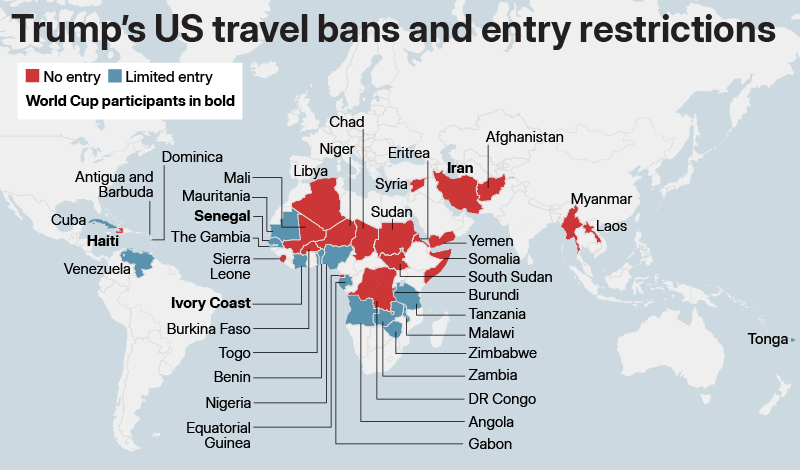
The line between football and geopolitics is impossible to separate at this tournament. Somali referee Omar Artan had his dreams of officiating at a World Cup crushed after being denied entry to the United States. Somalia is one of 19 countries subject to a full US visa travel ban. The ban was enacted last June and expanded in January. You think Fifa would have noticed that before putting Artan on its original 52-man roster.
Iraq striker Aymen Hussein endured a seven-hour wait in Chicago before eventually satisfying immigration officials and being allowed into the country.
Let’s imagine for a second that his entry was denied. Imagine being the player that sent your country to a first World Cup in 40 years – Hussein scored the winning goal against Bolivia in the intercontinental play-off final – only to be told you can’t play for your country at the tournament because of the US government’s own flaws in vetting individuals – and because you’re from an active conflict zone that the US is almost entirely responsible for creating.
The Iran team have had to relocate to Tijuana, Mexico, from Arizona, to set up camp. Hostilities between the two countries have been heightened since the US joined Israel in attacking Tehran on February 28. The Iran team will have to fly in and out of the US for all their games on the day of the game. On Tuesday, the Iran football federation had their entire ticket allocation for their games – all on US soil – withdrawn.
That Iran are in North America at all still beggars belief, given the conflict. Will they even show up for their first group game against New Zealand on June 15? Every indication is that they will, but is there a breaking point when Iran decide it’s not worth the hassle, boycott and leave Fifa’s flagship event in tatters?
The tournament arrives amid fierce debates about immigration, border security and asylum policies. The United States-Mexico border has become one of the defining political issues of the age, making it impossible to separate aspects of the tournament from wider political discussions.
For millions of supporters travelling to North America, visa policies, border controls and entry requirements are likely to become major talking points alongside football.
None of these problems are unexpected; the Trump Administration created the conditions so there was no way of avoiding them.
Infantino – administrator or diplomat?
Gianni Infantino’s role in the politicisation of this World Cup cannot be overstated.
Fifa’s decision to expand the number of teams from 32 to 48 has always been billed as giving more countries that otherwise wouldn't qualify a chance to play at a World Cup.
The Asian Football Confederation (AFC) was allocated 4.5 spots (four direct entries and one intercontinental play-off spot) for the 2022 World Cup in Qatar, but received 8.5 spots for the 2026 tournament.
Iraq were the main beneficiaries of that expansion, becoming the last team to qualify with their historic win over Bolivia in Monterrey, Mexico, in April, the end of a gruelling two-year-long qualifying process.
Africa saw their pot beefed up from five direct entries to 9.5 (nine direct and one intercontinental play-off spot). As a result, the Democratic Republic of the Congo will participate at a first World Cup since 1974 when the country was Zaire.
For all Fifa’s message of unity and inclusion, critics say the move to expand the number of participating teams is little more than a political project that increased the influence of Fifa's smaller member associations, many of whom helped cement Infantino's support base.
The expansion created dozens of qualification places, but it also strengthened Infantino's political relationships across Africa, Asia, Oceania and the Caribbean. Infantino announced in May he intends to run for re-election as Fifa president for a fourth term. You don't need a crystal ball to see which way those smaller nations will vote.
His relationship with various world leaders has repeatedly been called into question during his 15-year tenure. For example, Saudi Arabia has poured millions of dollars into Fifa’s coffers in sponsorship and won the rights to host the 2034 World Cup uncontested.

Previous Fifa presidents generally kept some distance from national leaders to maintain, at least on a surface level if not an actual one, political neutrality.
But his “Bromance” with US President Donald Trump has pulled back the curtain on that illusion.
Infantino has made multiple appearances alongside Trump at White House and Fifa events, while Trump has become heavily involved in promoting the World Cup.
Cooperation with a host country, and by extension, its leaders, is, of course, essential in the organisation and build-up to a tournament, but Infantino continually blurs the line between administrator and diplomat.
Perhaps his most galling stunt was presenting Trump with Fifa’s inaugural “Peace Prize” during the 2026 World Cup draw in Washington on December 5. Twelve weeks later, he was at war.
Human rights organisation FairSquare later filed an ethics complaint alleging that the award breached Fifa's neutrality obligations, while Norway's football federation publicly supported an investigation.
Infantino’s actions suggest not a governing body dealing with a government behind the scenes to host the biggest tournament in history, but one where he is actively endorsing Trump, the most polarising figure in world politics, and his policies on immigration, borders, security and America's global role.