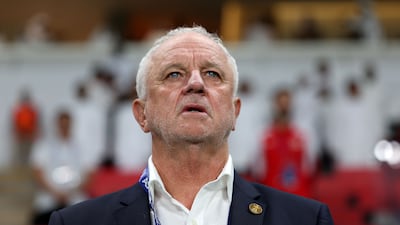

Iraqi football is in disarray. Its federation is consumed by feuds, legal challenges and accusations of political meddling. And now Graham Arnold, the Australian coach who ended the country’s 40-year wait for a World Cup, may be about to take charge of his last match.
Iraqi media report that his successor will be Emad Mohammed, a former national team striker with a patchy record in the dugout.
A federation at war with itself
The Iraqi Football Association is governed by a president chosen by 61 voting delegates drawn from clubs, regional bodies and professional associations. In Iraq, the job brings money, influence and political prestige. So, inevitably, parties and powerful benefactors take an interest in who gets it.
For five years, that man was Adnan Dirjal, a defender from the generation that qualified for the 1986 World Cup and a former sports minister. His deputy was Younis Mahmoud, the revered captain who lifted the 2007 Asian Cup.
The partnership’s collapse played out in public. In 2023, Mahmoud told a television audience that he had tried to curb Dirjal’s authority over contracts relating to the staging of the 2023 Gulf Cup that had been signed without the board’s knowledge. In August 2025, Mahmoud announced that he would stand against him.
World Cup qualification should have made Dirjal untouchable, but Mahmoud prevailed in May by 38 votes to 20, just before the tournament kicked off.
Dirjal stormed out, sarcastically congratulating the politician Mohammed Al Halbousi and Olympic Committee president Aqeel Muftin, both of whom he accused of orchestrating his defeat. Mahmoud’s camp denied any interference, and the Court of Arbitration for Sport has twice refused Dirjal’s requests to suspend the new board pending a final ruling on his challenge to the election.
One of the players who credited Dirjal for his work was Ali Al Hamadi. In an interview with The National, before the World Cup, the striker was asked whether a dressing room which included Kurds, Arabs, Chaldeans and Assyrians, in a country long scarred by division, ever discussed politics.
His response: “I think this is definitely probably the most together it’s ever been. And that’s credit to the staff, that’s credit to Adnan Dirjal as well for his work behind the scenes, recruiting players, the organisation.”
Arnold caught in the crossfire
Arnold was Dirjal’s appointment, and the new leadership inherited him weeks before the World Cup. Despite Iraq losing all three of their World Cup matches, Arnold was offered a four-year contract in July but agreed to sign for six months instead, intended to take him through to the 2027 Asian Cup.
He reasoned that a long deal might cost him his passion for the job and leave the federation with an expensive payout. However, the federation's vice-president, Sarmad Abdulilah, subsequently acknowledged that Arnold had also raised serious concerns about administrative failings, including arrangements for training camps, player transport and communications with clubs.
The new leadership began to introduce their own changes. The team’s manager, Mustafa Jalal, was replaced by Dr Mushtaq Kadhim, whose father has long-standing ties to Al Naft, an oil-backed club with a vote in federation elections. Jalal was experienced, fluent in English and was said to have worked well with Arnold’s foreign staff.
On the pitch, Iraq’s results were fuelling criticism. At the Gulf Cup in September, they needed only a draw against an already-qualified Saudi Arabia, but Arnold made changes due to concerns that players already on yellow cards could miss the semi-finals. His side lost 2-0.
But the federation stood by him, publicly reaffirming their confidence in the Australian in October.
Then earlier this month, the Asian Cup was postponed over security threats in Saudi Arabia. Arnold’s contract expires in February, leaving him without the tournament he had stayed on to coach.
The case for and against Emad Mohammed
Emad is widely tipped to be Arnold’s successor. In July, Mahmoud reportedly told him he would be first choice should talks with Arnold collapse.
On paper, he ticks a few boxes. Born in Kerbala in 1982, he was a striker who won 103 caps and scored 27 goals for Iraq. As a coach, he guided Iraq’s Under-20 side to the final of the 2023 Asian Championship and on to the World Cup in Argentina.
But is he the best candidate? His spells in club football were brief. His Under-23 team exited the 2026 Asian Championship without a victory, after which he said the federation had talked him out of resigning.
In 2024, Fifa banned him for six months over insults aimed at a television presenter, though he denied responsibility for the social media account involved. What makes it all the more interesting is that Emad himself noted in July that Arnold should stay and finish what he started.
What comes next
At the weekend, Iraqi media reported that Tuesday's match against Iran in Basra would be Arnold's last, regardless of the result. Federation sources claimed the board had agreed he would not continue, although no replacement had been confirmed. Emad is reportedly willing to take over if offered a long-term contract.
Importantly, Mahmoud also recently revealed that the federation was facing a financial crisis with a monthly wage bill of more than 400 million Iraqi dinars for national team coaches and their staff.
But the federation has yet to confirm any decision. Mahmoud said the coach's future would be discussed only when the senior and Olympic teams had finished their current matches, while board member Ghalib Al Zamili insisted the Australian will continue under his current contract.
Arnold wants to stay. Speaking on Monday ahead of the Iran match, he said he hoped to continue but acknowledged that his contract expires in February and his future rests with the federation.
If Arnold departs, the pertinent question is not whether Emad is up to the task. It is whether anyone could be while those above remain at war with one another.

