

Drive down any main road in almost any city in Morocco and soon enough Brahim Diaz will be running towards you. He’ll be the image on a big billboard, arms pumping, shy smile forming. He’s the face endorsing, during the country’s hosting of the Africa Cup of Nations, a major mobile network provider.
But he’s got significant competition. A beaming Achraf Hakimi, Brahim’s Atlas Lions teammate, fills almost as much advertising space, promoting a rival supplier of airtime.
Safe to report that, in their main jobs, Hakimi and Brahim are very much on the same wavelength, their productive relationship on the right flank of the national team one of the motors that has driven Morocco into Sunday’s Afcon final.

There, up against Senegal, the hope is that vibrant home support, the worldliness of a carefully constructed squad and the momentum of 26 matches unbeaten can bring 50 years of waiting for a second continental title to an end.
The invincible run has looked all the more dazzling since Brahim started pumping his arms in a Morocco jersey less than two years ago, after a period of significant prevarication over his international career.
-
Morocco players celebrate victory over Nigeria. AFP -
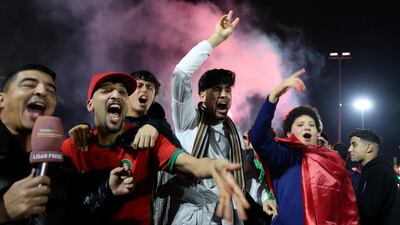
Morocco fans celebrate on the streets after winning their semi-final against Nigeria in Rabat. Reuters -

Morocco fans celebrate on the streets after winning their semi-final against Nigeria in Rabat. Reuters -

Morocco fans celebrate on the streets after winning their semi-final against Nigeria in Rabat. Reuters -

Morocco fans celebrate on the streets after winning their semi-final against Nigeria in Rabat. Reuters -
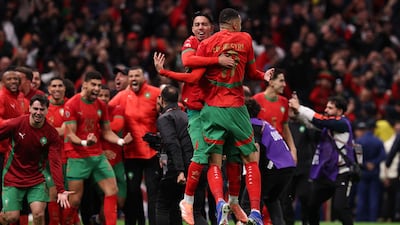
Morocco players celebrate victory over Nigeria. AFP -
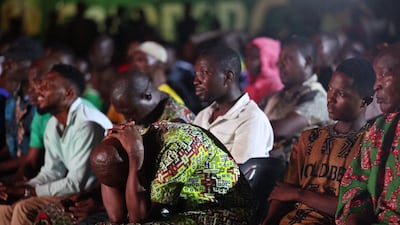
Nigeria fans gather to watch the semi-final in Lagos. Reuters -

Nigeria fans gather to watch the semi-final. AFP


He, like Hakimi and their midfield colleague Ismael Saibari, was born in Spain, Brahim to a father whose family come from Morocco and a Spanish mother. As a precocious, diminutive striker or playmaker, he was selected for Spain’s age-group teams throughout his teens and coveted by some of the most successful clubs in Europe.
His resume, by his mid-20s, already included a Premier League title with Manchester City, a Serie A winners medal with AC Milan and Liga and Uefa Champions League titles with Real Madrid, his current employer.
Walid Regragui, the head coach of Morocco and architect of the historic progress to the semi-final of the 2022 World Cup, worked hard on persuading Brahim, now 26, to make good on his eligibility for the Atlas Lions and to, effectively, abandon his Spain ambitions.
Since Brahim said yes to North Africa, Regragui has worked even harder at making him the footballer Morocco had a space for. His five goals, more than anybody else so far at this Afcon, are an indication Brahim has answered a need. His 13 goals in 21 games for Morocco testify that he hit the ground running.
Yet he did so from an uncertain launchpad. Fact is that Brahim, while appreciated by the coach at Real Madrid who oversaw most of his time there, Carlo Ancelotti, has very seldom been an established, week in, week out starter at Madrid.
He is frequently effective from the bench and valued for that. But he is acutely aware that, in the position he thrives in, just off a main striker or cutting from the wings, there is a queue for first XI status.
He is in a perpetual battle to be near the front of it while his teammates include Vinicius Junior, Jude Bellingham, Arda Guler, Rodrygo, Franco Mastantuono and Fede Valverde.
For Regragui, Brahim’s hunger for greater impact was something to be harnessed, but on Morocco’s terms. “He’s got a self-belief, a bit of ego, if you like,” Regragui told reporters, “because he wouldn’t have become a Real Madrid player and reached the level he has without that. But he’s also got the humility to listen, and his humility helps him to recognise that, to succeed, he has first and foremost to serve the team as a whole.”
Regragui reckons he, as a coach, has been harder on “Brahim than any player in the squad” in demanding that he define for himself a specific role, which, rather than as a No 10, playing behind a centre-forward like Ayoub El Kaabi, Youssef En-Nesyri or Al Ain’s Soufiane Rahimi, would be on the right of a front three, immediately in front of the gifted Hakimi. There would be a requirement to track back and recover possession as well as to take on his markers and attack goalscoring spaces.
“I know what he is capable of and thought that he could be producing more,” explained Regragui.
The coach travelled frequently to Madrid to speak face-to-face with Brahim, to share with him specific footage of match situations as they analysed how his role should develop.
It’s a role with a weighty legacy, too. Hakim Ziyech, the mercurial former Chelsea, Ajax and Galatasaray winger played with distinction and vision on the right flank during the historic 2022 World Cup campaign.
Ziyech, whose club form has since dipped, is not part of this Afcon. But while Brahim is a different sort of player, his influence means Ziyech is scarcely missed. And, to a large degree, some of the more severe criticism of Regragui - that his instincts are conservative rather than creative - has been quietened by the freedom he gives Brahim to use his outside right position as a point of departure rather than a fixed placement.
“He understands that the closer he is to the opposition penalty area the better he will show his talent,” said Regragui.
But there are clear responsibilities for Morocco’s 26-year-old star. “He has to take fewer risks when he’s further back because losing the ball puts us in danger. What has pleased me is not just that he has been scoring goals but that his mentality has developed. He battles, he chases, he protects the ball. He can become the best in the world if he pushes at it.”
That may seem a bold claim, not least after a semi-final, Wednesday’s exhausting 0-0 draw with Nigeria over 120 minutes that Morocco edged on penalties, in which Brahim’s impact was much reduced compared with the rest of his Afcon.
Yet there must be still optimism that his otherwise superb tournament, and a successful final on Sunday, represent a significant reboot for Brahim.
His fine Afcon has contrasted with the struggles in his absence of his club. In the last week, Madrid have sacked as coach Xabi Alonsowinner's, seven months after he replaced Ancelotti, and installed Alvaro Arbeloa as his stand-in. Under Arbeloa they were promptly bundled out of the Copa del Rey by lower-division Albacete.
All of which means they will be eager to inject some confidence, some changes, into their approach. Brahim will surely look like a welcome returnee when he lands back in the Spanish capital next week with, he hopes, a winner's medal in the competition his countrymen have been yearning to win for half a century.

