
Saudi Arabia remains “100 per cent committed” to the long-term success of Newcastle United, according to the club’s former co-owner Mehrdad Ghodoussi.
Ghodoussi, alongside his wife Amanda Staveley, brokered a takeover of the Tyneside club in October 2021 with the backing of the Saudi Public Investment Fund and the Reuben family.
Since then, the team has qualified for the Uefa Champions League twice and ended a 70-year wait for a major trophy when they won the League Cup last March.
Yet, despite an already substantial transfer outlay – Newcastle’s net spend of £430.6 million since 2021 is the fifth highest in the Premier League – they have been frustrated in their pursuit of grander ambitions by profit and sustainability rules (PSR).
The rules seek to promote sensible financial practice by limiting club losses to £105m across a rolling three-season period, but in doing so make it difficult to bridge the gap to the division’s wealthiest and most successful sides.
Manager Eddie Howe has described PSR as “not right”, while there have been rumours of restlessness among the club’s Saudi hierarchy at seeing their spending curbed and progress stalled.
However, speaking to The National at the World Sports Summit in Dubai, Ghodoussi insisted the PIF has a long-term vision for the club – and that their support is rock solid.
“The commitment is 100 per cent there. They love the club. They love the North East. They love the city. The commitment is 100 per cent there. I can guarantee you that,” said Ghodoussi, who departed the club with Staveley in July after selling their six per cent stake to the PIF and the Reubens.
“It's a great club. It's a great team. It's a great manager. It's great ownership. They have huge ambitions. I'm excited to watch how things progress. It's not easy being in the Premier League. You're going to have your ups and downs, but the future is bright.”
A new squad cost ratio (SCR) system is set to replace PSR next season, with spending on player or coaching fees and wages restricted to 85 per cent of football-related revenue.
While accepting some form of regulation must be adhered to, Ghodoussi said the imminent changes are an admission that the current framework is flawed.
He said: “Look, you do have constraints. I see where the Premier League are coming from and it's to try to create a level playing field.
“These things always move and change over time, and the Premier League is aware of it and that's why these new changes came into play. So, look, you've got to work within the boundaries. It was difficult, but we did.”
The PIF’s ‘hands-on’ approach
The 2021 takeover deposed Newcastle's loathed former owner Mike Ashley, while the equally unpopular incumbent first-team manager Steve Bruce swiftly followed him through the St James' Park exit.
Ghodoussi said they found a club in desperate need of modernisation, especially in the transfer department, where they used no data whatsoever – signing players based purely on the eye test – and didn't even have a subscription to the now ubiquitous Wyscout.
“It was very basic and that was one of the first things we had to focus on, invest in, just the basics, which is actually having access to data providers, which we didn't,” he said.
“These are things that you'd expect at any club. Your biggest risk is on the transfer side and you can see this with a multitude of clubs in recent years. We had to make sure that we didn't have any risks when we bought players. Usually you say there's a 75 per cent to 25 per cent ratio of error. We wanted no error.
“We wanted to be 100 per cent on the nose because we were new to the game and also [had] limited ability to invest, not because we didn't have deep pockets, but because of financial fair play as well. So that was always something that we had to be aware of.”
That initial transfer window of January 2022 proved pivotal with Kieran Trippier, Dan Burn and Bruno Guimaraes – all of whom have become mainstays of Howe's team – among the first through the door.
-

Newcastle United players and staff celebrate after the League Cup final win over Liverpool at Wembley Stadium on March 16, 2025. Reuters -

Newcastle United's Bruno Guimaraes and Kieran Trippier lift the League Cup trophy after beating Liverpool 2-1. Reuters -

Newcastle defender Dan Burn heads home the opening goal. Reuters -

Kieran Trippier and Sandro Tonali celebrate after Newcastle's win at Wembley. Reuters -

Newcastle's Dan Burn celebrates with the trophy after beating Liverpool. Reuters -
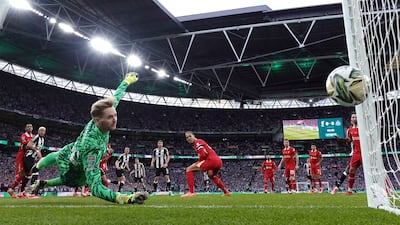
Liverpool goalkeeper Caoimhin Kelleher is beaten by Dan Burn's header for Newcastle's first goal. Getty Images -

Newcastle's Brazilian duo Bruno Guimaraes and Joelinton celebrate with the trophy. Reuters -

Newcastle striker Alexander Isak celebrates after putting his team 2-0 ahead. Reuters -
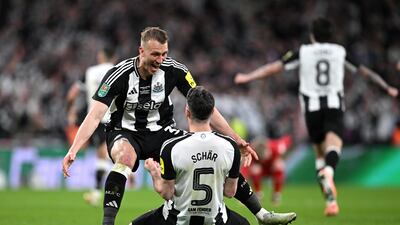
Newcastle defenders Dan Burn and Fabian Schar celebrate after the final whistle at Wembley. Getty Images -
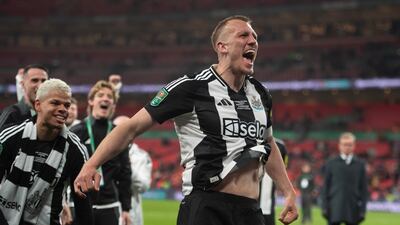
Newcastle's Dan Burn celebrates after the match at Wembley Stadium. Getty Images -
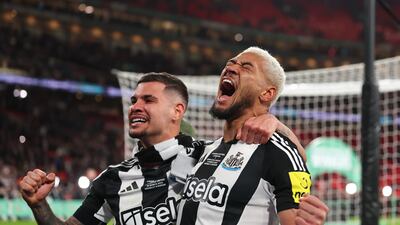
Bruno Guimaraes celebrates Newcastle's win with Joelinton. Getty Images


“Over time things shifted,” Ghodoussi continued. “It's not just purely driven by data and it's not driven purely by scouts on the ground. There's a combination of things that you have to take into account. Then also meeting the player, the characters around those players, those are hugely important.
“We looked at their social media, what kind of footprint they have. You talk to friends, family, you talk to people that work with them, you talk to people that may not like them and you try to understand why they didn't like them. Buying players is your biggest risk and you've got to mitigate that risk as much as you can.”
Asked how directly involved the PIF had been in steering the club's transformation, Ghodoussi added: “Oh, a lot. It's not just about capital. They are hands on. They were involved in every aspect of it. There were processes put into place.
“I sat on the executive committee. I sat on the transfer committee. We put these structures into place. Process was hugely important to [PIF governor] His Excellency Yasir Al Rumayyan. It's the thesis of how PIF works. So we instilled that into the way we worked at Newcastle.
“We brought that business know-how and we applied it to sports. But not forgetting that sports is an emotional business. So that human touch is necessary, right? Again, it's a balance between the two perspectives.”
Howe is a 'wonderful manager'
The first major decision the new owners had to make was a replacement for the sacked Bruce.
Eventually, they appointed Howe, who had spent a period of time out of the game having previously amassed an impressive body of work at Bournemouth. His leadership of the club and sustained good results have meant that decision has aged extremely well.
A slight drop off, particularly in away form, at the start of the current season invited the first criticism of his tenure, but Ghodoussi is adamant Howe remains the right man to take the club forward.
Having seen the start of the campaign overshadowed by Alexander Isak's acrimonious departure to Liverpool, Newcastle head into Wednesday's home game against Leeds United ninth in the table but having won their last two.

“Eddie's a friend. He's been there from the beginning of the journey. I think he's a wonderful manager,” said Ghodoussi. “Even that process on hiring, we went through a data process. We looked at a lot of managers. We interviewed a lot of managers. We narrowed it down to two, and it was Unai Emery and Eddie. We ended up going with Eddie at the end, but he's done an incredible job.
“Don't forget, we've been in two Champions Leagues in four years. We've been in two finals, and we've won a cup after 70 years. Let's not lose sight of what we've achieved in such a short period of time. It's important to support managers and be behind them.”
Asked about Newcastle's future prospects, Ghodoussi added: “From my perspective, it was always to be competitive, to be a top-four club, to be in the Champions League regularly – because consistency is what drives success – and to win trophies. Hopefully, at some point, they'll win the Premier League, hopefully, at some point, they'll win the Champions League. They deserve it, their club is meant to be at the top.”

