

It’s Monday, 5am in Manchester. The thermometer on the dashboard reads -5°C. I’m up early to travel to Fes, Morocco, for a week to follow the Africa Cup of Nations (Afcon). My first game will be later today, a last-16 encounter between Nigeria and Mozambique, but that seems a long time and one connection flight away.
After clearing a thick film of ice off the windscreen, I return the rental car to Manchester Airport, where the man from the hire car company is a Manchester United fan. As he takes me to the airport terminal, he asks: “Will Amorim last the week?”
Ruben Amorim’s clearly agitated and emotional behaviour in his past two press conferences on Friday and Sunday has cast significant doubt on his survival.
I don’t know the answer, nor that his dismissal has already been decided while I'm on my first leg of my journey to Barcelona. Friday saw an argument; he called out his bosses again on Sunday. Very quickly, it looked like the endgame, despite United sitting a respectable sixth in the Premier League table. It meant United were on target to secure European football for next season.
But United have been up and down all season, registering impressive wins against top sides including Liverpool, Chelsea, Newcastle United and Crystal Palace, yet suffering some awful defeats against Grimsby, Everton and Brentford. And those came when the team has ample time to prepare for matches since last season’s 15th-place league finish – United's lowest in half a century – meant no European football this term.
Failure to beat Wolves, who had not won a game all season, last week saw the mood sink at Old Trafford. Players were not happy and this was conveyed to the manager. In mitigation, the team are missing key players: Bryan Mbeumo, Amad Diallo and Noussair Mazraoui, who are representing their countries in Morocco. The injury list has become a long one, meaning the starting lineup at Leeds on Sunday was full of defenders. Rivals are also dropping more points than normal and while United have been in touching distance of a Uefa Champions League spot all season, every time the team have a chance to move up to fourth place, points are dropped.
A bumpy landing in Barcelona to change planes was followed by more turbulence when the phone networks bleeped back into action: Amorim had been sacked.
My day researching the competing teams in Afcon, was about to change dramatically as calls started coming in by the second. That’s normal, I’ve written about Manchester United for 36 years and there’s a demand for interviews when there’s big news. I won’t be able to do any of them.
“I did tell you, mate,” messages the man, a football agent, who’d given me a lift to the Celtic v Rangers Old Firm game on Saturday. He did say that Amorim’s days were numbered. “And Fletch has got the interim,” he added on Monday.
That’ll be Darren Fletcher, whom I’d been speaking to on Saturday (he’s a Celtic fan). He was telling me which players to watch out for, giving some context to teams I know little about. He’s a football nut and always has been. I appreciated it. There were a few hours of silence when he took training for United’s under-18s, his job for this season, one he was enjoying. Fletcher’s world was also about to change.
I had an hour to deal with everything and to eat some food too. Oh, there’s another message from a ticketing site called Bookaway. I’d booked a train from Fes to Rabat the following day with them. The schedule is a tight one. I was due to arrive in Rabat at 3pm and there’s a game at 5pm between Algeria and DR Congo.
“Hey, Andrew,” it began. “We would like to let you know that this booking has been cancelled and refunded. You should have a refund in your account in 7-10 business days depending on your bank.” The train website showed that my train had sold out.
The podcast was recorded first, then food and my flight boarded. Travelling with a British passport has been more complicated since Brexit and everything takes longer.
“So you’ve just arrived in Barcelona, cleared immigration and now you’re going back through immigration to Morocco,” asked the border official. “What are you travelling for?”
The same question was asked on arrival in rainy Fes a couple of hours later. The reason they are in Morocco’s third biggest city of 1.3 million was clearer. The country was staging the 35th edition of Afcon, and the modern airport was decorated with signage to welcome visitors. Literature was also distributed for free – a detailed printed guide in multiple languages. There are photos of the stunning new stadiums built by Morocco for this tournament and the 2030 World Cup finals (Morocco will co-host with Spain and Portugal) and some useful language tips in French and Darija (Moroccan Arabic), the main languages in Morocco.
There are other British football fans on the plane, too. Those pockets of supporters who found tickets and flights cheap and plentiful may have thought they would also be getting some January sun. Instead, it’s raining heavily as we leave the airport. The taxi driver wants to renegotiate the agreed fare, but there’s no renegotiation to be had. He backs down, tells me he used to be a footballer and drops me close to the stadium in rain so heavy that everyone is taking shelter. The stadium is three-quarters uncovered. The driver’s parting shot is that Nigeria’s Victor Oshimen is the best player that I’ll see tonight.
-

A Nigerian supporter outside the Fez Stadium, Fes, Morocco ahead of the last-16 Africa Cup of Nations match. All photos: Andy Mitten for The National -
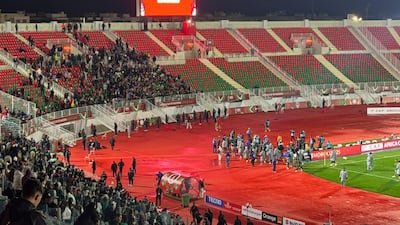
The rain in Fes kept many fans away as Nigeria ran out 4-0 winners. -
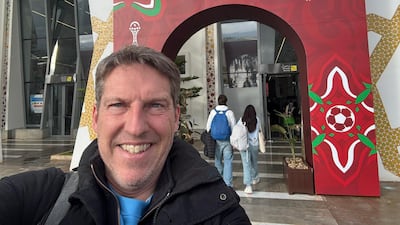
The National's Andy Mitten arriving at Fez Saiss Airport in Morocco ahead of his travel accross the country for the Africa Cup of Nations. -
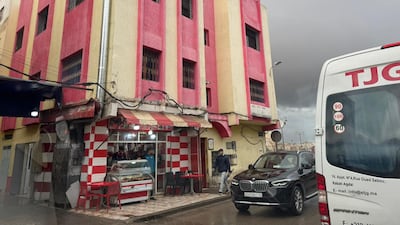
Supporters who found tickets and flights cheap and plentiful may have thought they would also be getting some January sun in Morocco. Instead, it’s raining heavily. -
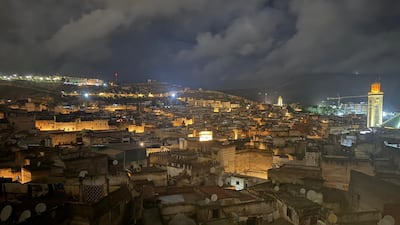
A view from Andy Mitten's medina in Fes, Morocco.


I speak to one of the many Nigerian journalists who are enthused that their side won all three group games. A few thousand Nigerian fans are standing in the rain and a few hundred from Mozambique. They sing their national anthem with pride.
It has been a very long day and I reach in my bag for a paracetamol to discover that my toiletries bag isn’t there. Oh no! Where can it be? With the toothpaste and contact lenses and shampoo and everything else? I message the manager of the riad in the ancient Medina, which I’m yet to explore and which will be my bed for the night. He tells me that he’ll buy me toothpaste and a toothbrush.
The game starts and it’s all Nigeria, as expected. It follows Egypt’s 3-1 over Benin, which had caused such a stir and spilt sweet tea and broken almond biscuits before the game as Benin equalised after 83 minutes. That took it to extra time, where Mohamed Salah finished off a 3-1 win in Agadir, a city by the Atlantic and the southernmost venue for the tournament.
In the Fes rain, the 45,000-capacity stadium is not even half full and the raucous fan scenes that have accompanied Morocco’s game are smaller in number, but there’s entertaining football and goals as Nigeria win 4-0 to reach the quarter-finals of the 24-team tournament.
I’m asked if I want a ticket for the Nigeria mixed zone, but I’ve seen quieter main line railway stations in Japan, don’t know any of the players and realise I won’t be able to get to any. My mother texts to me to say that Manchester United have sacked their manager, breaking the news 11 hours after the event. Thanks for that! But it’s a trip to the car-free Medina for a sleep, ahead of some exploring in the morning. Wonderwall by Oasis is playing in the car as we pass some of Fes’ most affluent areas before arriving at the gates of the densely populated Medina, its narrow streets home to 150,000.
“Today is gonna be the day. That they’re gonna throw it back to you ... And all the roads we have to walk are winding.”
“He didn’t last until lunchtime,” was the final message of the day, from the man at the car hire company who was convinced Ruben Amorim wouldn’t last the week.

