

There are 31 days in December and we can expect all of them to be dominated by Mohamed Salah's will-he-or-won't-he sign a new deal at Liverpool saga.
The scene was set on the very first day of the 12th month. After another man-of-the-match performance in which Salah's second-half penalty gave the Reds a 2-0 win over Manchester City, a scoreline that flattered the English champions, the Egyptian forward was asked about his contract situation.
“Honestly it's in my head. Until now this is the last City game I will play for Liverpool so I was just going to enjoy it,” Salah told Sky Sports in a post-match interview.
“The atmosphere was incredible so I will enjoy every second here. Hopefully we just win the league and will see what will happen.”
His comments added to the sense of urgency that Liverpool are running out of time to make Salah an offer that will entice arguably the world's best player on current form to commit his future to Anfield.

His recent goal celebrations have also been telling. A week after scoring against Southampton to reveal a torso chiselled from granite, Salah celebrated his goal against City by sitting in front of jubilant Liverpool fans to soak up the acclaim.
The imagery was powerful, the message clear: Salah has the supporters on his side. In the court of public opinion, Salah is the proletariat taking on his paymasters to get a better deal. A fight for the little man.
If that analogy seems fanciful, that's because it is. Liverpool may be a behemoth of English football, Fenway Sports Group a multibillion conglomerate with interests in a several sports, but Salah is one of the best remunerated players on the planet.
According to his agent, Ramy Abbas Issa, Salah’s current Liverpool contract helps him to earn at least £1 million a week when image rights and playing targets are factored in.
Salah's claims that no one from Liverpool has spoken to him about a new contract may technically be true in terms of direct contact between club and player, but it is hard to credit that talks have not been held, or are ongoing, between club and agent.
The Egyptian is in a strong bargaining position. His form this season has been nothing short of sensational. His penalty against City was his 11th in the Premier League, helping propel Liverpool nine points clear at the top of the table.
They have a 100 per cent record in the new format Uefa Champions League, guaranteed of at least a place in the play-offs with three games remaining.
To be clear, Salah is well within his rights to get the best deal he can. Equally, Liverpool are entitled to negotiate what they feel is a fair offer, given the player's age and whether it fits in with the club's wage structure.
But without the exception, there can be no rule. There is no other player like Salah in world football. Time and again he proves the difference-maker in matches.
A Liverpool team without Salah next season would rely heavily on the effective but inferior Luis Diaz and the hard-working but low-scoring Darwin Nunez, while also having to recruit a player or players with only the potential to fill the considerable void his departure would leave.
Salah knows this. He will be 33 in June, something he feels is being used by the club to beat him with in their negotiations. The celebration against Southampton was a reminder of what a 32-year-old Salah looks like, about as close to zero per cent body fat as you will see, and the implicit message that he is capable of playing at this level for many more years.
But is Salah in danger of going to the well too many times? Following the comeback win against Southampton, Salah told waiting reporters he was disappointed not to have received a formal contract offer and a resolution is “not in my hands” and that he was “probably more out than in” the door at Anfield.
-
Liverpool's Mohamed Salah celebrates after scoring their third goal in the 3-2 Premier League win against Southampton at St Mary's Stadium on November 24, 2024. Getty Images -
Liverpool's Mohamed Salah scores their third from the penalty spot. PA -

Liverpool's Mohamed Salah celebrates scoring their second goal. Reuters -

Liverpool's Mohamed Salah scores their second. PA -
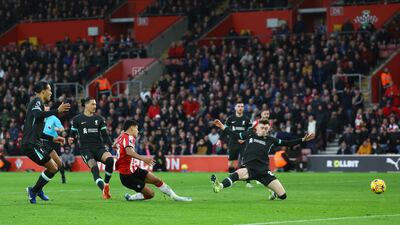
Southampton's Mateus Fernandes scores their second goal. Action Images -
Southampton's Mateus Fernandes celebrates after scoring their second goal. Getty Images -
Southampton's Adam Armstrong scores their first from the penalty spot. AP -
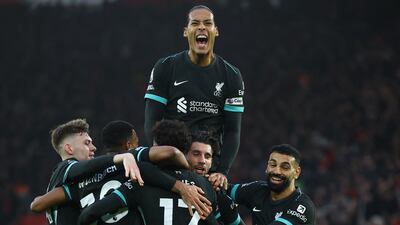
Liverpool's Dominik Szoboszlai celebrates scoring their first goal with teammates. Action Images -
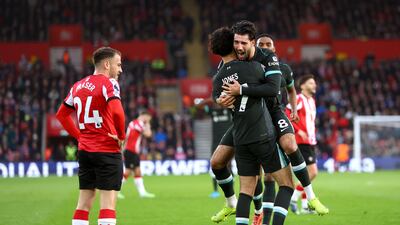
Dominik Szoboszlai of Liverpool celebrates scoring his team's opener with teammate Curtis Jones. Getty Images -
Liverpool's Dominik Szoboszlai scores his team's first goal. AFP -
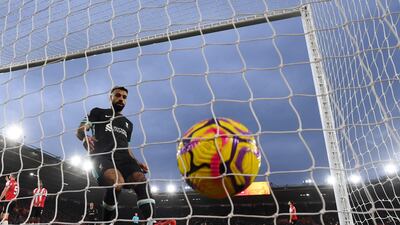
Mohamed Salah goes to collect the ball after making it 2-2 at St Mary's Stadium. AFP -
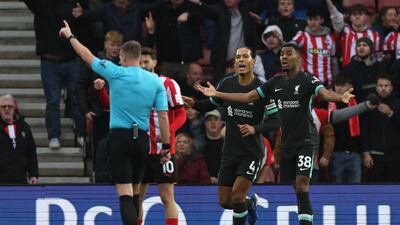
Liverpool's Ryan Gravenberch and Liverpool's Virgil van Dijk appeal to referee Samuel Barrott. Action Images -

Southampton goalkeeper Alex McCarthy makes a save from Liverpool's Conor Bradley. AFP


It's a well-worn line from the Egyptian, used repeatedly over the delay to his previous contract extension at Anfield. That process took more than 12 months to complete and ended with Salah signing a three-year deal in July 2022 worth a basic £350,000 a week.
Salah appears to be relying on that well-rehearsed strategy working for him again in his negotiations over a new contract. And while the groundswell of opinion is firmly on his side for now, that may well be tested if Salah continues to speak to the media after matches in which he portrays himself as the unwanted puppy in the shop window.
Newcastle are next up for the Reds followed by a short trip across Stanley Park to face local rivals Everton on Saturday. It will be the last Merseyside derby at Goodison Park before Everton move to a new stadium next season, saving Salah the trouble of telling everyone it will be his last at the ground.
Salah is free to negotiate with foreign clubs from January 1 as he enters the final months of his contract. There will be no shortage of suitors, with Al Ittihad expected to revive their interest in a player who would only elevate the Saudi Pro League to an even higher level.
His signing, an Arab player and devout Muslim, would eclipse even that of Cristiano Ronaldo, who joined Al Nassr as a free agent in January 2023. Liverpool will hope it doesn't come to that. The conundrum they face is relatively simple while also being entirely complex: Do they pay Salah what he wants or let him walk away for free?
The club are playing a dangerous game of chicken with their star player. Who will blink first?

