

The road along which the Saudi Pro League is speeding is a familiar one; over the past half century the United States, Japan and China have been down this way before. But this time it feels different.
Where the North American Soccer League failed to encourage the majority Stateside to embrace the game in the 1970s, the J.League’s experiment with highly-paid foreigners sowing the seeds for future development continues to pay off handsomely.
It is to China and the country’s boom and subsequent bust that the kingdom’s money-drenched experiment is most often compared as it mirrors the efforts to entice high-profile players, many near the peak of their powers, and for gargantuan sums.
There are plenty of parallels and lessons to be heeded if Saudi Arabia is to avoid a similar fate. Importantly, though, there are reasons to believe the differences between the countries are significant enough that the pitfalls may never arise.
While the ambitions are similar – to establish themselves as global football powers and enhance reputations through success on the field – the two nations start from differing positions.
Saudi Arabia has launched its move while already a member of Asia’s elite, having qualified for six World Cups and winning the Asian Cup on three occasions. The country also has an enviable record in Asian club competitions.
China has a fitful history of success that runs contrary to expectations that a country with such a large population should produce national teams capable of mixing with the game’s best.

But China has a troubled relationship with football. Corruption and poor performances by the national team long ago turned the fan base against the sport, with impatience undermining attempts to climb the Fifa rankings.
Wider government policy, too, has hindered forward momentum, with the long-term damage done by the One Child Policy creating an ageing nation and a populace reluctant to allow their children to commit to much beyond education.
Saudi Arabia does not have those issues, where an already passionate and fertile environment should only encourage greater success.
The story of China’s rise and fall is cautionary nonetheless.
Its genesis lay in the months leading up to Xi Jinping’s ascent to power in 2011 and a declaration made by the president-in-waiting that he wanted China to qualify for the World Cup, host the tournament and, eventually, produce a team capable of winning the title.
That proclamation set private enterprise off on a race to deliver Xi’s dream in the hope there would be positive political repercussions for those who played key roles in making that wish come true.
-
-

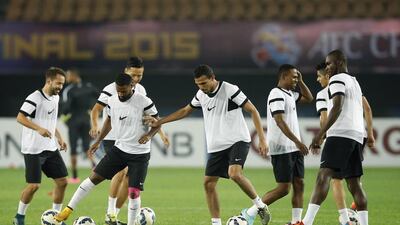
A supporter of UAE's Al-Ahli has colouring applied before the team's AFC Champions League final football match against Guangzhou Evergrande in Guangzhou, in southern China's Guangdong province on November 21, 2015 CHINA OUT AFP PHOTO -
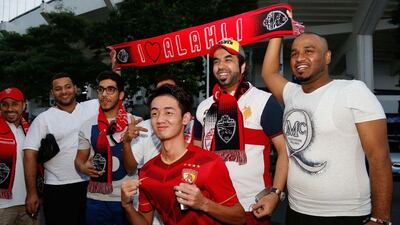
A Guangzhou Evergrande supporter (front) poses with supporters of UAE's Al-Ahli before the AFC Champions League final football match in Guangzhou, in southern China's Guangdong province on November 21, 2015 CHINA OUT AFP PHOTO -

A supporter of UAE's Al-Ahli applies face paint before the team's AFC Champions League final football match against Guangzhou Evergrande in Guangzhou, in southern China's Guangdong province on November 21, 2015 CHINA OUT AFP PHOTO -

A supporter of UAE's Al-Ahli arrives at the venue before the team's AFC Champions League final match against Guangzhou Evergrande in Guangzhou, in southern China's Guangdong province on November 21, 2015 CHINA OUT AFP PHOTO -

A Guangzhou Evergrande supporter puts a Chinese flag on her cheek before the team's AFC Champions League football final against UAE's Al-Ahli in Guangzhou, in southern China's Guangdong province on November 21, 2015 CHINA OUT AFP PHOTO -

A supporter of UAE's Al-Ahli walks outside the venue before the team's AFC Champions League final match against Guangzhou Evergrande in Guangzhou, in southern China's Guangdong province on November 21, 2015 CHINA OUT AFP PHOTO -
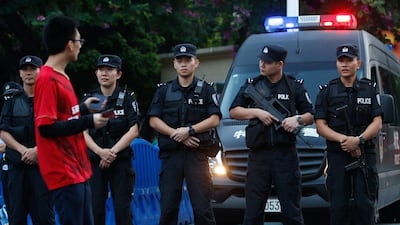
A Guangzhou Evergrande supporter walks past police outside the venue before the team's AFC Champions League football final against UAE's Al-Ahli in Guangzhou, in southern China's Guangdong province on November 21, 2015 CHINA OUT AFP PHOTO


Before long most aspects of Chinese big business were engaging with the game, none more so than the property sector. With access to considerable finance – the vast majority debt-fuelled – developers were quickly involved in a battle to out-spend one another.
After an accelerated build-up, Chinese football’s peak was to last approximately two years.
The summit was reached with Guangzhou Evergrande’s second Asian Champions League title in three years in 2015 under Marcello Lippi and the country remained on top until Shanghai Shenhua agreed in late 2016 to spend £635,000 a week to bring in Carlos Tevez.
From that lofty position Chinese football has fallen into virtual destitution in less than a decade.
China’s response to the Covid-19 pandemic has been blamed, but in truth a slow-motion collapse had already started, with regulatory battles between club owners and the authorities doing significant damage.
As the 2023 Chinese Super League campaign kicked off in April, Lippi and the other high profile coaches, as well as most of the players who had joined during the boom years, were gone.
Guangzhou, the dominant force during the cash-rich era, were relegated a year after owners Evergrande withdrew their funding due to growing concerns surrounding the company’s spiralling debt.
So could something similar happen in Saudi Arabia once the spending frenzy subsides?
Much will depend on how long the political will remains to fund the current spree. Like in China, the Saudi Pro League is unlikely to generate the funds – through broadcast deals and sponsorship – needed by clubs to continue spending at current levels. But with the government, and especially Crown Prince Mohammed bin Salman, leading the charge, the chances of Saudi Arabia following China along a similar downward path are slim.

