
There was a time before the likes of Floyd Mayweather and Manny Pacquiao when the boxing world revolved around a British-Yemeni featherweight.
But Naseem Hamed was no ordinary featherweight. The "Prince" or "Naz", as he was known, served up a potent blend of knockouts, charisma and controversy - all of which has been captured in the new biopic Giant which was released in the UK over the weekend.
The movie, which hits UAE cinemas this Thursday (January 15), stars Amir El Masry as Hamed and Pierce Brosnan as his trainer Brendan Ingle.
It comes more than two decades since Hamed last boxed – he retired at just 28 – but evokes memories of a dazzling career celebrated by the Arab world, cherished in the UK, and lauded by American audiences, who were particularly receptive to his trademark braggadocio.
The son of Yemeni migrants, the Sheffield-born former world featherweight champion was inducted into the International Boxing Hall of Fame in Canastota, New York, in 2014 – perhaps the greatest honour that can be bestowed upon a fighter. It was richly deserved.
Hamed’s career transcended boxing and catapulted a brash and unfathomably cocky young man to global celebrity. Hamed didn’t just shine, he was fluorescent.
Yet, as they say in show business, you must leave them wanting more, and that was the one thing he could not manage. Very few boxers ever do. In fact, it’s hard to think of another example of a solitary defeat proving so ruinous to a fighter’s perception as Hamed’s 2001 loss to a prime Marco Antonio Barrera. Given his extreme bravado, fame and disdain for rivals, perhaps it was inevitable the backlash to his eventual demise would be severe, even if a little unfair.
It arrived in April 2001 after a one-sided and chastening beating at the hands of the Mexican great, himself a recipient of Canastota’s hospitality, but that loss, forever remembered as the night the Prince got his comeuppance, cannot dull the brilliance of what came before.
Hamed, now 51, took up boxing aged just seven when his father, concerned about his diminutive stature, sent him to Ingle’s famed Sheffield gym to learn how to protect himself.
-
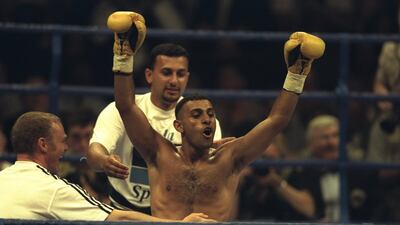
Naseem Hamed celebrates his win over Juan Cabrera of Argentina for the WBO featherweight title at Wembley Arena in 1997. Mark Thompson/Allsport -
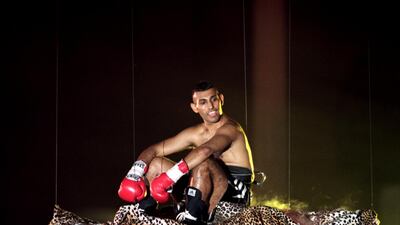
Prince Naseem Hamed enters the ring on a magic carpet to face Vuyani Bungu in 2000. Getty Images -

Prince Naseem Hamed knocks down Kevin Kelley in the third round in New York in 1997. Getty Images -

Featherweight champion Prince Naseem Hamed pounds a heavy bag in preparation for his fight with Mexican fighter Marco Antonio Barrera in 2001. AFP -
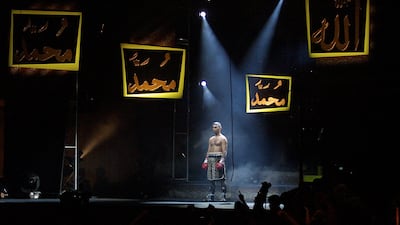
Prince Naseem Hamed appears amid sayings from the Quran prior to his fight against Marco Antonio Barrera at the MGM Grand Casino in Las Vegas. AFP -
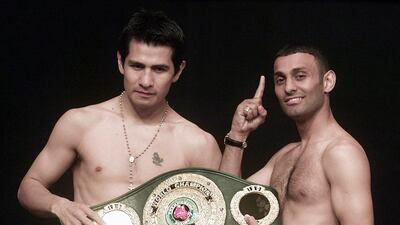
Prince Naseem Hamed, right, from England and Marco Antonio Barrera from Mexico pose with the IBO Featherweight belt following the weigh-in at the MGM Grand Casino in Las Vegas April 6, 2001. AFP -

Marco Antonio Barrera connects with a left against Prince Naseem Hamed. AFP -

Naseem Hamed, left, with promoter Frank Warren, centre, and Ricky Hatton at a press conference in London in 2016. Getty Images


By 12 he enjoyed a national reputation as one of the UK’s top juniors and was already honing his idiosyncratic boxing style. By definition he was a southpaw, although as was the way of Ingle fighters, he would regularly switch stances. Hamed’s style was inimitable: hands low, no conventional defence, almost entirely reliant on reflexes, with a contemptuous regard for traditional techniques.
All of that was offset by spellbinding speed and a freakish punching power that would regularly get him out of trouble.
Hamed threw his shots from absurd angles, comic book uppercuts, an arsenal of punches he described as his “rocket launchers”. Blessed with ambidextrous power, Hamed could knock opponents out with either fist – and knock them out he did.
Ring Magazine ranked him as the 43rd biggest puncher, pound-for-pound, in the history of boxing. Some of his opponents might have him higher.
He finished his 37-fight career with 36 wins, 31 of them by knockout. He picked up the WBO featherweight crown in 1995 and held it for almost seven years. He added the WBC and IBF titles on the way and only politics denied him the opportunity to become the first man to hold all four major belts in a division.
Hamed, who was also considered the lineal champion for three years, retired with a 16-1 record in world title fights, winning 14 of them by knockout.
Detractors point to a lack of depth in his resume, but the likes of Manuel Medina, Tom Johnson, Kevin Kelley, Wilfredo Vazquez, Wayne McCullough, Cesar Soto and Vuyani Bungu were among a list of nine men dispatched by the Prince who at one time or another held a world title.
Hamed felt he was unbeatable and his explosive style, arrogant swagger and taste for flamboyance made him pay-per-view gold. His fights were blockbuster events in the UK, while he successfully transferred his pulling power to the US where HBO gave him a major push.
Although some feel it was the start of his decline, Hamed’s transatlantic debut against Kelley perfectly encapsulated his appeal. He flew to New York aboard Concorde – his arrival announced on a huge billboard in Times Square – and stoked up a media frenzy with a series of incendiary remarks.
His ringwalk on the night lasted around three minutes longer than the fight itself.
Although that was hardly something unusual for Hamed, who four fights later would glide halfway to the ring to face Bungu on a ‘magic carpet’ wired to the ceiling, before jumping off to dance the rest of the way alongside Puff Daddy.
Confidence was never an issue, but it was the chinks emerging in his armour that made the Kelley fight so spectacular.
Rounds where both men score knockdowns are rare. In the four this lasted there were two of them – the second and the fourth – and by the time Hamed scrambled Kelley’s senses for good with a straight left, he himself had hit the Madison Square Garden canvas three times.
During HBO’s live telecast he was described as a “fraud” and “exposed” as his American opponent finished the first round on top, but by the end, colour commentator George Foreman purred as he dubbed him the “Prince of Power” and the “Prince of Entertainment”.
Larry Merchant called it the “Hagler-Hearns of the featherweight division”, and it was later named Ring Magazine’s fight of the year. Naz had arrived stateside – and in a big way.
After Kelley, he continued to win but outside of the ring there were problems as he split from Ingle, who passed away in 2018 aged 77, and his long-term promoter Frank Warren.
The end of the road came against Barrera. Where others feared Hamed’s power, the Mexican was unmoved, and while most were flummoxed by his unorthodoxy, Barrera saw opportunities.
Hamed would fight once more but was never the same and hung up his gloves the following year, three months after his 28th birthday. He had earned big money – Mayweather credits him as the pathfinder for smaller men to earn huge purses – and the hunger for a rebuild wasn't there.
Despite many years away from the public eye, Hamed’s significance to the sport has endured, and he has been a regular face in Saudi Arabia with the kingdom now a destination for big fights.
In 2022, he starred in a promotional video for Anthony Joshua’s rematch with Oleksandr Usyk, his taste for the theatrical as strong as ever, his showmanship unbowed.

