


The Ukrainians are now fighting for their homeland with a bravery, determination and skill which has rightly fired the imagination of a large part of the world.
The West, after a hesitant start, has impressively united to assemble a vast arsenal of sanctions which will over time collapse the Russian economy.
Even if Putin succeeds in subjugating Ukraine by brute force, which is not at this point clear, such subjugation cannot be sustained.
I am confident that in the end Ukraine will emerge as a strong independent nation and in the end, this aggression may well herald the downfall of Putin.
Those Russians with no access to information other than through the state propaganda machine may support his action, but many younger and better informed Russians will regard it as a complete disaster, making the country “a stench in the nostrils” of the world, to use the old Biblical words, and destroying what was left of their ambitions to become properly connected to the global economy.
But the operative phrase is “in the end”.
The question is: how long lasts the agony, how widely stretches the arena of conflict, how much of the world does he pull down around him, as he descends into the abyss.
The danger is that we are witnessing the third incarnation of Putin: first he was the Western-oriented leader I met more than two decades ago, in St Petersburg, wanting to reform Russia; second he became the autocrat, accumulating personal wealth and unfettered power, a Russian nationalist intent on rebuilding the Russian sphere of influence – but though cold-blooded, still calculating.
The anxiety is a third incarnation, Putin detached from reality, and with no one around him prepared to tell him the truth.
I have visited Ukraine at least once a year since 2007, and the Institute has a longstanding project there. Anyone who knows Ukrainians, particularly the young Europe-oriented cadres who represent the country’s future and who are increasingly forming the backbone of its government, knows the idea of them wanting to live under the heel of Putin’s Russia is an absurdity.
-
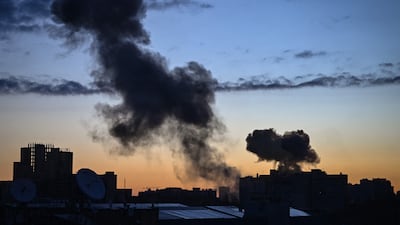
Smoke rising in Kyiv, which mayor Vitali Klitschko says faces a 'difficult and dangerous moment' as Russian forces step up strikes. AFP -

Pope Francis meets visitors holding the Ukrainian flag during his weekly general audience in the Vatican. AFP -

An anti-war protester demonstrates against Russia's invasion of Ukraine in front of the Nato headquarters in Brussels. AFP -
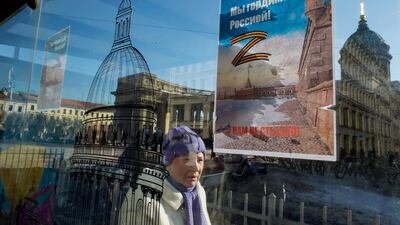
A poster in Saint Petersburg carries the letter Z, a symbol of support for the invasion, and reads: "We are proud of Russia! We are not ashamed!" AFP -

Amid the Ukraine war, there's time for a seaside stroll in Odesa. Reuters -
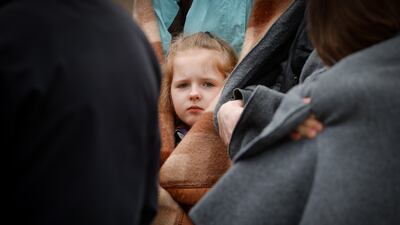
A child who fled from Ukraine to Belgium waits outside an immigration office in Brussels. EPA -
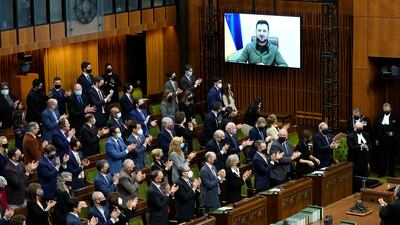
Ukrainian President Volodymyr Zelenskyy receives a standing ovation as he appears via videoconference to make an address to Canada's Parliament. AP -
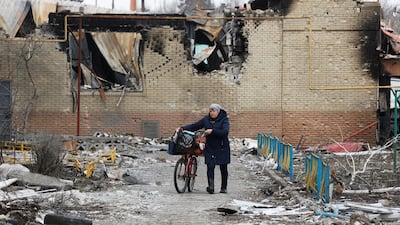
A woman walks with a bicycle next to a building damaged during the conflict in the separatist-controlled town of Volnovakha, Donetsk region. Reuters -
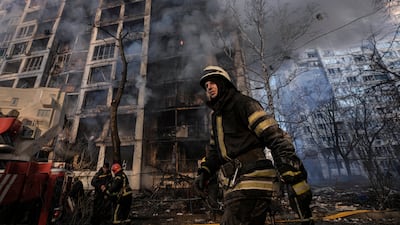
A firefighter outside a destroyed apartment building in a residential area of Kyiv. AP -

Ukrainian soldiers pay tribute to Col Valeriy Gudz, who was killed in battle against Russian troops, at a cemetery in the town of Boryspil. AP -
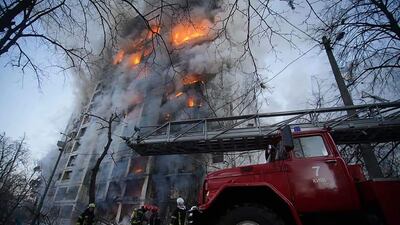
Firefighters work to extinguish a fire in a housing block hit by shelling in the Sviatoshynsky district, in western Kyiv. AFP -
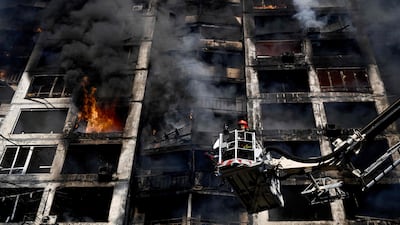
Two people were killed as a series of powerful explosions rocked residential districts in Kyiv just hours before talks between Ukraine and Russia were set to resume. AFP -
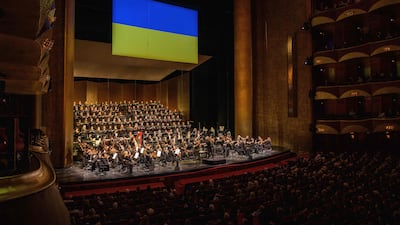
The Met Opera and Chorus performs during 'A Concert For Ukraine' in New York City. AFP -
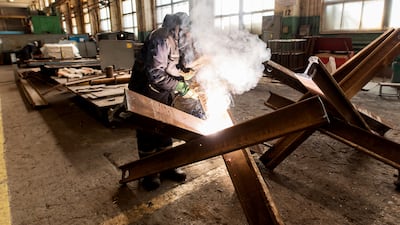
A worker welds metal at the Interpipe Steel plant in Dnipro, Ukraine. Hundreds of Interpipe’s 10,000 employees have joined the fight against Russia. AP -
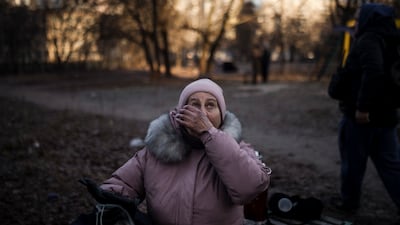
A woman is rescued by firefighters from her apartment in a burning building that was hit by artillery shells in Kyiv. AP -

Rescuers work at a building damaged by an air strike, in central Kharkiv, Ukraine. Reuters -
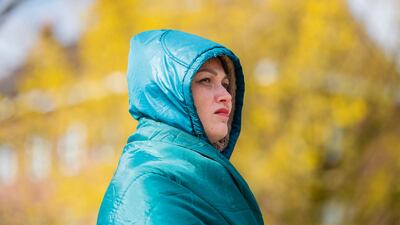
A woman who fled Ukraine to Belgium waits outside an immigration office, in Brussels. EPA -
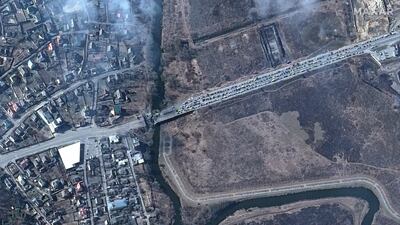
Cars stuck at the Irpin River bridge, as Russia unleashes a barrage of air strikes on cities across Ukraine. AFP -
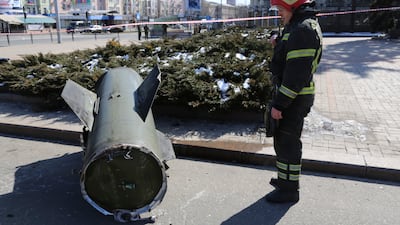
A firefighter looks at a section of a Ukrainian Tochka-U missile on a street in the separatist Donetsk region. The Russian military said 20 civilians were killed by a ballistic missile launched by the Ukrainian forces. AP -
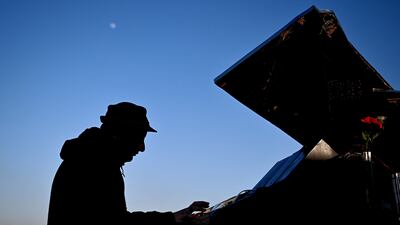
Musician Davide Martello plays a piano near the Ukrainian border in Medyka, Poland. More than 1.76 million people have crossed the Polish-Ukrainian border into Poland, the Polish Border Guard reported on March 14. EPA -
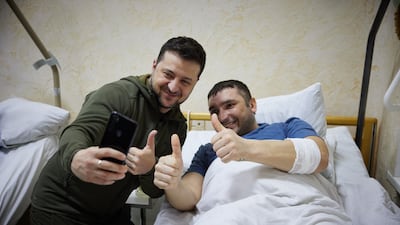
Ukrainian President Volodymyr Zelenskyy, left, snaps a selfie with a wounded man during a visit at a military hospital after fighting in the Kyiv region.AFP -
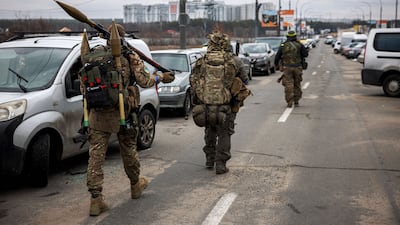
Ukrainian soldiers carry rocket-propelled grenades and sniper rifles as they walk towards the city of Irpin, north-west of Kyiv. AFP -

Troops carry an elderly woman on a stretcher across a makeshift bridge as Ukrainians flee Irpin. AFP -
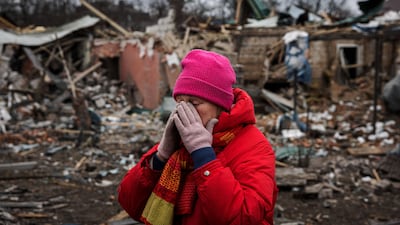
Irina Moprezova, 54, stands in front of a house that was damaged by an air strike in Irpin. AFP -
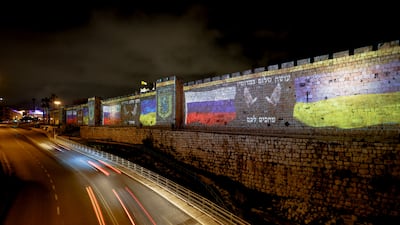
The flags of Russia and Ukraine are projected on the walls of Jerusalem's Old City, which a representative from the Jerusalem Municipality said is a show of support for diplomatic dialogue between the countries. Reuters -
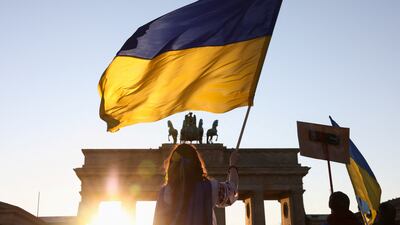
A person holds a Ukrainian flag during an anti-war demonstration at the Brandenburg Gate in Berlin, Germany. Reuters -
A Ukrainian soldier takes cover as people flee Irpin. AFP -

Ukrainians shelter in an underground train station during the day in Kyiv. EPA -
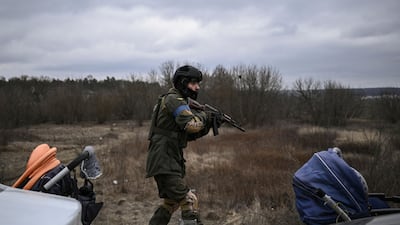
A Ukrainian serviceman walks carefully with his weapon in the city of Irpin, near Kyiv. AFP -
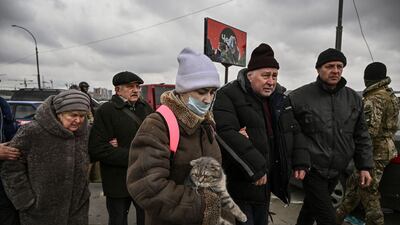
Ukrainian people flee the city of Irpin, north-west of Kyiv. AFP -
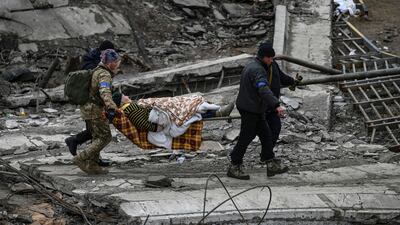
Ukrainian servicemen carry an elderly woman on a stretcher from the city of Irpin. AFP -
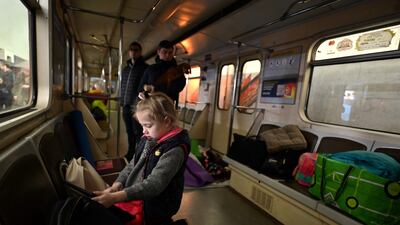
A girl plays games on her tablet inside a subway carriage being used as a bomb shelter in Kyiv. AFP -
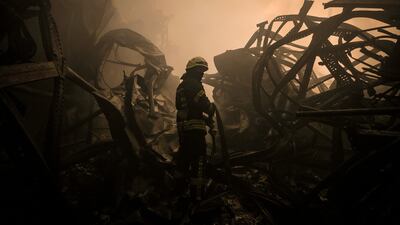
A Ukrainian firefighter drags a hose inside a large food products storage facility which was destroyed by an air strike on the outskirts of Kyiv. AP -

Ukrainian troops with a Javelin anti-tank missile on the front line in the northern Kyiv region. Reuters -
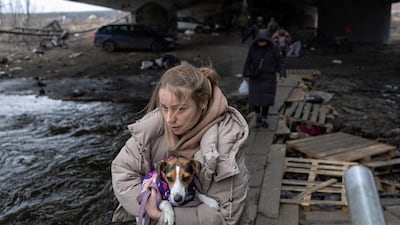
A woman carries her dog during an evacuation in Irpin. Reuters -
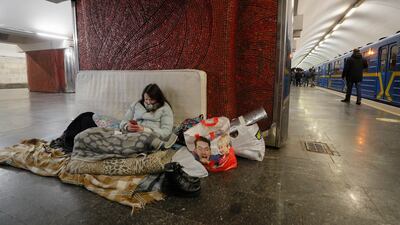
A Ukrainian woman takes shelter in a metro station during the day in Kyiv. EPA -
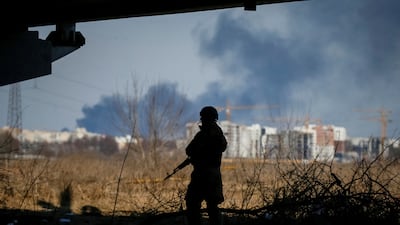
A member of the Ukrainian armed forces on patrol in Irpin. Reuters -

A Ukrainian fighter takes cover behind a car in the city of Irpin. AFP -
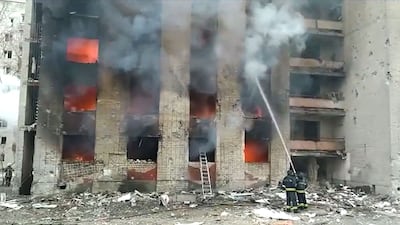
Firefighters at work after air strikes hit residential buildings in Chernihiv, northern Ukraine. AFP -
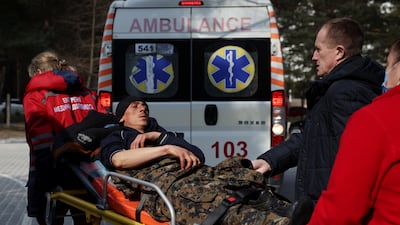
A man wounded in an air strike is helped by medical staff in Novoiavorivsk, western Ukraine. Getty -
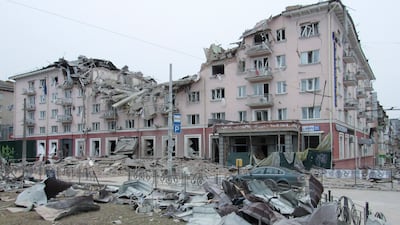
The ruins of the Ukraine Hotel after recent shelling in Chernihiv. EPA


They say they will fight to the last drop of blood and they mean it.
The question to which no one knows the answer is: to what extent does Putin retain some ability to conduct policy rationally?
Is there method in what to many seems madness? Has he launched this war to extract concessions, in respect of Ukraine’s future or its territory, or does he seriously believe he can govern a nation of 45 million people against their will, when even in Kharkiv he has faced bitter resistance, and has lost in four weeks a third to a quarter of the troops the Soviet Union lost in the ten years of occupying Afghanistan?
Comparisons with the second world war are easy to make. Put the television pictures in black and white and they could be from the 1940s.
But the differences are more important. Hitler led a Europe-wide fascist movement. Putin’s war is a one-man mission. More significant, Britain and the USA committed armed force to destroy Hitler. We have not made that commitment in respect of Putin. Indeed, we have gone out of our way to eschew it. The fighting will be done by Ukrainians.
And if the Russian army – for sure underperforming and as it turns out badly trained – uses its full military might, it will be tough for Ukraine to prevail in the short term, at least without terrible loss of life.
The West therefore needs a two-pronged strategy: ratchet up maximum pressure; and, at the same time, push for negotiation.
The pressure should be stated and clear. We knew for months this aggression was being planned. I favoured before the invasion a NATO conference held in person in Eastern Europe led by the president of the United states, which would have detailed all the different measures we would take if the invasion happened. It may be that nothing would have deterred Putin, but the toughest measures came after the invasion, and therefore had a punitive but not deterrent effect.

We should lay out now the further measures we will take in the event of escalation, and these should include:
- Further economic sanctions and complete ostracisation from the international financial community.
- An adjustment in our energy mix, which allows us credibly to relieve Europe of dependence on Russian gas and oil faster, and to allow us to ban or levy a punitive tax on Russian exports. We will need changes in European and American policy around fossil-fuel extraction, nuclear and even the temporary use of coal.
- A warning to Belarus, whose people do not support Putin’s actions, that it will pay a heavy price if it enters the war.
- Above all, the supply of weapons to Ukraine – particularly an uplift in surface-to-air missile (SAM) capacity and a commitment that arming Ukraine will be ongoing and will cover the full range of its needed capabilities.
I understand and accept that there is not political support for any direct military engagement by NATO of Russia. But we should be clear-eyed about what Putin is doing. He is using our correct desire not to provoke escalation alongside his willingness to escalate as a bargaining chip against us. When he is threatening NATO, even stoking fears of nuclear conflict, in pursuit of his attempt to topple by force a peaceful nation’s democratically elected president and wage war on its people, there is something incongruous about our repeated reassurance to him that we will not react with force.
I accept the reasoning behind our stance. But suppose he uses chemical weapons or a tactical nuclear weapon, or tries to destroy Kyiv as he did Aleppo in Syria, without any regard to the loss of civilian life – is it sensible to tell him in advance that whatever he does militarily, we will rule out any form of military response? Maybe that is our position and maybe that is the right position, but continually signalling it, and removing doubt in his mind, is a strange tactic.
This posture underlines the importance of the other prong of the strategy: a concerted and structured push for a negotiated settlement.
There will be those who say, rightly, that Putin deserves nothing but total defeat.
But the burden of this struggle is being borne by Ukrainians, not by us.
And the long-term punishment for Putin will rest not only on sanctions, but on the voluntary dissociation from Russia – country and corporate – which will not end until the end of his rule.
The next two weeks may be the last chance to achieve a negotiated settlement before the assault on Kyiv becomes worse, the Ukrainian people become hostile to any negotiation, or Putin faces a binary choice between “double down” or retreat.
And we should not underestimate the real economic price the world will pay for continued conflict with steep rises in fuel prices, food prices, global trade and inflation, as ever hitting the poorest in our society the worst.
The representatives of Ukraine and Russia are meeting. Israel and Turkey have been trying to mediate. The United States and China are in discussion. Chancellor Scholz and President Macron have directly engaged Putin.
But it appears quite ad hoc.
The president of Ukraine has rightly kept open a negotiated agreement. For the people of Ukraine that is the only alternative to a bitter, bloody and protracted guerrilla war.
We know Putin’s stated issues:
- NATO vs neutrality
- The stationing of offensive Western weapons systems in Ukraine
- Crimea
- The eastern regions of Donetsk and Luhansk
On the first two a deal is conceivable, though Ukraine would require binding guarantees from the West to contemplate giving up on NATO membership, and it will not yield on potential EU membership.
On the second two it may be possible to construct a process by which eventually their status will be decided, provided Putin doesn’t add a demand to keep the territory he is currently taking with considerable brutality in the corridor between Rostov and Odessa, a demand Ukraine could never accede to.
The final decision in any negotiation rests with Ukraine.
And we must not let this slip into another frozen conflict open to exploitation by Putin, as happened after 2014.
Ukraine will also need a Marshall Plan-type reconstruction.
All the various initiatives for peace need to be aligned, with Europe and the United States standing behind Ukraine in a structured negotiation which continues until agreement is reached or is clearly unreachable.
Ultimately, Europe and the United States will need to think through new security arrangements for Europe, the region and with Russia, as we had with the Soviet Union.

