Unity is key to a healthy and thriving community. Each of us has a part to play to ensure a cohesive and tolerant society that offers support to all of its members. But this goes beyond the individual; both public and private sector organisations have an important responsibility towards society, particularly during times of uncertainty. Tasked with safeguarding communities’ social ecosystems, they must aid in fostering solidarity and compassion while maintaining calm, and propagating optimism, which is crucial to boosting the morale of a public facing unprecedented circumstances.
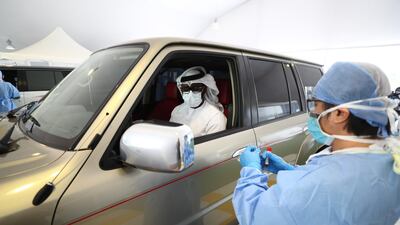
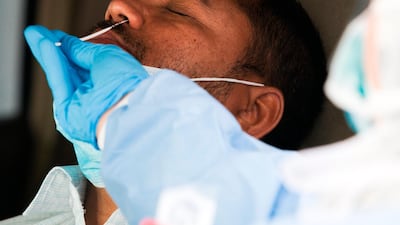
A health worker takes swab sample at a coronavirus drive-through screening centre in Abu Dhabi.
A health worker collects a swab sample.
A health worker wearing protective clothing administers a swab test.
A woman undergoes a nasal swab.
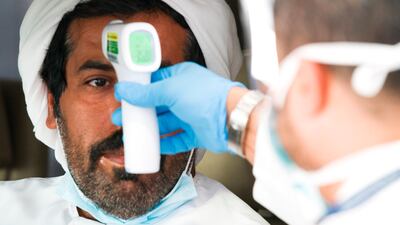
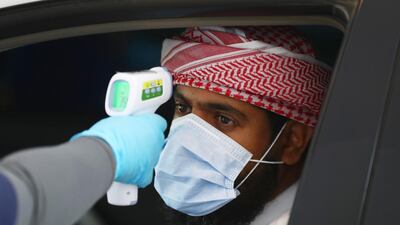
A health worker checks a man's temperature before conducting a coronavirus test at a drive-through testing centre.
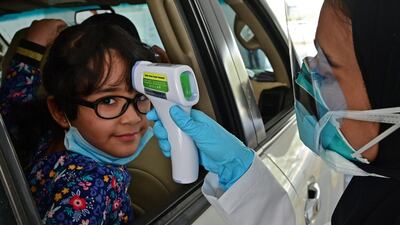
A nurse measures the body temperature of a small girl.
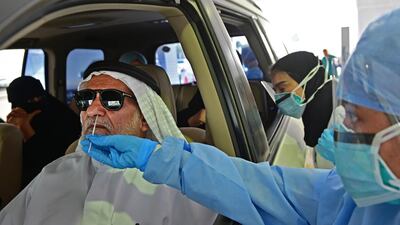
A nurse collects a swab sample at the drive-through centre.
A man has his temperature checked.
A nurse administers a swab test.
A technician takes a nasal swab.
Cars line up as people wait to enter the drive-through testing centre.
Today, we are facing a global health crisis that has affected all aspects of life. Covid-19 has indeed changed the world as we know it, but it is a challenge that we will surmount no matter how long it lasts. The key to overcoming it is a unified effort from both individuals and institutions. Working together to limit the impact of this disease will accelerate our recovery and eventually allow us to resume normal life.
Time and time again, the UAE has proved its readiness to face crises and their adverse effects head-on. The World Health Organisation has, in fact, ranked the UAE number one globally in the prevention of the spread of Covid-19, thanks to our wise leadership’s prompt response and implementation of strict precautionary measures. Moreover, the UAE community has risen to the challenge by strongly adhering to these measures, which include the Stay at Home initiative, guidelines for social distancing, and instructions to stay indoors during times allocated for the National Sterilisation Programme.
Covid-19 has changed the world as we know it, but we will surmount the challenge, no matter how long it lasts
Particularly praiseworthy are the extraordinary efforts of the UAE’s medical and healthcare staff. They have diligently worked around the clock to help contain the Covid-19 outbreak, and their heroism has contributed significantly to limiting the number of cases in the country. We could not be more grateful for their skills and sacrifices, as they bravely stand at the frontlines of the battle with the virus, risking their own safety for the well-being of our community.
A berry picker at the UAE’s first raspberry and blackberry model farm in full sanitary uniform. Victor Besa for The National
That well-being is also safeguarded by the collaboration between the teams from the public security, civil and service entities, to whom we also owe our gratitude. Additionally, essential staff in restaurants, supermarkets, pharmacies, delivery workers, and those carrying out cleaning and sterilisation across the emirate must be commended for helping to keep society functioning during this difficult time. And finally, we thank all those who are working from home; this small act is a crucial step in dampening the spread of this global pandemic.
The measures taken by the UAE are bold, but they reflect the wisdom and unwavering commitment of our leadership to protect its greatest asset – its people – at all times. This social contract is seen across Emirati society, which is characterised by unity and tolerance towards others. Our cultural pillars are the legacy of our ancestors, who adapted to survive the harshest of circumstances thanks to co-operation and strong social bonds. Due to this longstanding commitment to the greater good, in the present circumstances we are proud to see community members demonstrating their support and abiding by all the measures introduced to combat the outbreak.
Part of keeping the community safe and well is ensuring economic security. Abu Dhabi’s leadership has taken the necessary steps to support those who have been adversely affected financially by the current circumstances. Key is the economic stimulus programme launched by Sheikh Mohamed bin Zayed, Crown Prince of Abu Dhabi and Deputy Supreme Commander of the UAE Armed Forces, to accelerate the implementation of key economic initiatives under the Ghadan 21 programme. There have also been reductions in living costs and measures to facilitate business activity within the emirate. These incentives will help to mitigate economic damage and eventually contribute to accelerating growth, the fruits of which we will see once we emerge even stronger from this crisis.
In March, Sheikh Mohamed bin Zayed, Crown Prince of Abu Dhabi and Deputy Supreme Commander of the UAE Armed Forces, reassured UAE residents and citizens that there will be adequate supplies of medicine and food available during the coronavirus outbreak. Courtesy: Sheikh Mohamed bin Zayed Twitter account
The Department of Culture and Tourism is appreciative of the co-operation we have received from our partners, particularly hotel establishments, tourism facilities and event organisers. While their businesses have been affected by the crisis, we are working closely with their management to ensure the safety and well-being of visitors. Our inspectors are liaising with all partners to ensure strict implementation of the necessary precautionary measures. I would like to commend the efforts of our inspectors and thank them for all their strenuous field work at this critical time.
It is when facing such challenging circumstances that we most need to stand united. We will beat this pandemic by standing together and committing to following the directives of our wise leaders. Each one of us is responsible for protecting the health of others, and our sacrifices during this crucial period will help to ensure our own safety and that of our community. We must contain the spread of the virus by staying home as much as possible, and complying with social distancing in its various forms. Equally as important, we must remain positive. Although it may seem difficult at the moment, being optimistic is key. As long as we support one another, safeguard our bonds and help those who are suffering the adverse effects of these sudden changes in our lives, we will triumph.
Mohamed Khalifa Al Mubarak is Chairman of the Department of Culture and Tourism – Abu Dhabi

The bio
Favourite book: Peter Rabbit. I used to read it to my three children and still read it myself. If I am feeling down it brings back good memories.
Best thing about your job: Getting to help people. My mum always told me never to pass up an opportunity to do a good deed.
Best part of life in the UAE: The weather. The constant sunshine is amazing and there is always something to do, you have so many options when it comes to how to spend your day.
Favourite holiday destination: Malaysia. I went there for my honeymoon and ended up volunteering to teach local children for a few hours each day. It is such a special place and I plan to retire there one day.
A widely accepted definition was made by the All Party Parliamentary Group on British Muslims in 2019: “Islamophobia is rooted in racism and is a type of racism that targets expressions of Muslimness or perceived Muslimness.” It further defines it as “inciting hatred or violence against Muslims”.
Brief scores:
Everton 0
Leicester City 1
Vardy 58'
'The worst thing you can eat'
Trans fat is typically found in fried and baked goods, but you may be consuming more than you think.
Powdered coffee creamer, microwave popcorn and virtually anything processed with a crust is likely to contain it, as this guide from Mayo Clinic outlines:
Baked goods - Most cakes, cookies, pie crusts and crackers contain shortening, which is usually made from partially hydrogenated vegetable oil. Ready-made frosting is another source of trans fat.
Snacks - Potato, corn and tortilla chips often contain trans fat. And while popcorn can be a healthy snack, many types of packaged or microwave popcorn use trans fat to help cook or flavour the popcorn.
Fried food - Foods that require deep frying — french fries, doughnuts and fried chicken — can contain trans fat from the oil used in the cooking process.
Refrigerator dough - Products such as canned biscuits and cinnamon rolls often contain trans fat, as do frozen pizza crusts.
Creamer and margarine - Nondairy coffee creamer and stick margarines also may contain partially hydrogenated vegetable oils.
1. Domestic VAT refund amendments: request your refund within five years
If a business does not apply for the refund on time, they lose their credit.
2. E-invoicing in the UAE
Businesses should continue preparing for the implementation of e-invoicing in the UAE, with 2026 a preparation and transition period ahead of phased mandatory adoption.
3. More tax audits
Tax authorities are increasingly using data already available across multiple filings to identify audit risks.
4. More beneficial VAT and excise tax penalty regime
Tax disputes are expected to become more frequent and more structured, with clearer administrative objection and appeal processes. The UAE has adopted a new penalty regime for VAT and excise disputes, which now mirrors the penalty regime for corporate tax.
5. Greater emphasis on statutory audit
There is a greater need for the accuracy of financial statements. The International Financial Reporting Standards standards need to be strictly adhered to and, as a result, the quality of the audits will need to increase.
6. Further transfer pricing enforcement
Transfer pricing enforcement, which refers to the practice of establishing prices for internal transactions between related entities, is expected to broaden in scope. The UAE will shortly open the possibility to negotiate advance pricing agreements, or essentially rulings for transfer pricing purposes.
7. Limited time periods for audits
Recent amendments also introduce a default five-year limitation period for tax audits and assessments, subject to specific statutory exceptions. While the standard audit and assessment period is five years, this may be extended to up to 15 years in cases involving fraud or tax evasion.
8. Pillar 2 implementation
Many multinational groups will begin to feel the practical effect of the Domestic Minimum Top-Up Tax (DMTT), the UAE's implementation of the OECD’s global minimum tax under Pillar 2. While the rules apply for financial years starting on or after January 1, 2025, it is 2026 that marks the transition to an operational phase.
9. Reduced compliance obligations for imported goods and services
Businesses that apply the reverse-charge mechanism for VAT purposes in the UAE may benefit from reduced compliance obligations.
10. Substance and CbC reporting focus
Tax authorities are expected to continue strengthening the enforcement of economic substance and Country-by-Country (CbC) reporting frameworks. In the UAE, these regimes are increasingly being used as risk-assessment tools, providing tax authorities with a comprehensive view of multinational groups’ global footprints and enabling them to assess whether profits are aligned with real economic activity.
Contributed by Thomas Vanhee and Hend Rashwan, Aurifer
Red cards: Joao Moutinho (Wolves); Douglas Luiz (Aston Villa)
Man of the match: Emi Martinez (Aston Villa)
Top 5 concerns globally:
1. Unemployment
2. Spread of infectious diseases
3. Fiscal crises
4. Cyber attacks
5. Profound social instability
Top 5 concerns in the Mena region
1. Energy price shock
2. Fiscal crises
3. Spread of infectious diseases
4. Unmanageable inflation
5. Cyber attacks
Source: World Economic Foundation
The specs
Engine: 3.9-litre twin-turbo V8
Power: 640hp
Torque: 760nm
On sale: 2026
Price: Not announced yet
Teams
India (playing XI): Virat Kohli (c), Ajinkya Rahane, Rohit Sharma, Mayank Agarwal, Cheteshwar Pujara, Hanuma Vihari, Ravichandran Ashwin, Ravindra Jadeja, Wriddhiman Saha (wk), Ishant Sharma, Mohammed Shami
South Africa (squad): Faf du Plessis (c), Temba Bavuma, Theunis de Bruyn, Quinton de Kock, Dean Elgar, Zubayr Hamza, Keshav Maharaj, Aiden Markram, Senuran Muthusamy, Lungi Ngidi, Anrich Nortje, Vernon Philander, Dane Piedt, Kagiso Rabada, Rudi Second
The government has taken an increasingly tough line against companies that fail to pay employees on time. Three years ago, the Cabinet passed a decree allowing the government to halt the granting of work permits to companies with wage backlogs.
If wages are 10 days late, the new measures kick in and the company is alerted it is in breach of labour rules. If wages remain unpaid for a total of 16 days, the authorities can cancel work permits, effectively shutting off operations. Fines of up to Dh5,000 per unpaid employee follow after 60 days.
Despite those measures, late payments remain an issue, particularly in the construction sector. Smaller contractors, such as electrical, plumbing and fit-out businesses, often blame the bigger companies that hire them for wages being late.
The authorities have urged employees to report their companies at the labour ministry or Tawafuq service centres — there are 15 in Abu Dhabi.