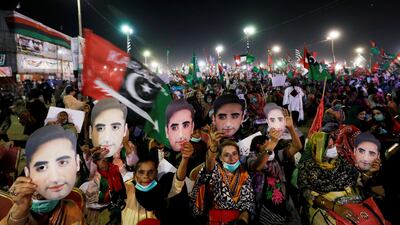

You might be forgiven for overlooking the emergence of the Pakistan Democratic Movement (PDM) in September, and the kick-off of its country-wide campaign a little over a week ago. Pakistan regularly sees new opposition movements led by familiar old faces, who embark on a "long march" to Islamabad hoping to achieve on the streets what they could not do at the ballot box. There are stirring declarations about the will of the people, often accompanied by coded appeals to the army's headquarters in Rawalpindi to step in on their behalf.
But every now and then, these "movements" turn into something much bigger: genuine mass mobilisations that force the entire political system to reboot itself. It is yet to be seen if the PDM will achieve its lofty goal of getting the military out of politics. But there are good reasons to think that it stands a chance of eventually easing mounting pressures on political and civic life.
Imran Khan's Pakistan Tehrik-e-Insaf (PTI) party formed the government in 2018, after what was seen in many quarters as a "judicial coup" that resulted in the electoral disqualification, imprisonment and exile of three-time prime minister Nawaz Sharif. The decisive tilt of the Pakistan Army leadership towards the PTI, and its effect on the ability of other parties – especially the Pakistan Muslim League (Nawaz) – to campaign in the 2018 general election led to the claim that Mr Khan was selected rather than elected.

The remarkable number of ministers in Mr Khan's Cabinet (12 out of 21) who had served under Gen Pervez Musharraf’s military government has made such allegations of military favouritism more prevalent. Meanwhile, retired and serving military personnel steadily took over a broader range of roles to "advise" the government on everything from media management to external investment in national infrastructure.
Many Pakistanis did not care about any of this. Mr Khan’s personal charisma and promises of transformative change struck a real chord within them, especially young people hungry for opportunity. But two years later, while the Prime Minister remains personally popular, there is no sign of the change that had been so emphatically promised.
Instead, the economy struggled even before the coronavirus pandemic struck. Government spending on services plummeted, while the cost of living soared. Covid-19 has bought some time with creditors, but the underlying problems remain.
Mr Khan’s alliance with the military and special economic interests limits his space for fiscal manoeuvre. While the enormous defence budget remains ring-fenced, there are signs that the government is turning on agro-business cartels, such as those led by sugar baron and former PTI secretary general Jahangir Tareen. This of course comes with significant political risks to the party’s unity and financial health, and it remains to be seen if the government will see such steps through.
The country’s material woes have been accompanied by growing restrictions on traditional media and social media that are affecting the Punjabi heartland in ways that were once only felt in the Pashtun and Baloch borderlands. This is one realm where the civil-military partnership between the Prime Minister and Chief of Army Staff, Gen Qamar Bajwa, has worked exceptionally well. But tightening the lid has only worsened the pressure cooker-like conditions across the country.

There are several warning signs that the PDM is not politics as usual. One is the size and diversity of the opposition coalition. The Pakistan People's Party (PPP) is currently facing the same treatment as the PML-N, with charges brought against its leader, Asif Ali Zardari, who presided over the country's return to democracy in 2008 following seven years of Gen Musharraf's rule. Many parties fear their turn is next, unless they band together.
As a result, the PDM now includes 11 parties, ranging from the PML-N with its strong base in Punjab; its long-time rivals, the PPP, that continues to dominate Sindh; religious parties of multiple denominations; ethnic Baloch nationalists; and Pashtun nationalist parties from Khyber-Pakhtunkhwa and Balochistan. The sheer variety of ethnicities and ideologies is remarkable, and an indication of the breadth of dissatisfaction with the status quo.
Another wake-up call for the authorities is the armies of supporters that the PDM is drawing on from beyond the formal political sphere. One of the co-sponsors of the all-party conference that led to the PDM’s formation is the Pakistan Bar Council, a statutory body with deep ties to the higher judiciary. It’s worth remembering that Pakistan’s lawyers led the 2008 movement that brought an end to Gen Musharraf’s rule.
The PDM has also made a strategic choice in electing Maulana Fazlur Rahman, the head of the Jamiat Ulema-e-Islam, as its overall leader. He has a long history of resisting Pakistan’s military rulers, but just as importantly, his religious affiliations mean that the PDM can bring thousands of students from the country’s largest madrassa network onto the streets across the country.
Each of these groups is powerful enough that the police would think twice before employing lethal force against them. When the lawyers and the madrassa students come out together, ordinary unhappy citizens are much more likely to feel safe to do so as well. And when ordinary people come out in numbers in Punjab – Pakistan’s most populous and privileged province – even the army hesitates.
Perhaps this is why Gen Bajwa's response to the PDM has been so low-key so far. This is despite the fact that PDM leaders have openly stated that they consider him the country's real ruler, and presumably as much of a target as Mr Khan. But experience has taught Pakistanis not to take anything at face value.

The country’s opposition movements have a long history of striking side deals with the military that, for its own part, has an equally long history of betting on more than one horse to maximise its leverage. It is entirely possible, for example, that the PDM could quietly change its tune if the army allows a return to "normal" politics, or simply stops protecting Mr Khan. While this may not be the dramatic denouement that democracy activists hope for, it would still be highly significant.
The turn-outs at the first three rallies have been sizable, and the campaign is currently slated to continue through to December, setting the stage for Senate elections in March 2021. It is simply too early to say what will happen next year, or who will blink first in the confrontations to come. In a country as complicated as Pakistan, little is preordained and even the most powerful must grope their way forward, one day at a time.
Johann Chacko is a writer and South Asia analyst

