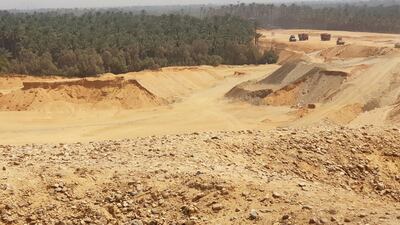
Water scarcity is a subject that has been given enough attention in the Mena region, where it is a serious problem. Its availability has always been a concern, particularly in the Arab world, whose population of more than 360 million people suffers from one of the lowest levels of available fresh water in the world, both on an absolute and per capita basis. As a report published last year by the UN Economic and Social Commission for Western Asia (Unescwa) put it, the region's people live "in conditions that range from water scarcity to absolute scarcity".
Of the 17 most water-stressed countries, 12 are located in Mena, according to the World Resource Institute. The World Bank estimates that climate-related water scarcity will cost the region 6 to 14 per cent of its GDP by 2050, with 70 per cent of the region's GDP exposed to "high or very high water stress".
-
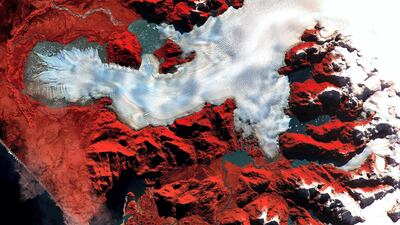
An image captured by Nasa's Terra satellite on May 2, 2000, shows the North Patagonia Ice Sheet in Chile. A single large glacier covered with crevasses is visible, while a semi-circular terminal moraine indicates that the glacier was once more extensive. Nasa -

A firefighter drags a hose closer to battle a grass fire in Knightsen, California. -
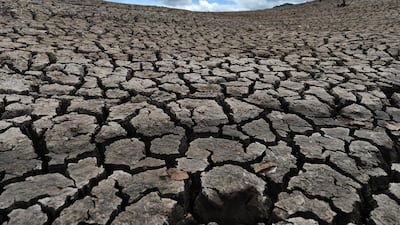
La Concepcion reservoir, which supplies 30 per cent of the Honduran capital of Tegucigalpa, during a severe drought caused by climate change. AFP -
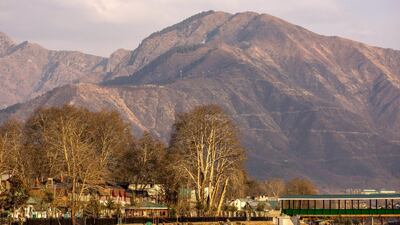
A view of mountains that used to be covered by snow, during a warm winter day in Srinagar, the summer capital of Indian-administered Kashmir. Getty -
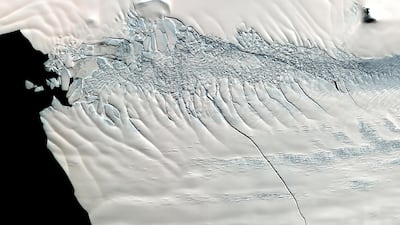
An image captured from Nasa's Terra spacecraft shows a vast crack across the Pine Island Glacier, a major ice stream that drains the West Antarctic Ice Sheet. Eventually, the crack will extend all the way across the glacier. -
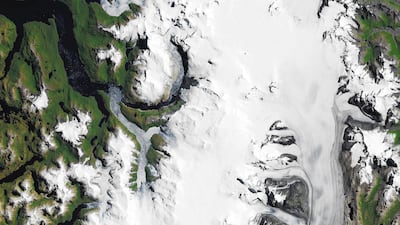
In this Landsat 8 image, glacial retreat is revealed in the rugged wilderness region of Patagonia, site of the largest contiguous areas of ice cover outside Antarctica. USGS -
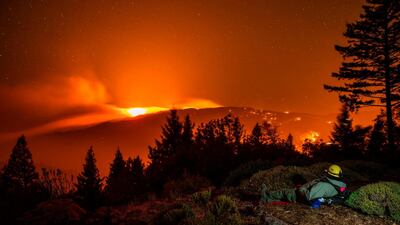
Destructive fires have raged in California and strong winds could spark new blazes. AFP -
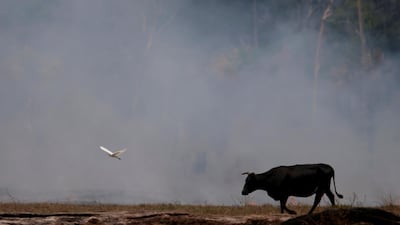
A bird flies next to an ox walking on a smouldering field after a fire burnt a tract of the Amazon rainforest as it was cleared by farmers in Brazil. Reuters -
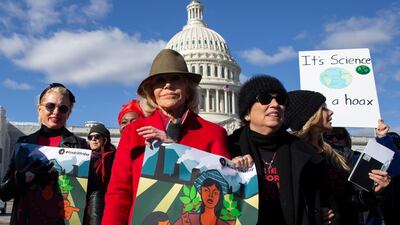
US actress Jane Fonda, centre, participates in a climate change protest before being arrested by US Capitol Police in Washington. EPA -
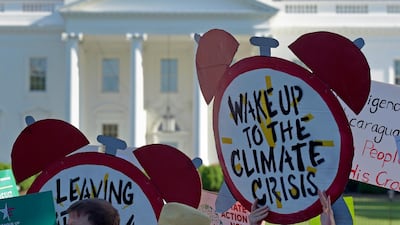
Protesters gather outside the White House in Washington to protest against Donald Trump's decision to withdraw the US from the Paris climate change accord. AP


Although the economic, health and social impacts of Covid-19 have attracted much attention, in the background concern over water resources has been rising. Each country in the region is facing its own water challenges but more recently, a variety of factors have exacerbated them. As Unescwa notes, these include a reliance on shared water resources across countries (many of which already find it difficult to co-operate across their borders), occupation and conflict affecting people’s ability to access water and sanitation services, global warming and related extreme weather, pollution, ageing infrastructure, inefficient water usage and high population growth rates.
Only two per cent of the Arab region is covered by wetlands, and 94 per cent of those are vulnerable to climate change. This makes coping with future water demands critical for the region’s well-being. Climate change may be a global threat, but its impact in Mena is particularly severe. Climate-induced water challenges in an already arid region require immediate attention. And although shortages of water are not new, the ever-increasing demand for it, coupled with the impacts of climate change, is exacerbating pressure on this vital resource.

The compounding effects of erratic rainfall, rapid urbanisation, rising desertification and increased risk of droughts will worsen water scarcity. Earlier this year, several countries in the region were hit by storms. In Cairo, unseasonally heavy rainfall and widespread flooding left many urban areas struggling to access potable water for a month. And in other parts of the region, more frequent droughts caused by climatic scenarios are expected to result in increases in soil and ground water salinity.
The need to prepare for future severe-weather events caused by climate change to achieve water security in the region is key.
Beyond its environmental effects, however, continued water scarcity could have several negative social and economic implications. Climate change will be a significant factor in forced human migration, in large part because of the water scarcity. And as the shortage becomes more acute, so does the risk of water-related disputes. Globally, tension is building over increasing competition for resources. Researchers anticipate that this will heighten the risk of future armed conflict.

Already, must work has been done by researchers about the role of water scarcity in igniting the Syrian civil war and fuelling armed conflict in Yemen. Now, in eastern Africa, relations between Egypt and Ethiopia have become increasingly heated over a major dam project that is centred on management of the region's water resources.
Water scarcity has also been found to be among the root causes of migration. By 2050, it's estimated that between 150 to 200 million people could be displaced because of climate-related factors such as desertification, sea level rises and increased extreme weather events. It is anticipated that the two major migration tracks will run through Mena and South Asia, according to a new report released by the Institute of Economics and Peace. A global water problem is looming and the Middle East is not immune to it.
While regional co-operation has long been a work in progress in the Arab world, most Arab states are nonetheless highly interdependent, especially when it comes to water. They rely on surface and groundwater reservoirs that straddle their borders, so moving towards a regional approach to combat water scarcity and enhancing water governance is more important than ever. As with any shared problem, facing the challenge requires shared solutions.
The fragility highlighted by the pandemic and the interconnected risks of water scarcity requires renewed political will and a blend of solutions to ensure the region is able to meet its water needs in the future.
Maram Ahmed is a Senior Fellow at Soas, University of London