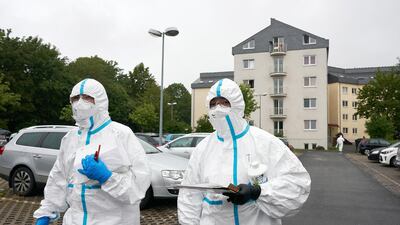
Emergency personnel in protective clothing stand in front of a student dormitory in Koblenz, Germany last week. At one point during the Covid-19 crisis, there was a shortage of PPE in Germany. AP Photo
Emergency personnel in protective clothing stand in front of a student dormitory in Koblenz, Germany last week. At one point during the Covid-19 crisis, there was a shortage of PPE in Germany. AP Phot

In the post-pandemic world, countries will prioritise resilience over trade-off vulnerabilities


  • English
  • Arabic

Among the group of countries to have handled the coronavirus pandemic well so far is Germany. Yet the height of the health crisis has exposed some painful lessons for Europe's biggest country. Berlin has held the line against the spread of infections but coping with the complex challenge has not been foregone.

Last week the Health Minister Jens Spahn revealed that at the height of the crisis, his officials were travelling around the world with “suitcases full of cash” to buy personal protective equipment (PPE). For a German republic that prizes rectitude in public life, that kind of behaviour is considered a heresy.

The situation has since become less of a scramble to fill shortages. Indeed Mr Spahn is able to boast that he is now sitting on a stockpile of two billion face masks to protect Germans from the virus as the outbreak continues.

The minister, who has ambitions to succeed Angela Merkel as Chancellor, spoke at the London-based think tank Policy Exchange on Friday. As the discussion broadened to the future, several important markers were laid down.

Germany's Health Minister Jens Spahn, left, seen next to WHO's Director General Tedros Adhanom Ghebreyesus last month, has taken valuable lessons from the coronavirus pandemic. AP Photo

While careful to make the point that he did not want to abandon globalisation – German factories continue to be big winners from the trend towards open trade – nonetheless the experience of scrambling for PPE was salutary.

There are a number of vulnerabilities exposed by the pandemic that leaders are now saying would not be tolerable in future.

The crisis has focused attention on the resilience of national healthcare networks, personal welfare, food security and supply chains. There is already a coming together in thinking about changes that need to be introduced to ensure that the shock to the system in recent months is not repeated.

The consequences of the global handbrake stop over the past few months are rapidly unfolding. In response, international policy makers are scrambling to keep up. From basic necessities, such as food and medicine, to framework issues, including international trade in goods and working practices, existing set-ups are rapidly being reconsidered.

One of the early pointers to how the future will look is due to emerge in the coming week.

On Tuesday the Food and Agriculture Organisation will publish its annual flagship report, the State of Food Security and Nutrition in the World (SOFI). The general outlook is bleaker than it has been for decades for global food output. Hunger levels are rising. With Covid-19, locust plagues and climate change, starvation hotspots are expanding around the world.

As the chief economist of the World Food Programme Arif Husain told me in an interview last week, the planet faces a supply-side and a demand-side crisis at the same time. Not even the Second World War saw this much stress on supply chains.

Alongside the shortages is a second, seemingly conflicting food crisis: too many food systems are producing overweight or obese populations. According to a series of medical reports, one of the greatest risk factors for people contracting Covid-19 is obesity.

The SOFI 2020 report will address the inequality of food within and between nations. It will set the outlines of a more sustainable system that seeks to ensure affordable and healthy diets. The summit of World Food Security in Rome in October is expected to examine how deliver a more resilient form of agriculture that does not trade off malnutrition here with unhealthy diets there.

Speaking at another think tank event last week, the US Trade Representative Robert Lighthizer set out the highlights of his battle to radically shake up the world trade system. His ideas are centred around what he sees as decades of invidious trade-offs. In his view, shifting manufacturing to low-cost countries amounted to saving a penny here or a penny there but it went too far in moving the many jobs out of America.

Expect America's genius for innovation and Germany's pursuit of technical excellence to be prioritised by national leaderships

Like the German minister, the US representative has looked at his country’s own domestic interests and considerations with fresh eyes.

The pandemic has moved the security of national supply chains for PPE, medicines and equipment like ventilators to the centre stage. It has underpinned Mr Lighthizer’s fundamental critique that the decades-long drop in America’s manufacturing workforce – from a peak of 20 million in 1980 to around 11m last year – has imposed intolerable social costs.

The US, Germany and other countries are rapidly applying the lessons of this crisis across the policy spectrum. For example, the loss of capability in telecommunications was mentioned by both Mr Spahn and Mr Lighthizer unprompted.

The steady loss of productivity across the workforce as result of the changing nature of jobs also grates. The search for more robust and better designed systems demonstrates that strength in a crisis is no longer mere political rhetoric.

So expect America’s genius for innovation and Germany’s pursuit of technical excellence to be prioritised by national leaderships with renewed focus.

The pandemic also offers a chance to shift the crosshairs away from a straight trade war. Better health and overall well-being can still be a shared international endeavour.

Damien McElroy is the London bureau chief of The National

COMPANY%20PROFILE
%3Cp%3E%3Cstrong%3EName%3A%20%3C%2Fstrong%3EEjari%3Cbr%3E%3Cstrong%3EBased%3A%20%3C%2Fstrong%3ERiyadh%2C%20Saudi%20Arabia%3Cbr%3E%3Cstrong%3EFounders%3A%20%3C%2Fstrong%3EYazeed%20Al%20Shamsi%2C%20Fahad%20Albedah%2C%20Mohammed%20Alkhelewy%20and%20Khalid%20Almunif%3Cbr%3E%3Cstrong%3ESector%3A%20%3C%2Fstrong%3EPropTech%3Cbr%3E%3Cstrong%3ETotal%20funding%3A%20%3C%2Fstrong%3E%241%20million%3Cbr%3E%3Cstrong%3EInvestors%3A%20%3C%2Fstrong%3ESanabil%20500%20Mena%2C%20Hambro%20Perks'%20Oryx%20Fund%20and%20angel%20investors%3Cbr%3E%3Cstrong%3ENumber%20of%20employees%3A%20%3C%2Fstrong%3E8%3C%2Fp%3E%0A
Scores

Day 2

New Zealand 153 & 56-1
Pakistan 227

New Zealand trail by 18 runs with nine wickets remaining

Scores:

Day 4

England 290 & 346
Sri Lanka 336 & 226-7 (target 301)

Sri Lanka require another 75 runs with three wickets remaining

The specs

Engine: 3.9-litre twin-turbo V8
Power: 620hp from 5,750-7,500rpm
Torque: 760Nm from 3,000-5,750rpm
Transmission: Eight-speed dual-clutch auto
On sale: Now
Price: From Dh1.05 million ($286,000)

SANCTIONED
  • Kirill Shamalov, Russia's youngest billionaire and previously married to Putin's daughter Katarina
  • Petr Fradkov, head of recently sanctioned Promsvyazbank and son of former head of Russian Foreign Intelligence, the FSB. 
  • Denis Bortnikov, Deputy President of Russia's largest bank VTB. He is the son of Alexander Bortnikov, head of the FSB which was responsible for the poisoning of political activist Alexey Navalny in August 2020 with banned chemical agent novichok.  
  • Yury Slyusar, director of United Aircraft Corporation, a major aircraft manufacturer for the Russian military.
  • Elena Aleksandrovna Georgieva, chair of the board of Novikombank, a state-owned defence conglomerate.
While you're here
UAE currency: the story behind the money in your pockets
UAE tour of Zimbabwe

All matches in Bulawayo
Friday, Sept 26 – UAE won by 36 runs
Sunday, Sept 28 – Second ODI
Tuesday, Sept 30 – Third ODI
Thursday, Oct 2 – Fourth ODI
Sunday, Oct 5 – First T20I
Monday, Oct 6 – Second T20I

FIXTURES

Thu Mar 15 – West Indies v Afghanistan, UAE v Scotland
Fri Mar 16 – Ireland v Zimbabwe
Sun Mar 18 – Ireland v Scotland
Mon Mar 19 – West Indies v Zimbabwe
Tue Mar 20 – UAE v Afghanistan
Wed Mar 21 – West Indies v Scotland
Thu Mar 22 – UAE v Zimbabwe
Fri Mar 23 – Ireland v Afghanistan

The top two teams qualify for the World Cup

Classification matches 
The top-placed side out of Papua New Guinea, Hong Kong or Nepal will be granted one-day international status. UAE and Scotland have already won ODI status, having qualified for the Super Six.

Thu Mar 15 – Netherlands v Hong Kong, PNG v Nepal
Sat Mar 17 – 7th-8th place playoff, 9th-10th place play-off

TO A LAND UNKNOWN

Director: Mahdi Fleifel

Starring: Mahmoud Bakri, Aram Sabbah, Mohammad Alsurafa

Rating: 4.5/5

Company%20profile
%3Cp%3E%3Cstrong%3EName%3A%3C%2Fstrong%3E%20Belong%3Cbr%3E%3Cstrong%3EBased%3A%3C%2Fstrong%3E%20Dubai%3Cbr%3E%3Cstrong%3EFounders%3A%3C%2Fstrong%3E%20Michael%20Askew%20and%20Matthew%20Gaziano%3Cbr%3E%3Cstrong%3ESector%3A%3C%2Fstrong%3E%20Technology%3Cbr%3E%3Cstrong%3ETotal%20funding%3A%3C%2Fstrong%3E%20%243.5%20million%20from%20crowd%20funding%20and%20angel%20investors%3Cstrong%3E%3Cbr%3ENumber%20of%20employees%3A%3C%2Fstrong%3E%2012%3C%2Fp%3E%0A
How to protect yourself when air quality drops

Install an air filter in your home.

Close your windows and turn on the AC.

Shower or bath after being outside.

Wear a face mask.

Stay indoors when conditions are particularly poor.

If driving, turn your engine off when stationary.

Mercer, the investment consulting arm of US services company Marsh & McLennan, expects its wealth division to at least double its assets under management (AUM) in the Middle East as wealth in the region continues to grow despite economic headwinds, a company official said.

Mercer Wealth, which globally has $160 billion in AUM, plans to boost its AUM in the region to $2-$3bn in the next 2-3 years from the present $1bn, said Yasir AbuShaban, a Dubai-based principal with Mercer Wealth.

Within the next two to three years, we are looking at reaching $2 to $3 billion as a conservative estimate and we do see an opportunity to do so,” said Mr AbuShaban.

Mercer does not directly make investments, but allocates clients’ money they have discretion to, to professional asset managers. They also provide advice to clients.

“We have buying power. We can negotiate on their (client’s) behalf with asset managers to provide them lower fees than they otherwise would have to get on their own,” he added.

Mercer Wealth’s clients include sovereign wealth funds, family offices, and insurance companies among others.

From its office in Dubai, Mercer also looks after Africa, India and Turkey, where they also see opportunity for growth.

Wealth creation in Middle East and Africa (MEA) grew 8.5 per cent to $8.1 trillion last year from $7.5tn in 2015, higher than last year’s global average of 6 per cent and the second-highest growth in a region after Asia-Pacific which grew 9.9 per cent, according to consultancy Boston Consulting Group (BCG). In the region, where wealth grew just 1.9 per cent in 2015 compared with 2014, a pickup in oil prices has helped in wealth generation.

BCG is forecasting MEA wealth will rise to $12tn by 2021, growing at an annual average of 8 per cent.

Drivers of wealth generation in the region will be split evenly between new wealth creation and growth of performance of existing assets, according to BCG.

Another general trend in the region is clients’ looking for a comprehensive approach to investing, according to Mr AbuShaban.

“Institutional investors or some of the families are seeing a slowdown in the available capital they have to invest and in that sense they are looking at optimizing the way they manage their portfolios and making sure they are not investing haphazardly and different parts of their investment are working together,” said Mr AbuShaban.

Some clients also have a higher appetite for risk, given the low interest-rate environment that does not provide enough yield for some institutional investors. These clients are keen to invest in illiquid assets, such as private equity and infrastructure.

“What we have seen is a desire for higher returns in what has been a low-return environment specifically in various fixed income or bonds,” he said.

“In this environment, we have seen a de facto increase in the risk that clients are taking in things like illiquid investments, private equity investments, infrastructure and private debt, those kind of investments were higher illiquidity results in incrementally higher returns.”

The Abu Dhabi Investment Authority, one of the largest sovereign wealth funds, said in its 2016 report that has gradually increased its exposure in direct private equity and private credit transactions, mainly in Asian markets and especially in China and India. The authority’s private equity department focused on structured equities owing to “their defensive characteristics.”

Tamkeen's offering
  • Option 1: 70% in year 1, 50% in year 2, 30% in year 3
  • Option 2: 50% across three years
  • Option 3: 30% across five years 
TEAMS

US Team
Dustin Johnson, Jordan Spieth
Justin Thomas, Daniel Berger
Brooks Koepka, Rickie Fowler
Kevin Kisner, Patrick Reed
Matt Kuchar, Kevin Chappell
Charley Hoffman*, Phil Mickelson*

International Team
Hideki Matsuyama, Jason Day 
Adam Scott, Louis Oosthuizen
Marc Leishman, Charl Schwartzel
Branden Grace, Si Woo Kim
Jhonattan Vegas, Adam Hadwin
Emiliano Grillo*, Anirban Lahiri*

denotes captain's picks


MATCH INFO

Syria v Australia
2018 World Cup qualifying: Asia fourth round play-off first leg
Venue: Hang Jebat Stadium (Malacca, Malayisa)
Kick-off: Thursday, 4.30pm (UAE)
Watch: beIN Sports HD

* Second leg in Australia scheduled for October 10

Traces%20of%20Enayat
%3Cp%3E%3Cstrong%3EAuthor%3A%3C%2Fstrong%3E%20Iman%20Mersal%3Cbr%3E%3Cstrong%3EPublisher%3A%3C%2Fstrong%3E%20And%20Other%20Stories%3Cbr%3E%3Cstrong%3EPages%3A%3C%2Fstrong%3E%20240%3C%2Fp%3E%0A
