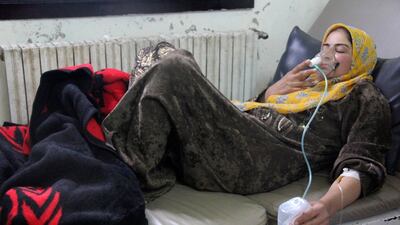
Chemical and biological weapons are morbidly brilliant for fighting in towns and cities, if you have no morals or scruples. And the level of psychological horror they inflict is exactly what terror groups want in their arsenal.
For the past 20 years, I have been in the battle to counter the use and proliferation of these weapons.
The first 10 of those years were in the military, working in the shadows to deal with toxic things in Afghanistan and Iraq. The past 10, ostensibly in Syria but really also in Iraq, I spent in a humanitarian role, trying to help unprotected civilians survive deadly fumes.
As the saying goes, the only thing necessary for the triumph of evil is for good men to do nothing.
In the past three years, there have been at least eight documented chemical attacks in Ghouta, Douma and Idlib province by the Syrian regime. These were predominantly carried out using chlorine, dropped as a barrel bomb or fired in a rocket. The UN’s Organisation for the Prohibition of Chemical Weapons confirmed that chlorine was used in the attack on the town of Douma, on 7 April 2018 that killed 43 people, mainly children. The regime in Damascus, the OPCW has said, is responsible.
We are in the ninth year of this shockingly violent conflict. This war has become synonymous with two distinct and irrefutable crimes against humanity: the use of chemical weapons and the direct targeting of hospitals and medical personnel.
In this nine-year period there have been over 200 documented uses of chemical weapons by the Syrian government and ISIS. The OPCW has been called to investigate some attacks, but Russia has used its veto power in the UN to limit its activities. I investigated a number of attacks in Syria, and on 29 April 2014, published the results of our investigation of the attacks on the Syrian towns of Kafr Zita and Talemenes a few days before.
This unequivocally showed chlorine was used and the regime was responsible. The regime continued to hammer the Damascus suburbs Ghouta and Douma with chlorine barrel bombs, which have had the same effect as they did in Aleppo in December 2016.
In my opinion, Syrian President Bashar Al Assad would not still be in power if he had not used chemical weapons. They are morbidly brilliant for fighting in built-up areas. Once buildings have been razed to the ground, it is almost impossible to force people out with conventional munitions. This is where gas is so effective. Mr Al Assad’s repeated use of gas has killed people underground or forced them into the open, where they are susceptible to bombs and bullets, leading to their surrender.
In this nine-year period there have been over 200 documented uses of chemical weapons by the Syrian government and ISIS
In this era of fake news, where everything is questioned and used to distort reality, usable evidence is key. The chance to collect evidence is often fleeting and opportunistic, and it is important that medical personnel and others have a basic understanding of how to collect evidence of a chemical attack if they are in the vicinity.
Too often, over the past nine years, the OPCW has either been unable to reach the sites of attacks or has been delayed to an extent that evidence has disappeared or been tampered with. At times, people have taken unbelievable risks to get evidence through Syrian Army lines to the outside world. This has been a source of great frustration for me and others in Syria over the years.
In the early days, the outside world spurned it because we were not "accredited" persons from a body tasked by the international community to investigate atrocities – only for that evidence to be verified by an "accredited" body many months or years later, and too late to have an impact or bring the perpetrators to book.
In more recent times, however, especially appertaining to attacks in Idlib, evidence of a standard that is admissible in an international court has found its way safely to western governments, allowing them to take direction where they saw fit.
It is also forming part of a growing body of evidence that will, I hope, one day, be used by the International Criminal Court to convict those responsible for atrocities and crimes against humanity in Syria. This, for many in Syria, is the only hope driving them forward, as they continue to suffer from malnutrition, air strikes and Covid-19 in the sprawling refugee camps, with no chance that the West will come galloping over the horizon to save them.
Since former US president Barack Obama's "red line" threat on chemical weapon use evaporated in the summer of 2013, these weapons have proliferated to a great extent.
The apparent ambivalence from global leaders as to their use, however, cannot be allowed to deepen. With Covid-19, the world has witnessed a not very toxic biological pathogen bringing things to a standstill. Now imagine how a highly toxic biological pathogen – that could spread as rapidly as Covid-19 – could be as imposing a threat as nuclear war or climate change. We must strain every nerve and sinew to put a stop to the continued proliferation of chemical and biological weapons.
Hamish de Bretton-Gordon is a chemical and biological weapons expert and author of his memoir Chemical Warrior

Key recommendations
- Fewer criminals put behind bars and more to serve sentences in the community, with short sentences scrapped and many inmates released earlier.
- Greater use of curfews and exclusion zones to deliver tougher supervision than ever on criminals.
- Explore wider powers for judges to punish offenders by blocking them from attending football matches, banning them from driving or travelling abroad through an expansion of ‘ancillary orders’.
- More Intensive Supervision Courts to tackle the root causes of crime such as alcohol and drug abuse – forcing repeat offenders to take part in tough treatment programmes or face prison.
Who has lived at The Bishops Avenue?
- George Sainsbury of the supermarket dynasty, sugar magnate William Park Lyle and actress Dame Gracie Fields were residents in the 1930s when the street was only known as ‘Millionaires’ Row’.
- Then came the international super rich, including the last king of Greece, Constantine II, the Sultan of Brunei and Indian steel magnate Lakshmi Mittal who was at one point ranked the third richest person in the world.
- Turkish tycoon Halis Torprak sold his mansion for £50m in 2008 after spending just two days there. The House of Saud sold 10 properties on the road in 2013 for almost £80m.
- Other residents have included Iraqi businessman Nemir Kirdar, singer Ariana Grande, holiday camp impresario Sir Billy Butlin, businessman Asil Nadir, Paul McCartney’s former wife Heather Mills.
Hunting park to luxury living
- Land was originally the Bishop of London's hunting park, hence the name
- The road was laid out in the mid 19th Century, meandering through woodland and farmland
- Its earliest houses at the turn of the 20th Century were substantial detached properties with extensive grounds
Terminator: Dark Fate
Director: Tim Miller
Starring: Arnold Schwarzenegger, Linda Hamilton, Mackenzie Davis
Rating: 3/5
Kill%20
%3Cp%3E%3Cstrong%3EDirector%3A%3C%2Fstrong%3E%20Nikhil%20Nagesh%20Bhat%3C%2Fp%3E%0A%3Cp%3E%3Cstrong%3EStarring%3C%2Fstrong%3E%3A%20Lakshya%2C%20Tanya%20Maniktala%2C%20Ashish%20Vidyarthi%2C%20Harsh%20Chhaya%2C%20Raghav%20Juyal%3C%2Fp%3E%0A%3Cp%3E%3Cstrong%3ERating%3A%3C%2Fstrong%3E%204.5%2F5%3Cbr%3E%3C%2Fp%3E%0A
MATCH INFO
Sheffield United 0 Wolves 2 (Jimenez 3', Saiss 6)
Man of the Match Romain Saiss (Wolves)
Who's who in Yemen conflict
Houthis: Iran-backed rebels who occupy Sanaa and run unrecognised government
Yemeni government: Exiled government in Aden led by eight-member Presidential Leadership Council
Southern Transitional Council: Faction in Yemeni government that seeks autonomy for the south
Habrish 'rebels': Tribal-backed forces feuding with STC over control of oil in government territory
ESSENTIALS
The flights
Fly Etihad or Emirates from the UAE to Moscow from 2,763 return per person return including taxes.
Where to stay
Trips on the Golden Eagle Trans-Siberian cost from US$16,995 (Dh62,414) per person, based on two sharing.
Farage on Muslim Brotherhood
Nigel Farage told Reform's annual conference that the party will proscribe the Muslim Brotherhood if he becomes Prime Minister.
"We will stop dangerous organisations with links to terrorism operating in our country," he said. "Quite why we've been so gutless about this – both Labour and Conservative – I don't know.
“All across the Middle East, countries have banned and proscribed the Muslim Brotherhood as a dangerous organisation. We will do the very same.”
It is 10 years since a ground-breaking report into the Muslim Brotherhood by Sir John Jenkins.
Among the former diplomat's findings was an assessment that “the use of extreme violence in the pursuit of the perfect Islamic society” has “never been institutionally disowned” by the movement.
The prime minister at the time, David Cameron, who commissioned the report, said membership or association with the Muslim Brotherhood was a "possible indicator of extremism" but it would not be banned.
RESULTS
6.30pm UAE 1000 Guineas Trial Conditions (TB) US$100,000 (Dirt) 1,400m
Winner Final Song, Christophe Soumillon (jockey), Saeed bin Suroor (trainer).
7.05pm Handicap (TB) $135,000 (Turf) 1,000m
Winner Almanaara, Dane O’Neill, Doug Watson.
7.40pm Handicap (TB) $175,000 (D) 1,900m
Winner Grand Argentier, Brett Doyle, Doug Watson.
8.15pm Meydan Challenge Listed Handicap (TB) $175,000 (T) 1,400m
Winner Major Partnership, Patrick Cosgrave, Saeed bin Suroor.
8.50pm Dubai Stakes Group 3 (TB) $200,000 (D) 1,200m
Winner Gladiator King, Mickael Barzalona, Satish Seemar.
9.25pm Dubai Racing Club Classic Listed Handicap (TB) $175,000 (T) 2,410m
Winner Universal Order, Richard Mullen, David Simcock.
Jigra
Starring: Alia Bhatt, Vedang Raina, Manoj Pahwa, Harsh Singh
RACE CARD
5pm: Handicap (PA) Dh70,000 1,400m
5.30pm: Handicap (TB) Dh70,000 1,000m
6pm: Maiden (PA) Dh70,000 2,000m
6.30pm: Handicap (PA) Dh70,000 2,000m
7pm: Maiden (PA) Dh70,000 1,600m
7.30pm: Al Ain Mile Group 3 (PA) Dh350,000 1,600m
8pm: Handicap (PA) Dh70,000 1,600m
Amith's selections:
5pm: AF Sail
5.30pm: Dahawi
6pm: Taajer
6.30pm: Pharitz Oubai
7pm: Winked
7.30pm: Shahm
8pm: Raniah
THE SPECS
Engine: 1.5-litre, four-cylinder turbo
Transmission: seven-speed dual clutch automatic
Power: 169bhp
Torque: 250Nm
Price: Dh54,500
On sale: now
Classification of skills
A worker is categorised as skilled by the MOHRE based on nine levels given in the International Standard Classification of Occupations (ISCO) issued by the International Labour Organisation.
A skilled worker would be someone at a professional level (levels 1 – 5) which includes managers, professionals, technicians and associate professionals, clerical support workers, and service and sales workers.
The worker must also have an attested educational certificate higher than secondary or an equivalent certification, and earn a monthly salary of at least Dh4,000.
Labour dispute
The insured employee may still file an ILOE claim even if a labour dispute is ongoing post termination, but the insurer may suspend or reject payment, until the courts resolve the dispute, especially if the reason for termination is contested. The outcome of the labour court proceedings can directly affect eligibility.
- Abdullah Ishnaneh, Partner, BSA Law
