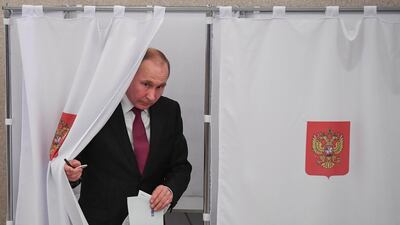
A great deal of decision-making on the part of world leaders is on hold until the result of the US election becomes clear.
The camp rooting for Democratic candidate Joe Biden is led by China, Iran and Venezuela. It is joined by several European countries, who see Donald Trump’s presidency as a menace to Nato. A number of Arab states, on the other hand, were reassured by the Trump administration’s reset of their traditional relationship with the US, which was restored after former president Barack Obama’s U-turn in favour of Iran, Turkey and their common project to impose religion on the state.
Turkish President Recep Tayyip Erdogan could never forget the support afforded by Mr Obama, Mr Biden (who was then vice president), and former US secretary of state Hillary Clinton for his project to install the Muslim Brotherhood in power throughout North Africa. However, in spite of the venomous rhetoric frequently traded between Turkey and the US, he has also enjoyed a close personal relationship with Donald Trump, which has saved him more than once. It saved him even when he sought to acquire the S-400 missile defence system from Russia, much to the US government’s ire, and forged personal relations with the Russian leader Vladimir Putin, though these recently deteriorated.
Israel, for its part, receives preferential treatment from the US no matter who is in the White House.
Former US president Obama was a help to Turkey's Erdogan in various (military) campaigns. Credit: Turkish Presidency via AP
Mr Putin prefers Mr Trump to Mr Biden, who the Russians see as a threat for the likelihood that he will reinvigorate Nato. The likelihood that Mr Biden could lift sanctions on Iran could also impact oil prices in a way that could hurt the Russian economy further. Fear of the Democrats’ retribution for Russia’s alleged role in meddling in the 2016 US elections also looms large.
All of these leaders build their policies, to a great extent, based on a US president’s identity and character. At the same time they have to balance that strategy with an awareness that the US and its foreign policy are led not only by the presidency, but also the legislative branch. There is also the rest of the US establishment and even Wall Street, which this year remarkably dropped their traditional support for the Republican Party in favour of Mr Biden.
Why is Iran more invested in a Biden presidency? That answer lies in the JCPOA nuclear deal with Iran, which was agreed along with European powers. The Obama administration had made the JCPOA one of its top priorities at a heavy cost, including the deliberate abandonment of Syria to Iran, Russia, and Turkey.
Mr Biden and much of his team, who were complicit in Mr Obama’s abandonment of Syria, have said that they would automatically return the US to the JCPOA and undo Mr Trump’s withdrawal from that deal. The Biden camp believes this is the easiest and quickest foreign policy victory it could achieve – a “master stroke” that would restore warmth to US relations with Europe.
One problem, however, lies in the question of how to resume negotiations with Tehran in a way that takes into account recent advancements in Iran’s ballistic missile programme and its regional role in Syria, Lebanon, Iraq and Yemen. A Biden administration must also assess how it could lift or ease sanctions on Iran when they have been enshrined in Congressional bills, given the likelihood that Republicans will continue to control the Senate. The Biden camp’s interest in returning to the JCPOA without thinking too hard about these issues is good news to Iran. That’s why Tehran sees value in “strategic patience”, waiting for Mr Biden’s time in the White House to arrive.
A billboard in Iran reads: 'Whoever comes [into office] they bring evil. America is still America.' Even so, Iran might be something of a 'blue state'. AP
The Biden camp's interest in returning to the JCPOA without thinking too hard is good news to Iran
The same could be said of China, a tentative ally of Iran. Beijing sees defeating Mr Trump as a strategic goal and sees Mr Biden a softer alternative. The socialist tendencies of some sections of the Democratic Party also bodes well, even while Mr Biden has the backing of Wall Street. While New York’s financiers are no ideological bedfellows with Beijing, they have been disturbed by Mr Trump’s open hostility to Chinese investment and the unpredictable impact of his capricious tweets on US financial markets.
Russia, which prefers Mr Trump to Mr Biden even though it is a signatory to the JCPOA, is concerned about the prospect of sanctions relief for Iran. Allowing Iran to resume pumping oil into global markets could push Russian oil prices down. Mr Putin also sees Mr Trump’s shakedown of Nato as a positive. Moscow has also found itself trapped in multiple quagmires around the world, including in Syria, and does not trust Turkey’s designs there or in Libya and elsewhere. In other words, while the Russian relationship with Mr Trump’s America is difficult and complicated, but it would be even more difficult with a Biden administration.
Kevin Rudd, Australia’s former prime minister and a studied expert on Chinese affairs, recently remarked that, in his view, China is hedging its alliances between Arab states and Iran. “Its strategy is along these lines: be friends to all, be enemies of none until someone finds you out and then duck for cover,” Mr Rudd said.
Saudi Arabia’s Prince Turki al-Faisal flipped that logic on its head. “What I’m afraid of is that actually…the Iranians will two-time the Chinese, in the sense that they will get all the benefits and the Chinese will get nothing in return for that strategic engagement”.
Russia is, in a sense, the quintessential 'red state'. AFP
Prince Turki also said that the Arab Gulf countries will not be radically impacted by either Chinese-Iranian relations or the outcome of the election in the US. “Arab countries,” he said, “will have to take into consideration that a Biden administration is emanating from an Obama administration, but not necessarily bound by Obama's implementation of his of his foreign policy, particularly on issues like the JCPOA and other issues in the area.
“Biden has said that he will go back to the JCPOA, but that he will have conditions…We still don't know what those conditions are, but he talked about Iranian missile production and also Iranian malign activity in the area.”
World leaders are thus awaiting the outcome of the US election, but at the same time are drawing various scenarios. Either way, Donald Trump will remain president until January, and a lot could happen until then. In the meantime, the presidents, prime ministers and supreme leaders of other nations will continue to hold their breath.
Raghida Dergham is the founder and executive chairwoman of the Beirut Institute and a columnist for The National

Future markets: Saudi Arabia, potentially Kuwait and other GCC countries
Dust and sand storms compared
Sand storm
Particle size: Larger, heavier sand grains
Visibility: Often dramatic with thick "walls" of sand
Duration: Short-lived, typically localised
Travel distance: Limited
Source: Open desert areas with strong winds
Dust storm
Particle size: Much finer, lightweight particles
Visibility: Hazy skies but less intense
Duration: Can linger for days
Travel distance: Long-range, up to thousands of kilometres
Source: Can be carried from distant regions
The biog
Favourite Quote: “Real victories are those that protect human life, not those that result from its destruction emerge from its ashes,” by The late king Hussain of Jordan.
Favourite Hobby: Writing and cooking
Favourite Book: The Prophet by Gibran Khalil Gibran
Starring: Abdullah Boushehri, Laila Abdallah, Lulwa Almulla
Rating: 3/5
Our family matters legal consultant
Name: Hassan Mohsen Elhais
Position: legal consultant with Al Rowaad Advocates and Legal Consultants.
MATCH INFO
Chelsea 0
Liverpool 2 (Mane 50', 54')
Red card: Andreas Christensen (Chelsea)
Man of the match: Sadio Mane (Liverpool)
MATCH INFO
CAF Champions League semi-finals first-leg fixtures
Tuesday:
Primeiro Agosto (ANG) v Esperance (TUN) (8pm UAE)
Al Ahly (EGY) v Entente Setif (ALG) (11PM)
Second legs:
October 23
Real estate tokenisation project
Dubai launched the pilot phase of its real estate tokenisation project last month.
The initiative focuses on converting real estate assets into digital tokens recorded on blockchain technology and helps in streamlining the process of buying, selling and investing, the Dubai Land Department said.
Dubai’s real estate tokenisation market is projected to reach Dh60 billion ($16.33 billion) by 2033, representing 7 per cent of the emirate’s total property transactions, according to the DLD.
Race 3
Produced: Salman Khan Films and Tips Films Director: Remo D’Souza Cast: Salman Khan, Anil Kapoor, Jacqueline Fernandez, Bobby Deol, Daisy Shah, Saqib Salem Rating: 2.5 stars
RESULT
Leeds United 1 Manchester City 1
Leeds: Rodrigo (59') Man City: Sterling (17')
Man of the Match: Rodrigo Moreno (Leeds)
FIXTURES
All times UAE ( 4 GMT)
Saturday
Fiorentina v Torino (8pm)
Hellas Verona v Roma (10.45pm)
Sunday
Parma v Napoli (2.30pm)
Genoa v Crotone (5pm)
Sassuolo v Cagliari (8pm)
Juventus v Sampdoria (10.45pm)
Monday
AC Milan v Bologna (10.45om)
Playing September 30
Benevento v Inter Milan (8pm)
Udinese v Spezia (8pm)
Lazio v Atalanta (10.45pm)
Company profile
Company name: Dharma
Date started: 2018
Founders: Charaf El Mansouri, Nisma Benani, Leah Howe
Based: Abu Dhabi
Sector: TravelTech
Funding stage: Pre-series A
Investors: Convivialite Ventures, BY Partners, Shorooq Partners, L& Ventures, Flat6Labs
Ziina users can donate to relief efforts in Beirut
Ziina users will be able to use the app to help relief efforts in Beirut, which has been left reeling after an August blast caused an estimated $15 billion in damage and left thousands homeless. Ziina has partnered with the United Nations High Commissioner for Refugees to raise money for the Lebanese capital, co-founder Faisal Toukan says. “As of October 1, the UNHCR has the first certified badge on Ziina and is automatically part of user's top friends' list during this campaign. Users can now donate any amount to the Beirut relief with two clicks. The money raised will go towards rebuilding houses for the families that were impacted by the explosion.”
Price: Dh4,699 for 128GB, Dh5,099 for 256GB, Dh5,499 for 512GB; 1TB unavailable in the UAE
Mercer, the investment consulting arm of US services company Marsh & McLennan, expects its wealth division to at least double its assets under management (AUM) in the Middle East as wealth in the region continues to grow despite economic headwinds, a company official said.
Mercer Wealth, which globally has $160 billion in AUM, plans to boost its AUM in the region to $2-$3bn in the next 2-3 years from the present $1bn, said Yasir AbuShaban, a Dubai-based principal with Mercer Wealth.
“Within the next two to three years, we are looking at reaching $2 to $3 billion as a conservative estimate and we do see an opportunity to do so,” said Mr AbuShaban.
Mercer does not directly make investments, but allocates clients’ money they have discretion to, to professional asset managers. They also provide advice to clients.
“We have buying power. We can negotiate on their (client’s) behalf with asset managers to provide them lower fees than they otherwise would have to get on their own,” he added.
Mercer Wealth’s clients include sovereign wealth funds, family offices, and insurance companies among others.
From its office in Dubai, Mercer also looks after Africa, India and Turkey, where they also see opportunity for growth.
Wealth creation in Middle East and Africa (MEA) grew 8.5 per cent to $8.1 trillion last year from $7.5tn in 2015, higher than last year’s global average of 6 per cent and the second-highest growth in a region after Asia-Pacific which grew 9.9 per cent, according to consultancy Boston Consulting Group (BCG). In the region, where wealth grew just 1.9 per cent in 2015 compared with 2014, a pickup in oil prices has helped in wealth generation.
BCG is forecasting MEA wealth will rise to $12tn by 2021, growing at an annual average of 8 per cent.
Drivers of wealth generation in the region will be split evenly between new wealth creation and growth of performance of existing assets, according to BCG.
Another general trend in the region is clients’ looking for a comprehensive approach to investing, according to Mr AbuShaban.
“Institutional investors or some of the families are seeing a slowdown in the available capital they have to invest and in that sense they are looking at optimizing the way they manage their portfolios and making sure they are not investing haphazardly and different parts of their investment are working together,” said Mr AbuShaban.
Some clients also have a higher appetite for risk, given the low interest-rate environment that does not provide enough yield for some institutional investors. These clients are keen to invest in illiquid assets, such as private equity and infrastructure.
“What we have seen is a desire for higher returns in what has been a low-return environment specifically in various fixed income or bonds,” he said.
“In this environment, we have seen a de facto increase in the risk that clients are taking in things like illiquid investments, private equity investments, infrastructure and private debt, those kind of investments were higher illiquidity results in incrementally higher returns.”
The Abu Dhabi Investment Authority, one of the largest sovereign wealth funds, said in its 2016 report that has gradually increased its exposure in direct private equity and private credit transactions, mainly in Asian markets and especially in China and India. The authority’s private equity department focused on structured equities owing to “their defensive characteristics.”
