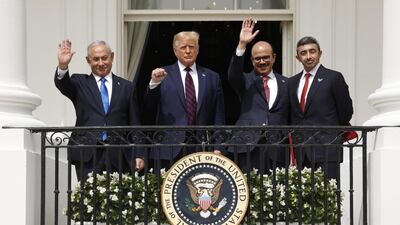

The Middle East faces uncertain times due in large part to the expansionist projects being undertaken by the governments of Turkey and Iran. While the former is pushing for an Ottoman revival, in concert with the Muslim Brotherhood, the latter is attempting to export its so-called Islamic Revolution across the region. The Arab world and Israel, meanwhile, are increasingly finding common ground and establishing diplomatic relations with one another.
Given the evolving geopolitical landscape, it seems unlikely that all these forces can come together to create a security alliance that safeguards the interests of the region at large. There is, however, an appetite within the international community for the creation of such a structure. And from recent conversations with diplomats and other security experts, I am given to understand that Iran – long adversarial towards its Gulf neighbours and Israel – could consider joining it if certain conditions are met.
At a UN Security Council meeting last week, Russia floated the idea of establishing a collective security system in the Gulf. But it was met with opposition from the US. Washington, it seems, saw this as Moscow’s attempt to shore up Iran’s place in the world polity – a no-no for the Trump administration until Tehran ends its destabilising activities in the region as well as its ambitions to develop nuclear weapons.

To be sure, the idea for the creation of an all-encompassing security umbrella is not new. Attempts have been made in the past by various entities but to no avail.
Amr Moussa, the former security general of the 22-member Arab League, had proposed a more comprehensive idea at a summit in Sirte in 2010. The initiative would have included 40 countries, including those in West Asia – Gulf states, Iran, Turkey and Israel – as well as in the Sahel, Sahara and the Horn of Africa regions. But it did not win everyone’s support, as it was deemed premature at the time.
Ten years later, the proposal seems just as unlikely – as was evidenced at the Security Council. But does this mean it should be given up on entirely? Norwegian diplomat Terje Rod-Larsen, famous for his role in Arab-Israeli negotiations in the 1990s that led to the Oslo Accords, supports it – despite being a critic of the Iranian regime.
"The Middle East is the only region in the world where not everybody's sitting at the same table," Mr Rod-Larsen told me. "In order to make things work, everybody has to go to the table – Iranians, Israelis, Turks and Arabs. And if they don't do it, the chaos and anarchy in the Middle East will continue." Suggesting that the recent Abraham Accords, which the UAE and Bahrain signed with Israel, signal a common desire to work together for peace, security and prosperity in the region, Mr Rod-Larsen said an over-arching security structure would also be welcome.
To my query on whether Iran and Israel would even sit at the same table, he said they don't have to from the outset. In fact, Mr Rod-Larsen believes Iran would be interested in joining provided Israel does not. Whether Israel can join later, given the right conditions, is an open-ended question.
A more pertinent question, however, is one that Mr Moussa has posed: should the leadership of the various countries insist on establishing peace before working together to form this structure, or should the focus be on creating the structure that would then, hopefully, lead to peace?
The answer is, of course, complex.
My own assessment is that, so long as Iran and Turkey continue to pursue their respective projects at the cost of the sovereignty and territorial integrity of the Arab states, it would be impossible to establish this structure first and then sue for peace. It would be illogical to even propose such a notion without a radical departure in Turkish President Recep Tayyip Erdogan’s policies and the dismantling of the deeply divisive and sectarian ideology that drives the regime in Tehran. One of the outcomes of the Turkish and Iranian projects has been the weakening of the nation-state in parts of the Mena region and its replacement with transnational solidarity, which is hugely problematic for, among other things, diplomatic relations between countries.

It is important to remember that some of the conflict in the region is predicated on the rivalries that exist between the major powers, which makes alliance-building that much more difficult. As the veteran British diplomat Jeremy Greenstock told me, it would be impossible to create a European-style body because “life and conflict are too raw at the moment for that to happen soon”.
Over the long run, the creation of such an alliance will depend heavily on the willingness of the deeply divided Security Council to even agree to seek accountability from the Iranian regime. Whether there is going to be any give on the part of the members, could, in turn, depend on the outcome of the US election. If President Donald Trump is re-elected, relations between the Arab world and Israel will continue to expand while Iran and Turkey continue their nefarious actions. If his opponent Joe Biden wins, however, the picture is less clear.
Raghida Dergham is the founder and executive chairwoman of the Beirut Institute

