
Saad Hariri, who was re-designated Prime Minister of Lebanon on Thursday, seems to have the tacit backing of a variety of local, regional and international actors. This means that, in return for the chance to form a government, he will inevitably expose himself to pressures from all those actors, including France, Iran and the US. Chief among them, of course, is the Iranian regime, which seeks to consolidate its interests in the country.
For its part, the Trump administration has just two priorities when it comes to this troubled Arab state. One is the ongoing talks between Lebanon and Israel to demarcate a maritime border to facilitate oil and gas exploration by both countries. The other is accountability of all the local political players aligned with Hezbollah, a proxy of Tehran that happens to be a formidable political party in Lebanon but is deemed a terrorist organisation by Washington.
The latter, however, makes Mr Hariri’s task of leading his country out of economic disrepair extremely difficult, given that Tehran remains determined to keep Lebanon in its cold embrace and resist the West’s attempts to draw Beirut closer to it with the help of economic assistance from the International Monetary Fund.

Mr Hariri has opted to return to the traditional practice of government formation in Lebanon, even if this means disregarding popular opposition to it. Indeed, the public has long tired of the "confessional" system, whereby the highest offices are proportionately reserved for representatives from certain religious communities. Despite its shortcomings, the year-long protest movement across Lebanon has made clear its rejection of the entire political class, which continues to hold on to power despite bringing the country to its knees.
The movement, which forced Mr Hariri's resignation in January, will have its doubts about his stated mission of forming a technocratic government. After all, he is part of the political system that the uprising rejects. One doesn't doubt Mr Hariri's ability to include "fresh faces" in his upcoming cabinet, as his Iranian backers will understand his need to portray himself as a reformer. But he will struggle to enact much-needed economic and political reforms, given how beholden he and his fellow ministers will be to vested interests in Beirut and Tehran.
Mr Hariri may already have conceded to a key demand made by Hezbollah and the Amal Movement to pick a finance minister from the Shiite community (which forms their voter base). It was a point of contention that forced Mustapha Adib to resign as prime minister-designate last month. If the influential French and US governments have indeed backed Mr Hariri’s expected concession in this regard – as a trade-off to facilitate the success of the so-called “French Initiative” to rescue the country – then one might well wave goodbye to any hopes of a new Lebanon. Handing over control of the finance ministry to someone with the support of the so-called “Shiite Duo” will effectively mean shelving any hopes of establishing accountability and transparency with regard to how business is done in the country.
-
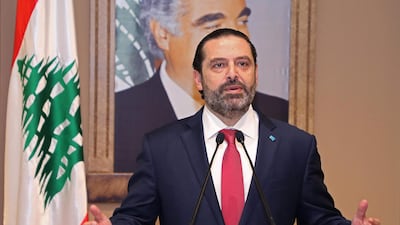
Saad Hariri announces the resignation of his government. AFP -

Mr. Hariri hands President Michel Aoun his government's resignation at the Baabda presidential palace. Dalati and Nohra / AFP -

Protesters celebrate the resignation of Prime Minister Saad Hariri in Beirut, Lebanon. AFP -

Mr Hariri speaks during an address to the nation. AP Photo -

Protesters celebrate after Mr Hariri announced his resignation, in Sidon. Reuters -

Protesters celebrate the resignation of Mr Hariri in Beirut. AFP -
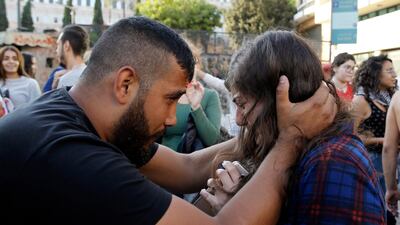
A protester calms another who was overwhelmed with tears in Beirut. AP Photo -

Protesters react as they watch a televised speech by Mr Hariri in the Ashrafieh area in Beirut. EPA -
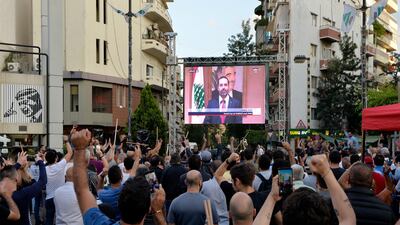
Protesters react as they watch a televised speech by Mr Hariri. EPA -

Protestors watch a television broadcast of Mr Hariri speaking, in Sidon. Reuters -

Mr Hariri walks to the podium to announce the resignation of his government. AFP -

Lebanon's Prime Minister Saad Hariri leaves after a news conference. Reuters


America's position may be problematic. The Trump administration is naturally suspicious of the ties that exist between Mr Hariri and Hezbollah, but it is unwilling to obstruct the French initiative at this stage. If it, however, ends up legitimising Iran's strategy in Lebanon – based on the consolidation of Hezbollah's dominance over the government and perhaps even the army – then Washington is likely to stand up to Paris. Mr Hariri's position is unenviable and might even become untenable – even though he may believe that he is on a rescue mission.
It is important to remember that Iran's strategy for "renewal" in Lebanon essentially translates to the formation of a stable government that would cement Beirut's subordination to Tehran. But it would be carried out through a non-provocative formula that includes the introduction of new names to the government who are ultimately loyal to Hezbollah. This also includes the removal of the Lebanese army from politics and its eventual subjugation. Call it a "soft and flexible" hegemony, if you like.
-
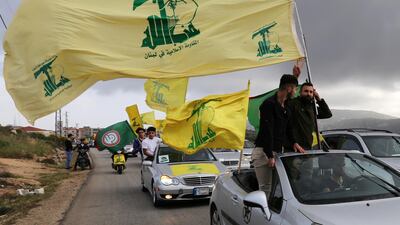
A supporter of Lebanon's Hezbollah gestures as he holds a Hezbollah flag in Marjayoun, Lebanon May 7, 2018. Reuters -
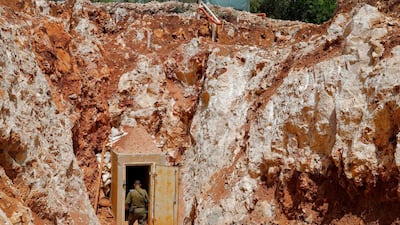
In 2019, Israel said this was a Hezbollah-dug tunnel under the "blue line", a demarcation line drawn by the UN to mark Israel's withdrawal from southern Lebanon in 2000. AFP -
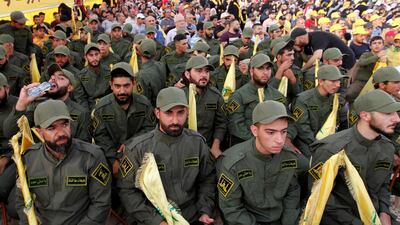
Lebanon's Hezbollah members hold party flags as they listen to their leader Sayyed Hassan Nasrallah. Reuters -

A banner depicting Hezbollah leader Sayyed Hassan Nasrallah and an United Nation's post in Lebanon. Reuters -
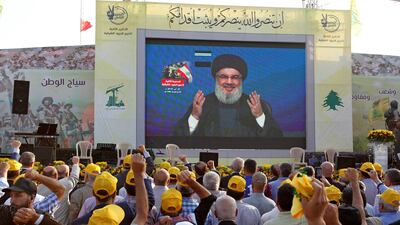
Hezbollah leader Hassan Nasrallah has direct ties with Iran's supreme leader Ayatollah Ali Khamenei. Reuters -
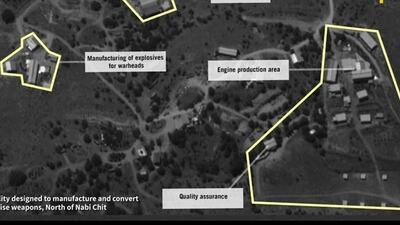
The Israeli military claimed that Hezbollah, with Iranian assistance, had been bringing specialised equipment to a weapons factory in southern Lebanon. Screengrab/YouTube -
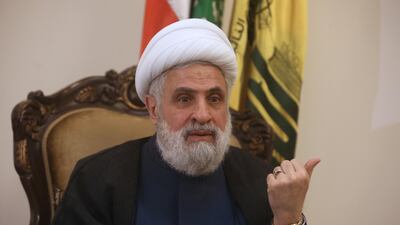
Lebanon's Hezbollah deputy leader Sheikh Naim Qassem gestures as he speaks during an interview with Reuters in Beirut, Lebanon March 15, 2018. Reuters -
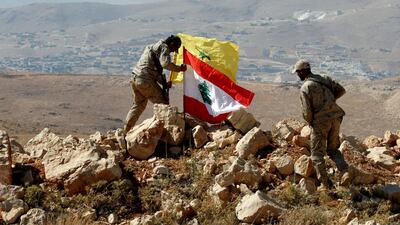
Hezbollah fighters put Lebanese and Hezbollah flags at Juroud Arsal, Syria-Lebanon border, July 25, 2017. Reuters -
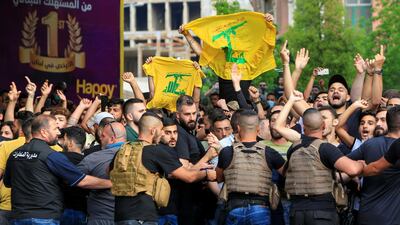
Lebanese soldiers try to block Hezbollah supporters as they gesture and chant slogans against anti-government demonstrators, in Beirut. Reuters -
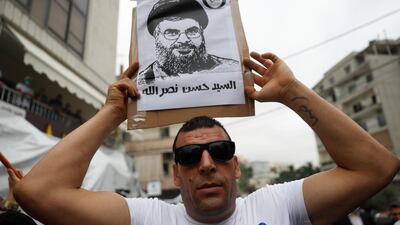
A Hezbollah supporter holds a placard of its leader Hassan Nasrallah, during a protest against the US in Beirut. AP Photo -
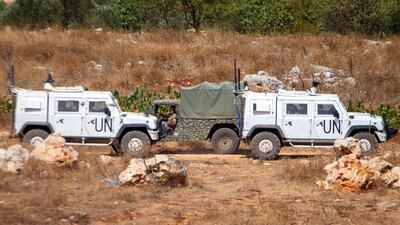
Lebanese soldiers on patrol drive by UN vehicles on the border with Israel on July 28, 2020. AP -
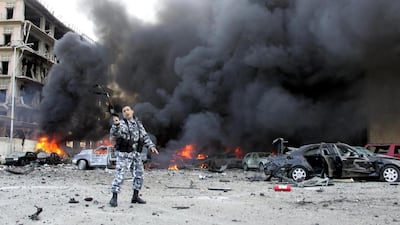
A Lebanese police officer gesturing on the site of an explosion in Beirut that killed ex-premier Rafik Hariri in 2005. AFP -
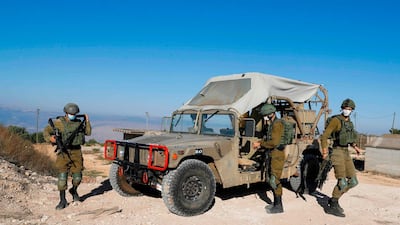
Israeli soldiers monitor the country's border with Lebanon near the northern town of Metula, in July 14, 2020. AFP -
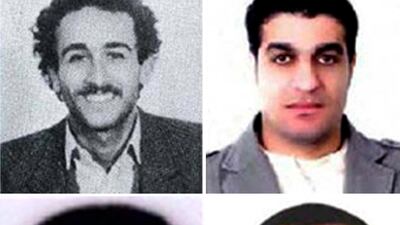
In this file photo obtained on July 29, 2011 from the Special Tribunal for Lebanon shows a combo of pictures showing four Hezbollah suspects indicted in the assassination case of former Lebanese prime minister Rafiq Hariri. AFP -
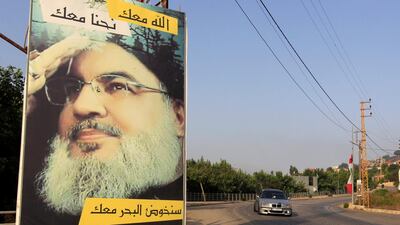
A car drives past a poster depicting Lebanon's Hezbollah leader Sayyed Hassan Nasrallah in Adaisseh village, near the Lebanese-Israeli border, Lebanon July 28, 2020. REUTERS/Aziz Taher


Mr Hariri's balancing act will therefore be a tricky one, especially as he banks on continued regional and international support, as well as pledges of economic assistance and financial aid from the West. He will also be aware that the next few months will be critical for Lebanon, and his own political fortunes, irrespective of whether Donald Trump wins re-election or is succeeded by Joe Biden. US sanctions on Iran, Hezbollah and their allies in Beirut will continue, at least for the foreseeable future.
As for the US presidential election itself, there is increasing uncertainty over which candidate will secure victory – or whether victory will be decisive. With less than two weeks to go, pollsters remain cautious, particularly after many of them erroneously predicted a Hillary Clinton win in the 2016 election.
Experts I recently spoke to are divided, too, although there is little doubt regarding US strategy in the Middle East, should Mr Trump get re-elected.
Paula Dobriansky, the former under secretary of state for democracy and global affairs, predicted a Trump win. Re-election, she said, would naturally mean the continuation of his administration’s “maximum pressure” campaign against Tehran. Michael Gfoeller, the former political adviser and regional co-ordinator for South Central Iraq in the erstwhile Coalition Provisional Authority, said as much. In fact, he even predicted an escalation in sanctions on Iran that would continue to curtail its oil exports and cripple its economy.
Carl Bildt, the former prime minister of Sweden, predicted a Biden victory, which he said would enable a return by all of the world's stakeholders to the negotiating table in the new president's bid to secure a new nuclear deal with Iran.
How exactly this will affect the future of Lebanon, only time will tell.
Raghida Dergham is the founder and executive chairwoman of the Beirut Institute

