


US President Donald Trump's warning to the Iranian government that he has ordered the US Navy to destroy any of its gunboats caught harassing American warships comes at a time when the regime in Tehran is facing arguably its greatest crisis since the 1979 revolution.
Mr Trump’s threat intensifies the pressure on Iran when it is already struggling to contend with a number of major challenges, from the coronavirus pandemic to the collapse of the economy.
Now the regime finds itself facing the prospect of a fresh military confrontation with the US following Mr Trump’s warning, which came after accusations that Iranian gunboats have been harassing American warships in the Gulf.
Mr Trump’s latest threat, which is said to have taken senior US military commanders by surprise, was made in a tweet and came after Iran had announced the successful launch of a military satellite.
“I have instructed the United States navy to shoot down and destroy any and all Iranian gunboats if they harass our ships at sea,” Mr Trump wrote.
The President's warning follows a series of incidents in the Gulf this month where gunboats operated by Iran's Islamic Revolutionary Guard Corps (IRGC) have been accused of conducting operations against shipping in the Strait of Hormuz. In one incident, they mistakenly seized a Chinese tanker, a deeply embarrassing move as China is one of the few countries still prepared to trade with Tehran.
-
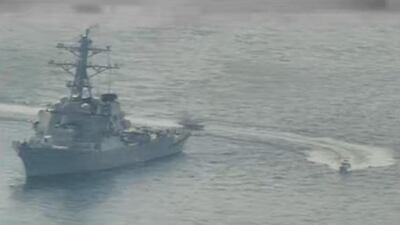
Iranian Islamic Revolutionary Guard Corps Navy (IRGCN) vessels near US Military ships at close range. EPA -
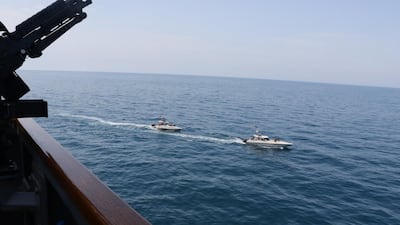
Iranian Islamic Revolutionary Guard Corps Navy (IRGCN) vessels near US Military ships at close range. EPA -
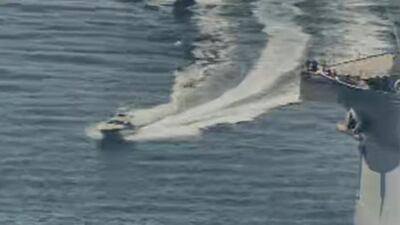
The US Navy accuses Iran of conducting 'unsafe' actions close to US warships. EPA -
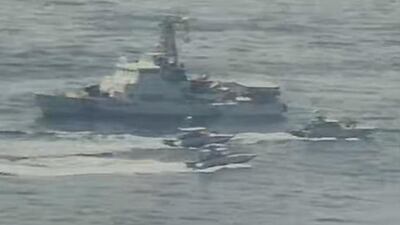
Iranian Islamic Revolutionary Guard Corps Navy (IRGCN) vessels near US Military ships at close range. EPA -
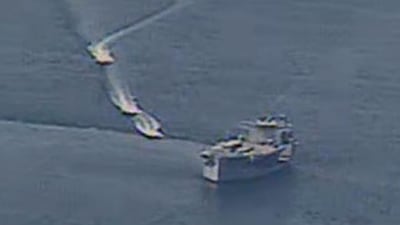
The US Navy accuses Iran of conducting 'unsafe' actions close to US warships. EPA -
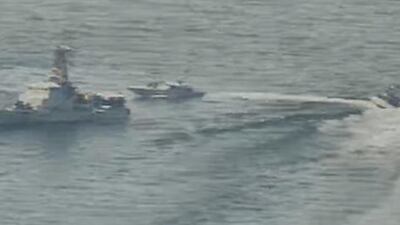
A handout photo made available by the US Naval Forces Central Command / US 5th Fleet via the Defense Visual Information Distribution Service (DVIDS) shows Iranian Islamic Revolutionary Guard Corps Navy (IRGCN) vessels near US Military ships. EPA -
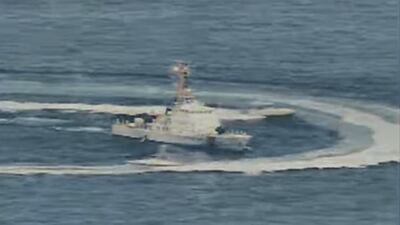
The US Navy accuses Iran of conducting 'unsafe' actions close to US warships. EPA


The US Naval Forces Central Command also reported that Iranian vessels had, on April 15, “repeatedly conducted dangerous and harassing approaches” while American warships were conducting standard training exercises in the area.
It has become a familiar ploy for the Iranian regime, when confronted with a domestic crisis, to attempt to deflect attention away from its domestic troubles by seeking to increase international tensions.
And the recent escalation follows a pattern of hostile activity undertaken by the IRGC that dates back to last summer, when hardliners in Tehran sought to respond to the impact of US sanctions on the Iranian economy by seeking to disrupt and intimidate Gulf shipping.
There has been a noticeable decline in Iranian activity in the region following its disastrous confrontation with the US at the start of the year, when an attack by an Iranian-sponsored militia in Iraq resulted in Mr Trump authorising the assassination of Qassem Suleimani, the head of the IRGC's Quds Force and one of the regime's leading hardliners. Iran's attempts to retaliate resulted in the shooting down of a Ukrainian passenger jet over Tehran with the loss of all 176 people on board.
The latest attempt to escalate tensions in the Gulf is therefore fraught with risk, not least because Mr Trump has already proved, with Suleimani’s killing, that he is perfectly willing to act on his threats of military action.
And Iran, while it might regard this week's successful satellite launch as a demonstration of its mounting military prowess, is currently in no position to initiate a fresh confrontation with Washington.
For all Tehran's bluster that it can withstand the economic impact of American sanctions, the fact that the regime has applied to the IMF for a £5 billion emergency aid package – the first time the Islamic Republic has made such a move since 1979 – suggests the government is facing a dire economic predicament.

With inflation running at around 35 per cent and the country experiencing mass unemployment, the government is facing mounting anger from ordinary Iranians over its handling of the economy. Moreover, it now faces further economic hardship following this week's dramatic collapse in the global oil market, which at one point saw prices enter negative territory for the first time in history.
Prior to this week’s dramatic events, Iran's oil sector had already seen exports decline from their pre-sanctions level of two million barrels a day to around 300,000 – a decline of more than 80 per cent. In order to meet the government’s 2020 budget requirements, the IMF estimates Iran needs oil prices to reach the unlikely figure of $195 a barrel, whereas, in the wake of the recent turbulence in the oil markets, prices are hovering around the $19 a barrel mark.
-
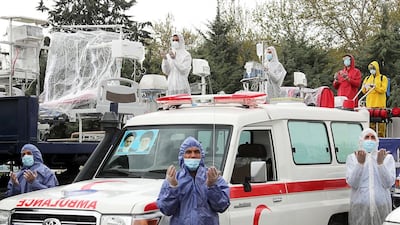
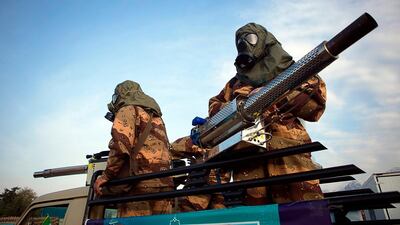
Iranian army soldiers wearing protective face masks parade with disinfection equipment to mark National Army Day in Tehran on April 17, 2020. Iranian military via EPA, HO -
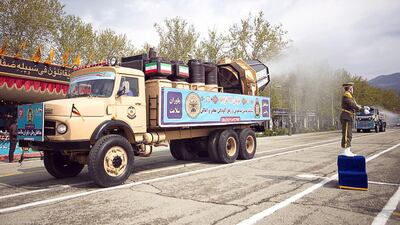
Iran did not hold a main ceremony on its annual National Army Day due to the coronavirus crises in the country. Iranian military via EPA, HO -
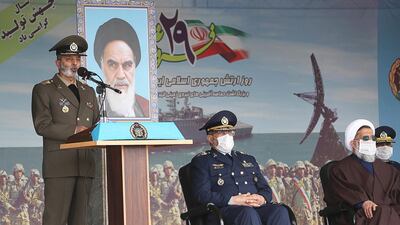
Iran is one of the most impacted countries by the pandemic with over 5,000 reported deaths. Iranian military via EPA, HO -

Iran’s parliament has suggested that the true toll of the virus may in fact be double the official numbers. Iranian military via EPA, HO -
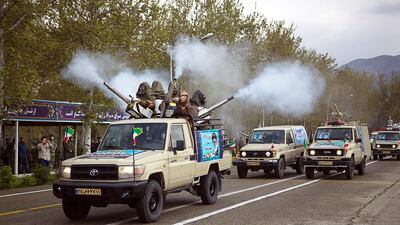
The military has been deployed in the mass national sterilisation programme and to aid the domestic civilian administrations handle the crisis. Iranian military via EPA, HO -
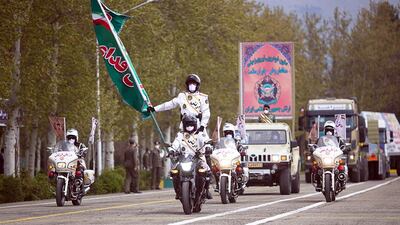
Soldiers wearing protective face masks as they parade amid the ongoing coronavirus pandemic. Iranian military via EPA, HO -
Iran is one of the most effected countries by the pandemic with over 5,000 reported deaths. Iranian military via EPA, HO -
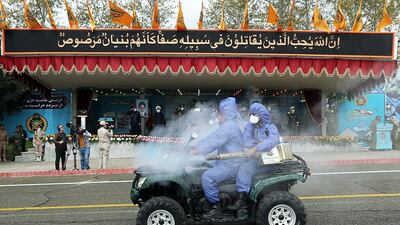
Soldiers wearing protective face masks as they parade amid the ongoing coronavirus pandemic. Iranian military via EPA, HO


President Hassan Rouhani has tried to put a brave face on Iran’s predicament, claiming that his country would not be as badly affected by the price collapse because it was less reliant on oil exports than other countries.
The reality, though, is that the economy is in a tailspin, one that is only likely to intensify following this week’s developments, and will only increase public disapproval with the government’s performance.
Then there is the criticism the regime has faced over its handling of the pandemic, where the authorities have recorded nearly 90,000 cases of Covid-19 and more than 5,000 deaths, making Iran the worst-affected country in the Middle East.
-
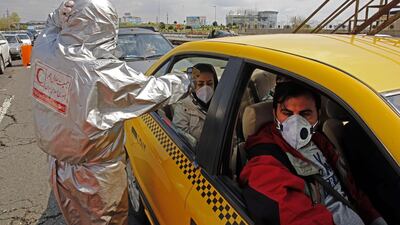
Members of Iranian Red Crescent test people with possible coronavirus Covid-19 symptoms, as police blocked Tehran to Alborz highway to check every car following ordered by the Iranian government, outside Tehran. AFP -
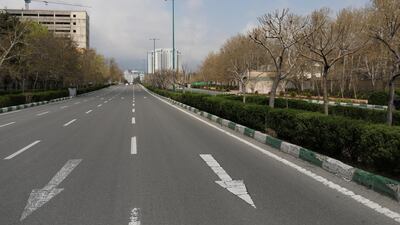
General view of a deserted street, during the intercity ban, amid fear of coronavirus disease (COVID-19), in Tehran, Iran. REUTERS -
A member of the Iranian Army works at a temporary hospital in Tehran, Iran. AP Photo -
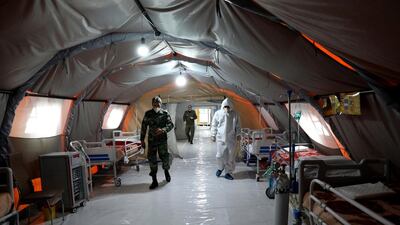
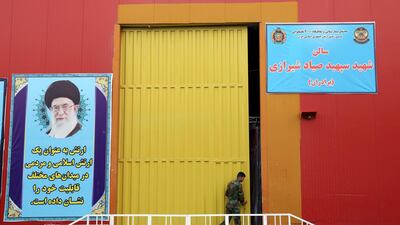
Iranian army soldiers work in a temporary 2,000-bed hospital for COVID-19 coronavirus patients set up by the army at the international exhibition center in northern Tehran, Iran. AP Photo -
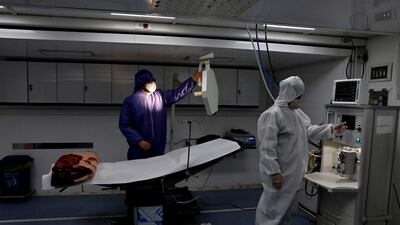
People in protective clothing work in a temporary 2,000-bed hospital for COVID-19 coronavirus patients set up by the Iranian army at the international exhibition center in northern Tehran, Iran. AP Photo -
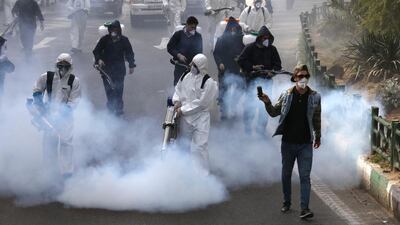
Firefighters disinfect a square against the new coronavirus as a man takes film, in western Tehran, Iran. AP Photo -
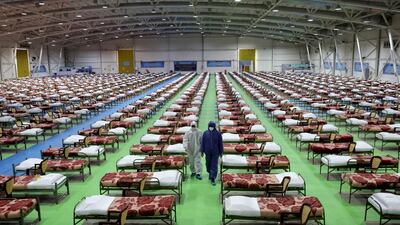
People in protective clothing walk past rows of beds at a temporary 2,000-bed hospital for COVID-19 coronavirus patients set up by the Iranian army at the international exhibition center in northern Tehran, Iran. AP Photo -
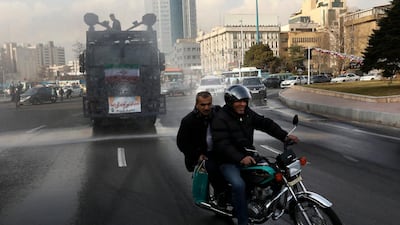
A police vehicle disinfects streets against the coronavirus, in Tehran, Iran. AP Photo -
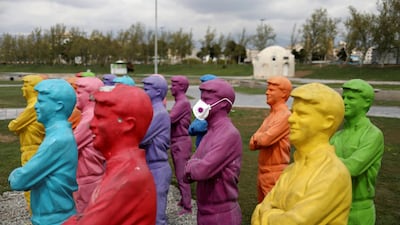
A statue wearing a protective face mask is pictured, amid fear of coronavirus disease (COVID-19), in Azadi square, in Tehran, Iran. REUTERS -
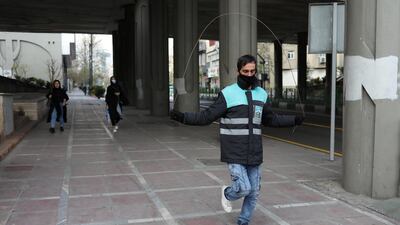
A man wearing a protective face mask and gloves, amid fear of coronavirus disease (COVID-19), jumps rope at Valiasr street in Tehran, Iran. REUTERS -
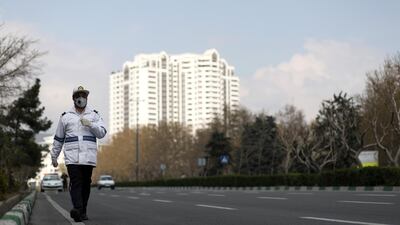
A traffic police officer wears a protective face mask and gloves, amid fear of coronavirus disease (COVID-19), as he walks in Tehran, Iran. REUTERS -
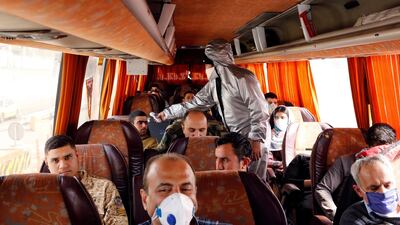
A member of Iranian red crescents test passengers of a bus for possible coronavirus Covid-19 symptoms, as police blocked Tehran to Alborz highway to check every car following ordered by Iranian government, outside of Tehran. EPA -
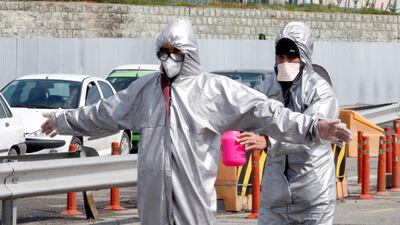
Members of Iranian Red Crescent get themselves disinfected after testing people for possible coronavirus Covid-19 symptoms, outside of Tehran. EPA


Claims that the government has deliberately tried to conceal the true extent of the outbreak have added to Tehran's woes, especially after satellite images appeared to show the authorities preparing mass graves at a cemetery on the outskirts of the holy city of Qom. Further concerns that Tehran was trying to cover up its mishandling of the pandemic have been raised by Michelle Bachelet, the United Nation's High Commissioner for Human Rights, who has warned that Tehran could be accelerating the execution of prisoners who took part in protests over fears that the coronavirus was spreading through crowded and unsanitary prisons.
Whether this is true or not, the fact remains that the Iranian government is in the midst of a major crisis, one where provoking a fresh confrontation with the US is not going to help its chances of survival.
Con Coughlin is the Telegraph’s defence and foreign affairs editor

