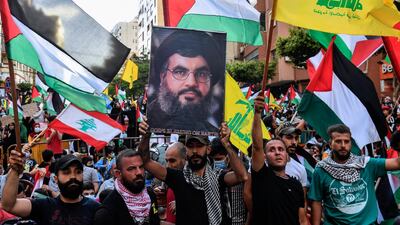

As the situation in Israel and the Palestinian areas has deteriorated in the past week, Lebanon's Hezbollah has watched developments closely. The party welcomes much of what has happened, but it is too early for it to celebrate. Palestinian gains are more likely than not to affirm Hezbollah's limited appeal.
Hezbollah's assessment will be primarily focused on what the conflict has meant for Iran and its regional allies, rather than on how it has advanced the interests of the Palestinian people. Hezbollah will have welcomed Hamas's ability to bring Israel to a relative standstill while continuing to fire at Israeli targets, despite the ferocious bombardment of Gaza.
Much like Hezbollah in the Lebanon war of 2006, Hamas's ability to hit Israel has represented a moral victory to its supporters, regardless of Israel's more massive destruction of Palestinian areas. There has also been an improvement in the quality and range of Hamas's weapons, so that the organisation has inflicted damage as far away as Tel Aviv and Jerusalem, even forcing Israel to close its international airport.
Hamas’s potency signals the group’s full reintegration into the “resistance axis", the coalition of Iranian-led countries and armed groups opposed to Israel and the US. The ties between Hamas and Hezbollah, which had deteriorated during the Syrian conflict, improved markedly in 2017. The latest round of fighting in Gaza takes the reconciliation process a step further.
Hezbollah will have also welcomed that Hamas largely sidelined the Palestinian Authority in the clash with Israel over its storming of Al Aqsa Mosque last week. After the expulsion efforts in Sheikh Jarrah, it was Hamas that bombed Israeli targets. Though this condemned Gazans to new destruction, politically it underlined the ineptitude of the Ramallah-based Palestinian leadership, which had already discredited itself by postponing legislative elections on April 30.
A third development Hezbollah will have watched with satisfaction is that the Palestinians of Israel joined the protests against the Israeli government, creating the semblance of a broad Palestinian front in favour of Palestinian rights. To Hezbollah, this suggests that Israel's contradictions are coming to the fore, which in the party's eyes confirms its argument that the country is not viable.
And fourth, Hezbollah, like Iran, will probably have regarded Hamas's strikes against Israel as payback for Israel's bombing of Iranian combatants and proxies in Syria. Tehran can claim that it has imposed a deterrence relationship with Israel. Hamas cannot retaliate for each Israeli attack on Iranian or allied forces in Syria, but the effect of what is happening in Gaza on Israel's domestic stability is more potent than the domestic consequences of what Iran has suffered in Syria.
Despite all this, Hezbollah should be careful about claiming victory too soon. There is little doubt that the latest Gaza war, because it was coupled with protests inside Israel’s 1948 borders, has represented an important new turn in the Palestinian-Israeli relationship. Moreover, the emotions provoked regionally have shown that “Palestinian resistance", which Iran and its regional allies claim to champion, continues to pack a powerful punch, particularly in the face of Israel’s injustices.
However, precisely because of that, Palestinians will take their actions as a continuation of generations of national struggle, in which Iran’s and Hezbollah’s roles are only secondary. Nor is Hamas seen by most Palestinians as a vanguard in their fight for self-determination. In a poll by the Palestinian Centre for Policy and Survey Research last March, prior to the expected elections, only 22 per cent of respondents (15 per cent in the West Bank and 33 per cent in Gaza) wanted Hamas to lead the next Palestinian Authority government.
One can expect Palestinian citizens of Israel to take an even dimmer view of Hamas. Palestinian national liberation remains primarily a secular and nationalistic phenomenon, with few ties binding it to Iran’s regional agenda.
Nor has the "resistance axis" been able to transform the fighting in Gaza into a weapon to place its Arab rivals on the defensive. The Organisation of Islamic Co-operation immediately condemned Israeli actions last week and held a foreign ministers' meeting on Sunday. At the virtual gathering, the Saudi Foreign Minister, Prince Faisal bin Farhan, described Israel's "systematic crimes" and notably reaffirmed the Arab Peace Initiative of 2002, which Israel has largely ignored.
The fighting also failed to have an impact on the agreements last year between several Arab states and Israel. This suggests that the long-term significance of the Gaza fighting is more likely to be felt internally and in the occupied territories, affecting Israel’s relations with Palestinians at home and under Israeli rule, than to transform the relationship between Israel and regional actors.
While Hezbollah may relish the fact that the weapons of the “axis of resistance” are causing more damage in Israel, it should remember that in any war Israel is far more capable of escalating to higher levels of devastation than its enemies. In Hezbollah’s case, the party’s challenge will be containing the popular backlash after any war, because few Arabs are willing to lose everything on Iran’s behalf.
Michael Young is a senior editor at the Carnegie Middle East Centre in Beirut and a Lebanon columnist for The National
-
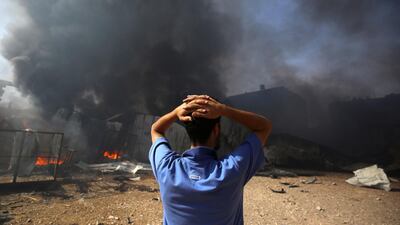
A man watches a factory in the northern Gaza Strip burn after it was hit by what witnesses said was an Israeli artillery bombardment. Reuters -
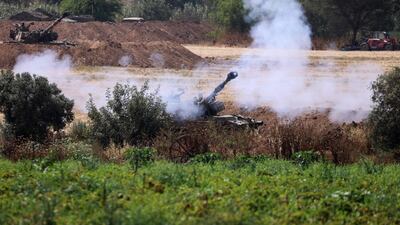
Israeli army tanks fire shells from a position by the border into the Gaza Strip. AFP -
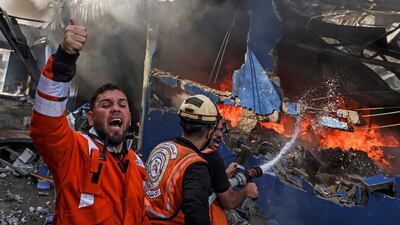
Palestinian firefighters douse a fire at the Foamco mattress factory following an Israeli air strike to the east of Jabalia in the northern Gaza Strip. AFP -
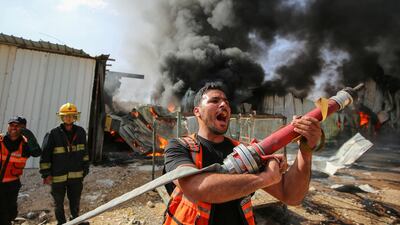
A Palestinian firefighter takes part in efforts to put out a fire at a factory in the northern Gaza Strip after it was hit by Israeli artillery shells. Reuters -
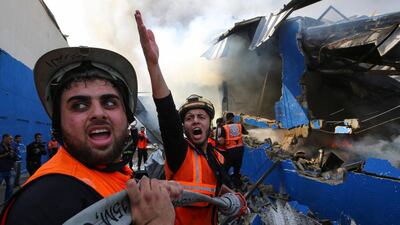
Palestinian firefighters at a factory in the northern Gaza Strip that witnesses say was hit by Israeli artillery shells. Reuters -
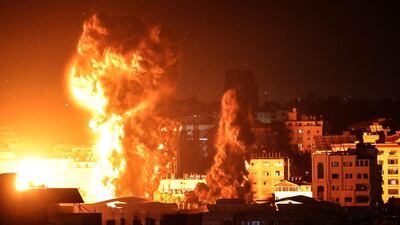
Fire and smoke rise over Gaza city as Israeli warplanes attack the Palestinian enclave. AFP -
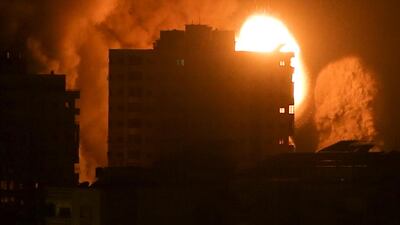
Smoke and flames rise above a building during Israeli air strikes, amid a flare-up of Israeli-Palestinian violence, in Gaza city. Reuters -
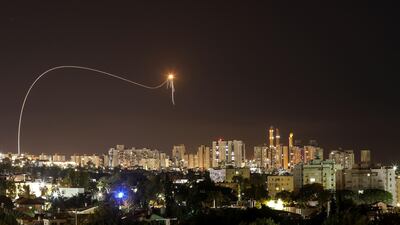
Seen from Ashkelon in Israel, a missile from Israel's Iron Dome air defence system leaves a bright trail as it moves to intercept rockets launched from the Gaza Strip. Reuters -
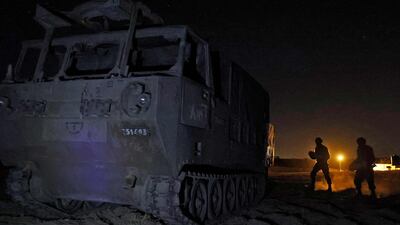
Israeli soldiers next to an ammunition carrier at their position by the border with the Gaza Strip. AFP



