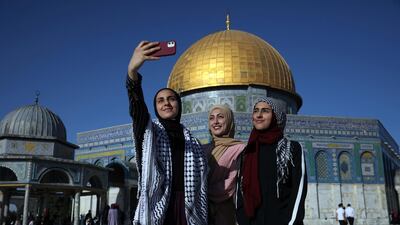
Arabs are among the communities that have called Jerusalem home for centuries. AP

Why Palestinians are entitled to live in Jerusalem in peace


  • English
  • Arabic

The iron key to Jerusalem’s Church of the Holy Sepulchre is tinged ochre with rust. Nearly every morning before dawn for more than 800 years, it has been used by a member of the Nusseibeh family, who are Muslim, to unlock the church’s doors for the Christian clergy who preside over its services.

Exactly how or when the arrangement began has receded from public memory. But to the custodians and the clergy, how it all started does not matter as much as what their daily ritual represents, which is the respect and spirit of co-operation with which their communities regard each other in their shared city.

A reminder of that message is sorely needed now in Jerusalem, as the city – and others in Palestine and Israel – continue to see an eruption of violence between Jews and Arabs, stemming from the threat of eviction of Palestinian residents from one of its neighbourhoods, Sheikh Jarrah, this month. Jewish settlers have used a 1970 law that gives priority to Jews' property claims over those of Palestinians in a case that Israel's top court suspended after the latest violence began.

Right-wing extremism has been on the rise in Israel since the 1970s, and in 1980, the Knesset passed a bill declaring “Jerusalem, complete and united” to be Israel’s capital. With this declaration of sovereignty came another to extend Israeli legal jurisdiction over East Jerusalem, which the international community still considers to be illegally occupied land. Under international law, any evictions within occupied land are also illegal. East Jerusalem is envisioned to be the capital of any future Palestinian state.

Unrest has rocked Israeli cities this week. AP

Evictions not only undermine legal norms, but also the heritage and dignity of Jerusalem’s Palestinians. Many of them, who live mainly in East Jerusalem, have ancient roots in the city – the Nusseibehs trace theirs back to 637. Others are refugees, having been displaced from other parts of Palestine during Israel’s creation in 1948. These families, in particular, have faced constant pressure to leave since Israel’s capture of East Jerusalem in 1967.

As the speaker of Jordan’s Parliament told a meeting of the Arab League this week, what has transpired in Sheikh Jarrah is not a simple “real-estate dispute”. The UN’s Office of the High Commissioner for Human Rights has said that evictions such as those in process in Sheikh Jarrah “create a coercive environment” that may lead to a “forcible transfer” of the broader Palestinian population from its land. As long as the spectre of such a tragedy remains, it will provide wind in the sails of violent militant movements in Palestine, including those of Hamas, which has launched hundreds of rockets into Israeli territory from Gaza this week. Some of them inadvertently killed Arabs.

US President Joe Biden, whose country has long billed itself the arbiter of a prospective Palestinian-Israeli peace, has not yet been able to influence events. Rather, his administration has been criticised for its apparent equivocation as the violence worsens. In a briefing on Thursday, Mr Biden took care to avoid any strong statements, opting instead of safer, universal truths. One of them was the assertion that Jerusalem, “a city of such importance to people of faith from around the world, must be a place of peace”.

But the only way for that to happen is for Israel to take strong measures to ease tensions within its population. After that, it must sue for a long-term political solution that assures the rights of the Palestinians who live in Jerusalem, and lets go of any claims of exclusive ownership over this holy city.


Our legal columnist

Name: Yousef Al Bahar

Advocate at Al Bahar & Associate Advocates and Legal Consultants, established in 1994

Education: Mr Al Bahar was born in 1979 and graduated in 2008 from the Judicial Institute. He took after his father, who was one of the first Emirati lawyers

Three ways to limit your social media use

Clinical psychologist, Dr Saliha Afridi at The Lighthouse Arabia suggests three easy things you can do every day to cut back on the time you spend online.

1. Put the social media app in a folder on the second or third screen of your phone so it has to remain a conscious decision to open, rather than something your fingers gravitate towards without consideration.

2. Schedule a time to use social media instead of consistently throughout the day. I recommend setting aside certain times of the day or week when you upload pictures or share information. 

3. Take a mental snapshot rather than a photo on your phone. Instead of sharing it with your social world, try to absorb the moment, connect with your feeling, experience the moment with all five of your senses. You will have a memory of that moment more vividly and for far longer than if you take a picture of it.

India cancels school-leaving examinations

Celta Vigo 2
Castro (45'), Aspas (82')

Barcelona 2
Dembele (36'), Alcacer (64')

Red card: Sergi Roberto (Barcelona)

RACE CARD

4.30pm: Maiden Dh80,000 1,400m
5pm: Conditions Dh80,000 1,400m
5.30pm: Liwa Oasis Group 3 Dh300,000 1,400m
6pm: The President’s Cup Listed Dh380,000 1,400m
6.30pm: Arabian Triple Crown Group 2 Dh300,000 2,200m
7pm: Wathba Stallions Cup Handicap (30-60) Dh80,000 1,600m
7.30pm: Handicap (40-70) Dh80,000 1,600m.

COMPANY%20PROFILE
%3Cp%3E%3Cstrong%3EDate%20started%3A%3C%2Fstrong%3E%202020%3Cbr%3E%3Cstrong%3EFounders%3A%3C%2Fstrong%3E%20Khaldoon%20Bushnaq%20and%20Tariq%20Seksek%3Cbr%3E%3Cstrong%3EBased%3A%3C%2Fstrong%3E%20Abu%20Dhabi%20Global%20Market%3Cbr%3E%3Cstrong%3ESector%3A%3C%2Fstrong%3E%20HealthTech%3Cbr%3E%3Cstrong%3ENumber%20of%20staff%3A%3C%2Fstrong%3E%20100%3Cbr%3E%3Cstrong%3EFunding%20to%20date%3A%3C%2Fstrong%3E%20%2415%20million%3C%2Fp%3E%0A
The Melbourne Mercer Global Pension Index

The Melbourne Mercer Global Pension Index

Mazen Abukhater, principal and actuary at global consultancy Mercer, Middle East, says the company’s Melbourne Mercer Global Pension Index - which benchmarks 34 pension schemes across the globe to assess their adequacy, sustainability and integrity - included Saudi Arabia for the first time this year to offer a glimpse into the region.

The index highlighted fundamental issues for all 34 countries, such as a rapid ageing population and a low growth / low interest environment putting pressure on expected returns. It also highlighted the increasing popularity around the world of defined contribution schemes.

“Average life expectancy has been increasing by about three years every 10 years. Someone born in 1947 is expected to live until 85 whereas someone born in 2007 is expected to live to 103,” Mr Abukhater told the Mena Pensions Conference.

“Are our systems equipped to handle these kind of life expectancies in the future? If so many people retire at 60, they are going to be in retirement for 43 years – so we need to adapt our retirement age to our changing life expectancy.”

Saudi Arabia came in the middle of Mercer’s ranking with a score of 58.9. The report said the country's index could be raised by improving the minimum level of support for the poorest aged individuals and increasing the labour force participation rate at older ages as life expectancies rise.

Mr Abukhater said the challenges of an ageing population, increased life expectancy and some individuals relying solely on their government for financial support in their retirement years will put the system under strain.

“To relieve that pressure, governments need to consider whether it is time to switch to a defined contribution scheme so that individuals can supplement their own future with the help of government support,” he said.

PROFILE BOX:

Company/date started: 2015

Founder/CEO: Rami Salman, Rishav Jalan, Ayush Chordia

Based: Dubai, UAE

Sector: Technology, Sales, Voice, Artificial Intelligence

Size: (employees/revenue) 10/ 100,000 downloads

Stage: 1 ($800,000)

Investors: Eight first-round investors including, Beco Capital, 500 Startups, Dubai Silicon Oasis, Hala Fadel, Odin Financial Services, Dubai Angel Investors, Womena, Arzan VC


Third Test

Day 3, stumps

India 443-7 (d) & 54-5 (27 ov)
Australia 151

India lead by 346 runs with 5 wickets remaining

The specs
  • Engine: 3.9-litre twin-turbo V8
  • Power: 640hp
  • Torque: 760nm
  • On sale: 2026
  • Price: Not announced yet
SERIES INFO

Afghanistan v Zimbabwe, Abu Dhabi Sunshine Series

All matches at the Zayed Cricket Stadium, Abu Dhabi

Test series

1st Test: Zimbabwe beat Afghanistan by 10 wickets
2nd Test: Wednesday, 10 March – Sunday, 14 March

Play starts at 9.30am

T20 series

1st T20I: Wednesday, 17 March
2nd T20I: Friday, 19 March
3rd T20I: Saturday, 20 March

TV
Supporters in the UAE can watch the matches on the Rabbithole channel on YouTube

The biog

Name: Salem Alkarbi

Age: 32

Favourite Al Wasl player: Alexandre Oliveira

First started supporting Al Wasl: 7

Biggest rival: Al Nasr

Spec%20sheet
%3Cp%3E%3Cstrong%3EDisplay%3A%3C%2Fstrong%3E%204.7%22%20Retina%20HD%2C%201334%20x%20750%2C%20625%20nits%2C%201400%3A1%2C%20True%20Tone%2C%20P3%3Cbr%3E%3Cstrong%3EChip%3A%3C%2Fstrong%3E%20Apple%20A15%20Bionic%2C%206-core%20CPU%2C%204-core%20GPU%2C%2016-core%20Neural%20Engine%3Cbr%3E%3Cstrong%3ECamera%3A%3C%2Fstrong%3E%2012MP%2C%20f%2F1.8%2C%205x%20digital%20zoom%2C%20Smart%20HDR%2C%20Deep%20Fusion%3Cbr%3E%3Cstrong%3EVideo%3A%3C%2Fstrong%3E%204K%2B%40%2024%2F30%2F60fps%2C%20full%20HD%2B%40%2030%2F60fps%2C%20HD%2B%40%2030%20fps%3Cstrong%3E%3Cbr%3EFront%20camera%3A%20%3C%2Fstrong%3E7MP%2C%20f%2F2.2%2C%20Smart%20HDR%2C%20Deep%20Fusion%3B%20HD%20video%2B%40%2030fps%3Cbr%3E%3Cstrong%3EBattery%3A%3C%2Fstrong%3E%20Up%20to%2015%20hours%20video%2C%2050%20hours%20audio%3B%2050%25%20fast%20charge%20in%2030%20minutes%20with%2020W%20charger%3B%20wireless%20charging%3Cbr%3E%3Cstrong%3EBiometrics%3A%3C%2Fstrong%3E%20Touch%20ID%3Cbr%3E%3Cstrong%3EDurability%3A%3C%2Fstrong%3E%20IP67%2C%20dust%2C%20water%20resistant%20up%20to%201m%20for%2030%20minutes%3Cbr%3E%3Cstrong%3EPrice%3A%3C%2Fstrong%3E%20From%20Dh1%2C849%3C%2Fp%3E%0A

Graduated from the American University of Sharjah

She is the eldest of three brothers and two sisters

Has helped solve 15 cases of electric shocks

Enjoys travelling, reading and horse riding


Top financial tips for graduates

Araminta Robertson, of the Financially Mint blog, shares her financial advice for university leavers:

1. Build digital or technical skills: After graduation, people can find it extremely hard to find jobs. From programming to digital marketing, your early twenties are for building skills. Future employers will want people with tech skills.

2. Side hustle: At 16, I lived in a village and started teaching online, as well as doing work as a virtual assistant and marketer. There are six skills you can use online: translation; teaching; programming; digital marketing; design and writing. If you master two, you’ll always be able to make money.

3. Networking: Knowing how to make connections is extremely useful. Use LinkedIn to find people who have the job you want, connect and ask to meet for coffee. Ask how they did it and if they know anyone who can help you. I secured quite a few clients this way.

4. Pay yourself first: The minute you receive any income, put about 15 per cent aside into a savings account you won’t touch, to go towards your emergency fund or to start investing. I do 20 per cent. It helped me start saving immediately.