Supporters with Hezbollah, Iran and Palestine flags during an anti-Israel protest in the southern Khiam area by Lebanon's border with Israel. AFP

How Iran is planning to exploit the Palestine-Israel crisis


  • English
  • Arabic

The ground beneath the Palestinian territories and Israel is shifting so rapidly that it is impossible to predict what is going to happen next. As I write this, Israeli forces may have decided to launch a ground invasion of Gaza, having determined that they cannot back down now, as Hamas continues to fire rockets into their territory in response to the violence on the streets of Jerusalem between Palestinians and Israelis.

Such an operation, however, will not only further enrage the residents of Gaza – the Palestinian territory under the control of Hamas – but those Arabs living within Israel as well. Whether the situation has slipped out of the Israeli government’s control or not, there is palpable anger on the streets days after Israeli right-wing extremists engaged in violence with ordinary Palestinians, including worshippers, around Al Aqsa Mosque in Jerusalem.

A ground invasion of Gaza could also overturn the balance of power in the country and its immediate neighbourhood, as it potentially entraps Israel on multiple fronts: within Israel itself, in Gaza to its west and in Lebanon to its north. The Iranian regime, which has allies in both Gaza and Lebanon and considers Israel to be a mortal enemy, may even consider firing its own rockets into the country for the first time. That calculation is not yet clear.

For the Israeli leadership, invasion could serve as a means to destroy Hamas by taking down Gaza’s military and civilian infrastructure, while containing its own home front and restoring deterrence. On the other hand, Hamas and its patrons in Tehran may seize the opportunity to defeat Israel through a barrage of missiles from the aforementioned fronts while weaponising Palestinian anger inside Israel.

Hezbollah, Tehran’s proxy group in Lebanon, is no doubt prepared to heat up the Lebanese front, the military logic behind which is that Israel may not be able to withstand attacks on two fronts. In all likelihood, Israel fears the Lebanese front more than it does the one in Gaza, because of the advanced Iranian military supplies delivered to Hezbollah.

In Tehran’s estimation, the international political climate could present it with an opportune moment to engage in confrontation with Israel.

One reason for this is the lack of effectiveness on the part of the members of the so-called Middle East Quartet – the UN, US, EU and Russia – who have historically been involved in mediating the Palestine-Israel peace process.

In the event of a confrontation, Tehran is betting on inaction from the European powers. It is anticipating little more than European sympathy for the Palestinians and its criticism of actions taken by Israel, Hamas and Hezbollah. Britain, France and Germany seem determined to revive the nuclear deal that the global powers had struck with Iran in 2015 before former US president Donald Trump pulled his country out of it. Talks are still under way in Vienna and Tehran is expecting them to maintain their focus on the same.

Russia, meanwhile, has long withdrawn from the role once played by the Soviet Union. It has become pragmatic and is closer to Israel than it was in the past. But for Moscow, the priority right now seems to be the upcoming meeting between Russian Foreign Minister Sergey Lavrov and US Secretary of State Antony Blinken in Reykjavik on Thursday. They are expected to discuss a broad range of issues, including the future of Ukraine and the summit between US President Joe Biden and his Russian counterpart, Vladimir Putin, scheduled for next month.

US President Joe Biden will be under pressure to resolve the ongoing crisis in Palestine and Israel. AP Photo
In Tehran's estimation, the international political climate presents it with an opportune moment to engage in confrontation with Israel

As for the US, Mr Biden will be forced to pay attention to the developments in Israel. This is not just due to America’s strategic relationship with Israel, but also because he will probably view the current crisis through the lens of the nuclear talks in Vienna. The revival of the 2015 deal is a priority for his administration, too.

One of the hurdles for Mr Biden, however, is that he won’t be able to mediate between Iran and Israel with the purpose of deescalating the situation in Gaza, Lebanon or Israel itself – in the unlikely event any of these fronts heat up. At present, there is some sympathy for ordinary Palestinians in the US media but that could change if there is indeed a military confrontation between Israel on the one side and Hamas, Hezbollah and Iran on the other.

Given the inherent bias the US has towards Israel, the Islamic Republic will test the Biden administration and the American media equally on one of the most difficult issues for them. It will put the US president in a spot by trying to force him to choose between his administration's support for Israel and his own determination to revive the nuclear deal with Tehran.

Meanwhile, important though it is to consider the geopolitical ramifications of a potential invasion of Gaza, one must not forget the humanitarian crisis it could engender as well as the possible setbacks for Israel’s neighbouring countries, including Egypt and Lebanon.

With the Biden administration seemingly distracted and with the potential for Israel to make a mistake, Iran could see this as its golden opportunity to achieve its goals.

Raghida Dergham is the founder and executive chairwoman of the Beirut Institute and a columnist for The National

  • A demonstrator holding a Palestinian flag gestures during a protest over tension in Jerusalem and Israel-Gaza escalation, near Hawara checkpoint near Nablus in the Israeli-occupied West Bank, May 14, 2021. Reuters
    A demonstrator holding a Palestinian flag gestures during a protest over tension in Jerusalem and Israel-Gaza escalation, near Hawara checkpoint near Nablus in the Israeli-occupied West Bank, May 14, 2021. Reuters
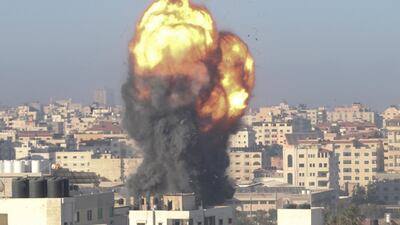
  • A fireball and smoke billow up into the air during an Israeli air strike on Gaza City targeting the Ansar compound, linked to the Hamas movement, in the Gaza Strip. AFP
    A fireball and smoke billow up into the air during an Israeli air strike on Gaza City targeting the Ansar compound, linked to the Hamas movement, in the Gaza Strip. AFP
  • A nurse at Al Shifa Hospital holds a baby, who was pulled alive from under the rubble while seven other family members perished after an Israeli air strike struck Al Shati Refugee Camp in Gaza City. AFP
    A nurse at Al Shifa Hospital holds a baby, who was pulled alive from under the rubble while seven other family members perished after an Israeli air strike struck Al Shati Refugee Camp in Gaza City. AFP
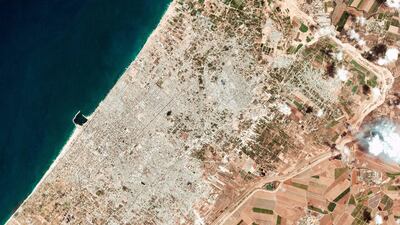
  • This satellite photo released by Planet Labs shows the Gaza Strip. AP Photo
    This satellite photo released by Planet Labs shows the Gaza Strip. AP Photo
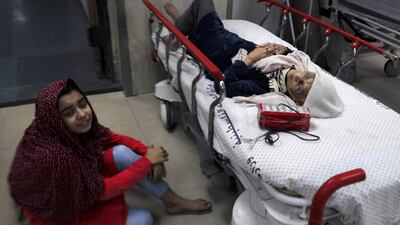
  • A Palestinian girl sits on the floor next to her wounded grandmother at Al Shifa Hospital, after an Israeli air strike on Al Shati Refugee Camp in Gaza City. AFP
    A Palestinian girl sits on the floor next to her wounded grandmother at Al Shifa Hospital, after an Israeli air strike on Al Shati Refugee Camp in Gaza City. AFP
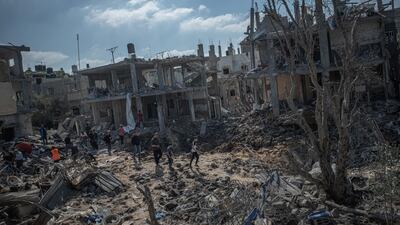
  • People inspect the damage done to Beit Hanoun after a night of Israeli raids in Gaza City, Gaza. Getty Images
    People inspect the damage done to Beit Hanoun after a night of Israeli raids in Gaza City, Gaza. Getty Images
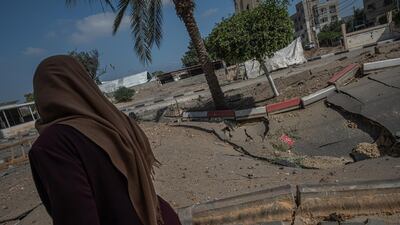
  • A woman walks beside a broken asphalt, after an Israeli air strike on Beit Hanoun, in the northern Gaza Strip. Getty Images
    A woman walks beside a broken asphalt, after an Israeli air strike on Beit Hanoun, in the northern Gaza Strip. Getty Images
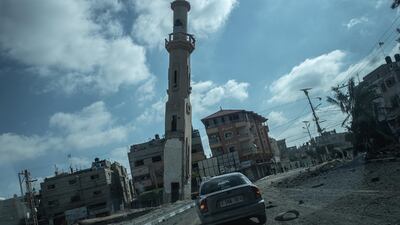
  • A car drives through rubble, after an Israeli raid in northern Gaza City. Getty Images
    A car drives through rubble, after an Israeli raid in northern Gaza City. Getty Images
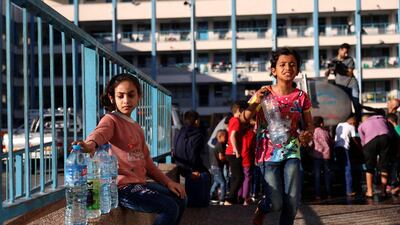
  • Palestinian girls who fled home due to Israeli air and artillery strikes, wait to fill bottles with water at a school hosting refugees in Gaza city. AFP
    Palestinian girls who fled home due to Israeli air and artillery strikes, wait to fill bottles with water at a school hosting refugees in Gaza city. AFP
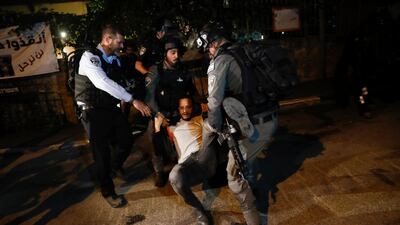
  • Israeli police arrest a Palestinian demonstrator during a protest in Sheikh Jarrah neighborhood in east Jerusalem. EPA
    Israeli police arrest a Palestinian demonstrator during a protest in Sheikh Jarrah neighborhood in east Jerusalem. EPA
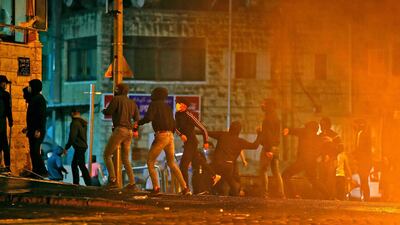
  • Palestinian protesters hurl stones during clashes with Israeli forces in the Shuafat camp for Palestinian refugees, neighbouring the Israeli settlement of Ramat Shlomo, in Israeli-annexed east Jerusalem. AFP
    Palestinian protesters hurl stones during clashes with Israeli forces in the Shuafat camp for Palestinian refugees, neighbouring the Israeli settlement of Ramat Shlomo, in Israeli-annexed east Jerusalem. AFP
SHAITTAN
%3Cp%3E%3Cstrong%3EDirector%3A%20%3C%2Fstrong%3EVikas%20Bahl%3Cbr%3E%3Cstrong%3EStarring%3A%20%3C%2Fstrong%3EAjay%20Devgn%2C%20R.%20Madhavan%2C%20Jyothika%2C%20Janaki%20Bodiwala%3Cbr%3E%3Cstrong%3ERating%3A%20%3C%2Fstrong%3E3%2F5%3C%2Fp%3E%0A
Islamophobia definition

A widely accepted definition was made by the All Party Parliamentary Group on British Muslims in 2019: “Islamophobia is rooted in racism and is a type of racism that targets expressions of Muslimness or perceived Muslimness.” It further defines it as “inciting hatred or violence against Muslims”.

Mercer, the investment consulting arm of US services company Marsh & McLennan, expects its wealth division to at least double its assets under management (AUM) in the Middle East as wealth in the region continues to grow despite economic headwinds, a company official said.

Mercer Wealth, which globally has $160 billion in AUM, plans to boost its AUM in the region to $2-$3bn in the next 2-3 years from the present $1bn, said Yasir AbuShaban, a Dubai-based principal with Mercer Wealth.

Within the next two to three years, we are looking at reaching $2 to $3 billion as a conservative estimate and we do see an opportunity to do so,” said Mr AbuShaban.

Mercer does not directly make investments, but allocates clients’ money they have discretion to, to professional asset managers. They also provide advice to clients.

“We have buying power. We can negotiate on their (client’s) behalf with asset managers to provide them lower fees than they otherwise would have to get on their own,” he added.

Mercer Wealth’s clients include sovereign wealth funds, family offices, and insurance companies among others.

From its office in Dubai, Mercer also looks after Africa, India and Turkey, where they also see opportunity for growth.

Wealth creation in Middle East and Africa (MEA) grew 8.5 per cent to $8.1 trillion last year from $7.5tn in 2015, higher than last year’s global average of 6 per cent and the second-highest growth in a region after Asia-Pacific which grew 9.9 per cent, according to consultancy Boston Consulting Group (BCG). In the region, where wealth grew just 1.9 per cent in 2015 compared with 2014, a pickup in oil prices has helped in wealth generation.

BCG is forecasting MEA wealth will rise to $12tn by 2021, growing at an annual average of 8 per cent.

Drivers of wealth generation in the region will be split evenly between new wealth creation and growth of performance of existing assets, according to BCG.

Another general trend in the region is clients’ looking for a comprehensive approach to investing, according to Mr AbuShaban.

“Institutional investors or some of the families are seeing a slowdown in the available capital they have to invest and in that sense they are looking at optimizing the way they manage their portfolios and making sure they are not investing haphazardly and different parts of their investment are working together,” said Mr AbuShaban.

Some clients also have a higher appetite for risk, given the low interest-rate environment that does not provide enough yield for some institutional investors. These clients are keen to invest in illiquid assets, such as private equity and infrastructure.

“What we have seen is a desire for higher returns in what has been a low-return environment specifically in various fixed income or bonds,” he said.

“In this environment, we have seen a de facto increase in the risk that clients are taking in things like illiquid investments, private equity investments, infrastructure and private debt, those kind of investments were higher illiquidity results in incrementally higher returns.”

The Abu Dhabi Investment Authority, one of the largest sovereign wealth funds, said in its 2016 report that has gradually increased its exposure in direct private equity and private credit transactions, mainly in Asian markets and especially in China and India. The authority’s private equity department focused on structured equities owing to “their defensive characteristics.”

Bahrain%20GP
%3Cp%3EFriday%20qualifying%3A%207pm%20(8pm%20UAE)%3C%2Fp%3E%0A%3Cp%3ESaturday%20race%3A%207pm%20(UAE)%3C%2Fp%3E%0A%3Cp%3ETV%3A%20BeIN%20Sports%3C%2Fp%3E%0A
The President's Cake

Director: Hasan Hadi

Starring: Baneen Ahmad Nayyef, Waheed Thabet Khreibat, Sajad Mohamad Qasem 

Rating: 4/5

Tributes from the UAE's personal finance community

• Sebastien Aguilar, who heads SimplyFI.org, a non-profit community where people learn to invest Bogleheads’ style

“It is thanks to Jack Bogle’s work that this community exists and thanks to his work that many investors now get the full benefits of long term, buy and hold stock market investing.

Compared to the industry, investing using the common sense approach of a Boglehead saves a lot in costs and guarantees higher returns than the average actively managed fund over the long term. 

From a personal perspective, learning how to invest using Bogle’s approach was a turning point in my life. I quickly realised there was no point chasing returns and paying expensive advisers or platforms. Once money is taken care off, you can work on what truly matters, such as family, relationships or other projects. I owe Jack Bogle for that.”

• Sam Instone, director of financial advisory firm AES International

"Thought to have saved investors over a trillion dollars, Jack Bogle’s ideas truly changed the way the world invests. Shaped by his own personal experiences, his philosophy and basic rules for investors challenged the status quo of a self-interested global industry and eventually prevailed.  Loathed by many big companies and commission-driven salespeople, he has transformed the way well-informed investors and professional advisers make decisions."

• Demos Kyprianou, a board member of SimplyFI.org

"Jack Bogle for me was a rebel, a revolutionary who changed the industry and gave the little guy like me, a chance. He was also a mentor who inspired me to take the leap and take control of my own finances."

• Steve Cronin, founder of DeadSimpleSaving.com

"Obsessed with reducing fees, Jack Bogle structured Vanguard to be owned by its clients – that way the priority would be fee minimisation for clients rather than profit maximisation for the company.

His real gift to us has been the ability to invest in the stock market (buy and hold for the long term) rather than be forced to speculate (try to make profits in the shorter term) or even worse have others speculate on our behalf.

Bogle has given countless investors the ability to get on with their life while growing their wealth in the background as fast as possible. The Financial Independence movement would barely exist without this."

• Zach Holz, who blogs about financial independence at The Happiest Teacher

"Jack Bogle was one of the greatest forces for wealth democratisation the world has ever seen.  He allowed people a way to be free from the parasitical "financial advisers" whose only real concern are the fat fees they get from selling you over-complicated "products" that have caused millions of people all around the world real harm.”

• Tuan Phan, a board member of SimplyFI.org

"In an industry that’s synonymous with greed, Jack Bogle was a lone wolf, swimming against the tide. When others were incentivised to enrich themselves, he stood by the ‘fiduciary’ standard – something that is badly needed in the financial industry of the UAE."