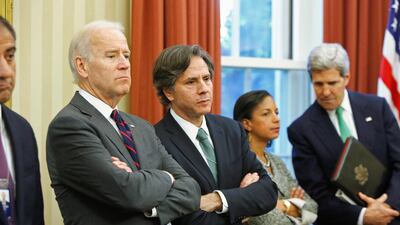
The question is whether Antony Blinken and others in US President-elect Joe Biden's foreign policy team will be willing to listen to people who don't share their worldview. Reuters
When Tony Blair became Britain’s prime minister in 1997, he famously called for “joined-up government”. If there is one thing that we will need in 2021, it is a lot more joined-up thinking – and not just in government but across sectors, societies and disciplines.
This applies most obviously to how the world deals with the Covid-19 pandemic. Sharing best practices and experiences of the vaccines currently being rolled out is going to be crucial over the next few months, although there will doubtless still be a minority of conspiracy theorists and "liberty lovers" determined not to learn any lessons from the year the globe shut down.
But joined-up thinking is needed in other areas as well, most especially in the field of international relations. Over the past 10 years or so, I have been well placed to see how often governments, academia, think tanks and the mainstream media operate in silos, and don’t talk to each other even when they are dealing with the same matters.
Great depths of expertise, won over many years, may essentially go wasted, or are appreciated only within a relatively small circle – because the minister is not interested in speaking to the professor, who in any case thinks the minister is a shifty politician and not worth talking to; the think tank fails to publicise its relevant report, while all the above look down on the journalist as a generalist who doesn’t really know the subject. In theory, all of those writing on, researching, and conducting international relations ought to be informing each other, adding to each others’ sums of knowledge from their unique vantage points.
CAMBERLEY, ENGLAND - APRIL 11: British Prime Minister Tony Blair inspects Officer cadets after they completed their training at the Royal Military Academy Sandhurst April 11, 2003 in Camberley. Some 409 cadets took part in the event and it is the first time ever a serving Labour Prime Minister took the inspection and salute. (Photo by Julian Herbert/Getty Images)
But there is huge resistance to this. A foreign ministry will frequently insist on relying only on its internal staff. Academics are often more concerned with being published in prestigious journals with minuscule readerships than educating a wider public. The think tank regards a successful conference as an end in itself, and appears to imagine that the insights aired will be spread by some kind of osmosis. The op-ed columnist has made his mind up a long time ago; why should he or she consult further?
Even within these silos there can be further barriers to dialogue. The grand theorists of “International Relations” and the local specialists of “Area Studies” have often operated as though they had little to say to each other. In all of these instances, opportunities for greater understanding are missed because many are overly convinced that their own particular lens is the best through which to see the world.
In Asia this mentality is a cause for concern about President-elect Joe Biden's foreign policy team. Mr Biden's picks for secretary of state and national security adviser, Antony Blinken and Jake Sullivan, are experienced, intelligent and well-regarded. But they – along with Mr Biden's plan for a "Summit For Democracy" and all the talk of human rights – arouse suspicion that the administration will be characterised by an idealistic liberal internationalism that could shade into interventionism.
Will the Biden White House listen enough to hard-headed foreign policy realists, to historians such as Hugh Peyman, who locate the China of today within the context of its thousands of years of culture and Confucianism, to outstanding regional analysts such as Amitav Acharya, Kishore Mahbubani and Bilahari Kausikan, and to smaller nations that want to see give and take rather than confront based on ideological conviction?
This is not to suggest that anyone in Mr Biden’s team discard their perspectives (that might be welcome, but would be too much to ask). But it is to hope that they are truly well-informed, which means being prepared to listen to experts with whom they may be predisposed to disagree.
Joined-up thinking – acknowledging that Muammar Qaddafi had been key to Libya's stability – might have avoided the situation the country is in today. EPA
Mr Biden has first-hand knowledge of the dangers of unjoined-up thinking. When he was Barack Obama’s vice president in 2011, he and then secretary of defence Robert Gates both opposed military intervention in Libya. Mr Obama overrode them, and declared that “the dark shadow of tyranny has been lifted” after Muammar Qaddafi’s death. But far from becoming a flourishing democracy, the stability that the late “brotherly guide” had imposed with such brutality has so dissipated that the slave trade has now been re-established in the country.
I see how often governments, academia, think tanks and the mainstream media operate in silos
A little joined-up thinking – acknowledging that Qaddafi had kept fractious tribes from warring and cracked down hard on homegrown Islamist extremists – might have stayed Mr Obama's hand and avoided the disastrous abyss into which Libya has since fallen. Similar concern about the longer-term ramifications led many of us to oppose the 2003 US-led invasion of Iraq and caution against excessive western optimism in the early days of the Arab uprisings a decade ago.
The approach I am proposing will be hard for some. Those who believe, for instance, that the western model of liberal democracy is the only legitimate form of government, will find it difficult not to see China solely as a country that needs “fixing”. Too many already take that line. An Asian analyst working in Washington recently told me that anyone who tries to understand Beijing’s point of view there risks being labelled a “panda lover”.
Such arrogance needs to be tempered, and can be by consulting widely – not just with ideological opponents, but with the vast array of people who have spent careers writing about different regions, theories, histories, and cultures, from highbrow academics to hard-scrabble reporters, and more: to novelists, artists and all those who endeavour to understand the human condition in its numerous nuances.
You may not change your mind. But you may have it opened, if only just a crack. That, to me, is the value of “joined-up thinking” in an age of unquestioning partisanship.
Sholto Byrnes is an East Asian affairs columnist for The National

UAE currency: the story behind the money in your pockets
SolarWinds supply chain attack: Came to light in December 2020 but had taken root for several months, compromising major tech companies, governments and its entities
Microsoft Exchange server exploitation: March 2021; attackers used a vulnerability to steal emails
Kaseya attack: July 2021; ransomware hit perpetrated REvil, resulting in severe downtime for more than 1,000 companies
Log4j breach: December 2021; attackers exploited the Java-written code to inflitrate businesses and governments
Goalkeepers: Ali Khaseif, Fahad Al Dhanhani, Mohammed Al Shamsi, Adel Al Hosani
Defenders: Bandar Al Ahbabi, Shaheen Abdulrahman, Walid Abbas, Mahmoud Khamis, Mohammed Barghash, Khalifa Al Hammadi, Hassan Al Mahrami, Yousef Jaber, Salem Rashid, Mohammed Al Attas, Alhassan Saleh
Midfielders: Ali Salmeen, Abdullah Ramadan, Abdullah Al Naqbi, Majed Hassan, Yahya Nader, Ahmed Barman, Abdullah Hamad, Khalfan Mubarak, Khalil Al Hammadi, Tahnoun Al Zaabi, Harib Abdallah, Mohammed Jumah, Yahya Al Ghassani
Forwards: Fabio De Lima, Caio Canedo, Ali Saleh, Ali Mabkhout, Sebastian Tagliabue, Zayed Al Ameri
Who's who in Yemen conflict
Houthis: Iran-backed rebels who occupy Sanaa and run unrecognised government
Yemeni government: Exiled government in Aden led by eight-member Presidential Leadership Council
Southern Transitional Council: Faction in Yemeni government that seeks autonomy for the south
Habrish 'rebels': Tribal-backed forces feuding with STC over control of oil in government territory
65 - Henrik Stenson (SWE), Sebastian Soderberg (SWE), Adri Arnaus (ESP), Victor Perez (FRA), Jhonattan Vegas (VEN)
66 - Phil Mickelson (USA), Tom Lewis (ENG), Andy Sullivan (ENG), Ross Fisher (ENG), Aaron Rai (ENG), Ryan Fox (NZL)
67 - Dustin Johnson (USA), Sebastian Garcia Rodriguez (ESP), Lucas Herbert (AUS), Francesco Laporta (ITA), Joost Luiten (NED), Soren Kjeldsen (DEN), Marcus Kinhult (SWE)
68 - Alexander Bjork (SWE), Matthieu Pavon (FRA), Adrian Meronk (POL), David Howell (ENG), Christiaan Bezuidenhout (RSA), Fabrizio Zanotti (PAR), Sean Crocker (USA), Scott Hend (AUS), Justin Harding (RSA), Jazz Janewattananond (THA), Shubhankar Sharma (IND), Renato Paratore (ITA)
If you go...
Flying
There is no simple way to get to Punta Arenas from the UAE, with flights from Dubai and Abu Dhabi requiring at least two connections to reach this part of Patagonia. Flights start from about Dh6,250.
Touring
Chile Nativo offers the amended Los Dientes trek with expert guides and porters who are met in Puerto Williams on Isla Navarino. The trip starts and ends in Punta Arenas and lasts for six days in total. Prices start from Dh8,795.
Favourite breed of dog: All of them. I can’t possibly pick a favourite.
Favourite place in the UAE: The Stray Dogs Centre in Umm Al Quwain. It sounds predictable, but it honestly is my favourite place to spend time. Surrounded by hundreds of dogs that love you - what could possibly be better than that?
Favourite colour: All the colours that dogs come in
For first two Test in India Joe Root (captain), Jofra Archer, Moeen Ali, James Anderson , Dom Bess, Stuart Broad , Rory Burns, Jos Buttler, Zak Crawley, Ben Foakes, Dan Lawrence, Jack Leach, Dom Sibley, Ben Stokes, Olly Stone, Chris Woakes. Reserves James Bracey, Mason Crane, Saqib Mahmood, Matthew Parkinson, Ollie Robinson, Amar Virdi.
Emirates flies from Dubai to Seattle from Dh5,555 return, including taxes. Portland is a 260 km drive from Seattle and Emirates offers codeshare flights to Portland with its partner Alaska Airlines.
The car
Hertz (www.hertz.ae) offers compact car rental from about $300 per week, including taxes. Emirates Skywards members can earn points on their car hire through Hertz.
Parks and accommodation
For information on Crater Lake National Park, visit www.nps.gov/crla/index.htm. Because of the altitude, large parts of the park are closed in winter due to snow. While the park’s summer season is May 22-October 31, typically, the full loop of the Rim Drive is only possible from late July until the end of October. Entry costs $25 per car for a day. For accommodation, see www.travelcraterlake.com. For information on Umpqua Hot Springs, see www.fs.usda.gov and https://soakoregon.com/umpqua-hot-springs/. For Bend, see https://www.visitbend.com/.
Keep it fun and engaging
Stuart Ritchie, director of wealth advice at AES International, says children cannot learn something overnight, so it helps to have a fun routine that keeps them engaged and interested.
“I explain to my daughter that the money I draw from an ATM or the money on my bank card doesn’t just magically appear – it’s money I have earned from my job. I show her how this works by giving her little chores around the house so she can earn pocket money,” says Mr Ritchie.
His daughter is allowed to spend half of her pocket money, while the other half goes into a bank account. When this money hits a certain milestone, Mr Ritchie rewards his daughter with a small lump sum.
He also recommends books that teach the importance of money management for children, such as The Squirrel Manifesto by Ric Edelman and Jean Edelman.
Timeline
2012-2015
The company offers payments/bribes to win key contracts in the Middle East
May 2017
The UK SFO officially opens investigation into Petrofac’s use of agents, corruption, and potential bribery to secure contracts
September 2021
Petrofac pleads guilty to seven counts of failing to prevent bribery under the UK Bribery Act
October 2021
Court fines Petrofac £77 million for bribery. Former executive receives a two-year suspended sentence
December 2024
Petrofac enters into comprehensive restructuring to strengthen the financial position of the group
May 2025
The High Court of England and Wales approves the company’s restructuring plan
July 2025
The Court of Appeal issues a judgment challenging parts of the restructuring plan
August 2025
Petrofac issues a business update to execute the restructuring and confirms it will appeal the Court of Appeal decision
October 2025
Petrofac loses a major TenneT offshore wind contract worth €13 billion. Holding company files for administration in the UK. Petrofac delisted from the London Stock Exchange
6.30pm: Sheikh Zayed bin Sultan Al Nahyan Jewel Crown Prep Rated Conditions (PA) Dh 125,000 (T) 2,200m. Winner: Somoud, Richard Mullen, Jean de Roualle.
7pm: Wathba Stallions Cup Handicap (PA) Dh 70,000 (T) 1,600m. Winner: AF Arrab, Tadhg O’Shea, Ernst Oertel.
