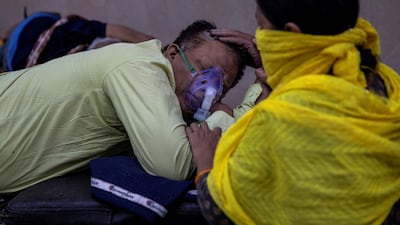
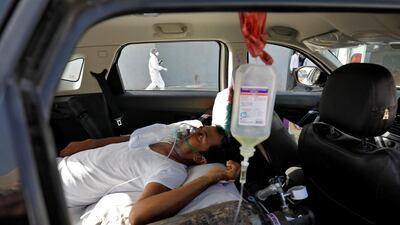
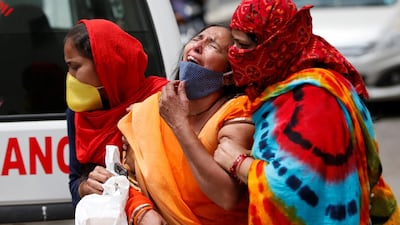
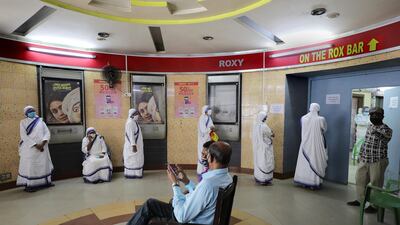
The numbers are grim. In the 24 hours to Sunday morning, India reported almost 350,000 new coronavirus cases, setting a record for the most Covid-19 infections for a fourth consecutive day. More than 2,000 lives were lost during this time, bringing the total national death toll to 190,000. As of Sunday, nearly 17 million residents have reportedly contracted the virus.
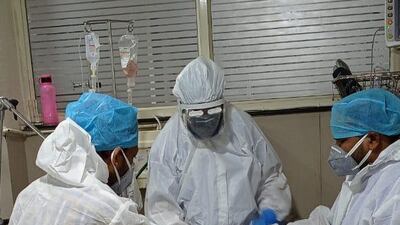
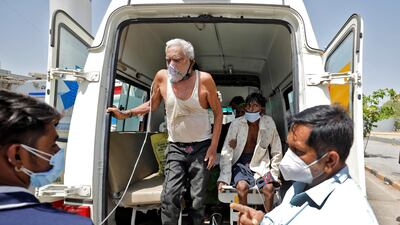
Behind these cold statistics are individual human beings, as is often pointed out. And it is impossible not to be moved by any of their stories: of those who suffer, have suffered or died; of their near and dear ones who have tried to get them much-needed medical attention; of medical professionals and other frontline workers who have risked their own lives in order to save those of others.
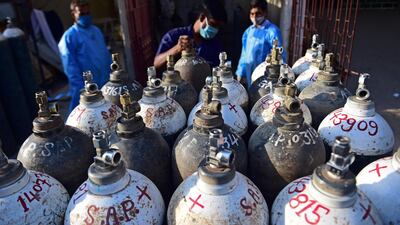
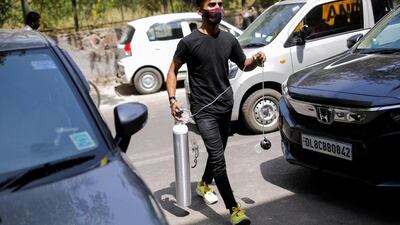
The deaths of 13 Covid-19 patients in a hospital fire in Mumbai on Friday tragically encapsulates a larger story, of the ailing healthcare infrastructure in many Indian cities. Hospitals have found themselves unable to take in more patients, faced by a shortage of beds, equipment, manpower and even medical oxygen. The country's pharmaceutical industry, which has been at the forefront of global vaccine production, is now struggling to deliver under the enormous pressure at home. And even as the various organs of government, civil society and the private sector urgently offer whatever help they can provide, warnings from frontline doctors that the surge is only the "tip of the iceberg" portend something more calamitous.
To some extent, what has happened in India could happen anywhere. Earlier in this pandemic, healthcare systems in countries like Italy and Brazil were completely overwhelmed. In the past year, it has become clear that a global effort and strict measures are needed to combat this pandemic and save lives.
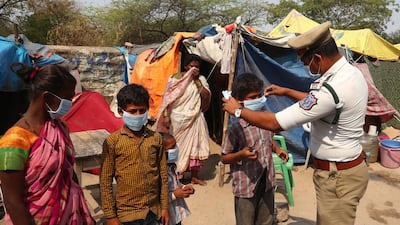
Optimism in the course of progress fighting the pandemic always carries the danger of complacency. India escaped last year's first wave largely unscathed, due in part to an effective lockdown. In absolute terms, the country is implementing the world's largest Covid-19 inoculation drive, with 127 million doses already given. Thus some government officials, politicians and the public dropped their guard. Election campaigns, with large crowds, have been held in a handful of states. Religious festivals and various social gatherings, where people were seen without masks, became superspreaders. Health authorities, meanwhile, did not anticipate a need to stock up on medical oxygen and vaccines for a second wave that many experts have pointed out was all but inevitable.
Amid the chaos, the international community is rightly rallying around India. Saudi Arabia is sending liquid oxygen; the UAE and Singapore are in talks to export oxygen tankers; Germany has offered oxygen generation plants. Members of US Congress, meanwhile, are pressing their government to support India's proposal at the World Trade Organisation to grant a waiver from intellectual property rights protections to Covid-19 vaccines, therapeutics and related technologies.
Even India's so-called adversaries are pitching in. Pakistan, with which it has fought three wars, is offering to send ambulances and volunteers. China, with which it is embroiled in a border dispute, is offering technological support.
Undoubtedly, there are lessons to be learnt from the Indian example and its current devastating surge. But now is the time for solidarity with India and its people.
Time and again, this pandemic has shown how inter-connected and inter-dependent the world really is. Despite the efforts by some nations to go it alone, no one country can solve all of its problems by itself.
What is Reform?
Reform is a right-wing, populist party led by Nigel Farage, a former MEP who won a seat in the House of Commons last year at his eighth attempt and a prominent figure in the campaign for the UK to leave the European Union.
It was founded in 2018 and originally called the Brexit Party.
Many of its members previously belonged to UKIP or the mainstream Conservatives.
After Brexit took place, the party focused on the reformation of British democracy.
Former Tory deputy chairman Lee Anderson became its first MP after defecting in March 2024.
The party gained support from Elon Musk, and had hoped the tech billionaire would make a £100m donation. However, Mr Musk changed his mind and called for Mr Farage to step down as leader in a row involving the US tycoon's support for far-right figurehead Tommy Robinson who is in prison for contempt of court.
At a glance - Zayed Sustainability Prize 2020
Launched: 2008
Categories: Health, energy, water, food, global high schools
Prize: Dh2.2 million (Dh360,000 for global high schools category)
Winners’ announcement: Monday, January 13
Impact in numbers
335 million people positively impacted by projects
430,000 jobs created
10 million people given access to clean and affordable drinking water
50 million homes powered by renewable energy
6.5 billion litres of water saved
26 million school children given solar lighting
UAE%20Warriors%2045%20Results
%3Cp%3E%3Cstrong%3E%0DMain%20Event%0D%3A%20Lightweight%20Title%3C%2Fstrong%3E%0D%3Cbr%3EAmru%20Magomedov%20def%20Jakhongir%20Jumaev%20-%20Round%201%20(submission)%0D%3Cbr%3E%3Cstrong%3ECo-Main%20Event%0D%3A%20Bantamweight%3C%2Fstrong%3E%0D%3Cbr%3ERany%20Saadeh%20def%20Genil%20Franciso%20-%20Round%202%20(submission)%0D%3Cbr%3E%3Cstrong%3ECatchweight%20150%20lbs%3C%2Fstrong%3E%0D%3Cbr%3EWalter%20Cogliandro%20def%20Ali%20Al%20Qaisi%20-%20Round%201%20(TKO)%0D%3Cbr%3E%3Cstrong%3EBantamweight%3C%2Fstrong%3E%0D%3Cbr%3ERenat%20Khavalov%20def%20Hikaru%20Yoshino%20-%20Round%202%20(TKO)%0D%3Cbr%3E%3Cstrong%3EFlyweight%3C%2Fstrong%3E%0D%3Cbr%3EVictor%20Nunes%20def%20Nawras%20Abzakh%20-%20Round%201%20(TKO)%0D%3Cbr%3E%3Cstrong%3EFlyweight%3C%2Fstrong%3E%0D%3Cbr%3EYamato%20Fujita%20def%20Sanzhar%20Adilov%20-%20Round%201%20(submission)%0D%3Cbr%3E%3Cstrong%3ELightweight%3C%2Fstrong%3E%0D%3Cbr%3EAbdullo%20Khodzhaev%20def%20Petru%20Buzdugen%20-%20Round%201%20(TKO)%0D%3Cbr%3E%3Cstrong%3ECatchweight%20139%20lbs%3C%2Fstrong%3E%0D%3Cbr%3ERazhabali%20Shaydullaev%20def%20Magomed%20Al-Abdullah%20-%20Round%202%20(submission)%0D%3Cbr%3E%3Cstrong%3EFlyweight%3C%2Fstrong%3E%0D%3Cbr%3ECong%20Wang%20def%20Amena%20Hadaya%20-%20Points%20(unanimous%20decision)%0D%3Cbr%3E%3Cstrong%3EMiddleweight%3C%2Fstrong%3E%0D%3Cbr%3EKhabib%20Nabiev%20def%20Adis%20Taalaybek%20Uulu%20-%20Round%202%20(submission)%0D%3Cbr%3E%3Cstrong%3ELight%20Heavyweight%3C%2Fstrong%3E%0D%3Cbr%3EBartosz%20Szewczyk%20def%20Artem%20Zemlyakov%20-%20Round%202%20(TKO)%3C%2Fp%3E%0A
What the law says
Micro-retirement is not a recognised concept or employment status under Federal Decree Law No. 33 of 2021 on the Regulation of Labour Relations (as amended) (UAE Labour Law). As such, it reflects a voluntary work-life balance practice, rather than a recognised legal employment category, according to Dilini Loku, senior associate for law firm Gateley Middle East.
“Some companies may offer formal sabbatical policies or career break programmes; however, beyond such arrangements, there is no automatic right or statutory entitlement to extended breaks,” she explains.
“Any leave taken beyond statutory entitlements, such as annual leave, is typically regarded as unpaid leave in accordance with Article 33 of the UAE Labour Law. While employees may legally take unpaid leave, such requests are subject to the employer’s discretion and require approval.”
If an employee resigns to pursue micro-retirement, the employment contract is terminated, and the employer is under no legal obligation to rehire the employee in the future unless specific contractual agreements are in place (such as return-to-work arrangements), which are generally uncommon, Ms Loku adds.
The%20specs
%3Cp%3E%3Cstrong%3EPowertrain%3A%20%3C%2Fstrong%3ESingle%20electric%20motor%0D%3Cbr%3E%3Cstrong%3EPower%3A%20%3C%2Fstrong%3E201hp%0D%3Cbr%3E%3Cstrong%3ETorque%3A%20%3C%2Fstrong%3E310Nm%0D%3Cbr%3E%3Cstrong%3ETransmission%3A%20%3C%2Fstrong%3ESingle-speed%20auto%0D%3Cbr%3E%3Cstrong%3EBattery%3A%20%3C%2Fstrong%3E53kWh%20lithium-ion%20battery%20pack%20(GS%20base%20model)%3B%2070kWh%20battery%20pack%20(GF)%0D%3Cbr%3E%3Cstrong%3ETouring%20range%3A%20%3C%2Fstrong%3E350km%20(GS)%3B%20480km%20(GF)%0D%3Cbr%3E%3Cstrong%3EPrice%3A%20%3C%2Fstrong%3EFrom%20Dh129%2C900%20(GS)%3B%20Dh149%2C000%20(GF)%0D%3Cbr%3E%3Cstrong%3EOn%20sale%3A%3C%2Fstrong%3E%20Now%3C%2Fp%3E%0A
Key facilities
- Olympic-size swimming pool with a split bulkhead for multi-use configurations, including water polo and 50m/25m training lanes
- Premier League-standard football pitch
- 400m Olympic running track
- NBA-spec basketball court with auditorium
- 600-seat auditorium
- Spaces for historical and cultural exploration
- An elevated football field that doubles as a helipad
- Specialist robotics and science laboratories
- AR and VR-enabled learning centres
- Disruption Lab and Research Centre for developing entrepreneurial skills
Asia Cup Qualifier
Venue: Kuala Lumpur
Result: Winners play at Asia Cup in Dubai and Abu Dhabi in September
Fixtures:
Wed Aug 29: Malaysia v Hong Kong, Nepal v Oman, UAE v Singapore
Thu Aug 30: UAE v Nepal, Hong Kong v Singapore, Malaysia v Oman
Sat Sep 1: UAE v Hong Kong, Oman v Singapore, Malaysia v Nepal
Sun Sep 2: Hong Kong v Oman, Malaysia v UAE, Nepal v Singapore
Tue Sep 4: Malaysia v Singapore, UAE v Oman, Nepal v Hong Kong
Thu Sep 6: Final
Asia Cup
Venue: Dubai and Abu Dhabi
Schedule: Sep 15-28
Teams: Afghanistan, Bangladesh, India, Pakistan, Sri Lanka, plus the winner of the Qualifier
Benefits of first-time home buyers' scheme
- Priority access to new homes from participating developers
- Discounts on sales price of off-plan units
- Flexible payment plans from developers
- Mortgages with better interest rates, faster approval times and reduced fees
- DLD registration fee can be paid through banks or credit cards at zero interest rates
Company Profile
Name: Thndr
Started: 2019
Co-founders: Ahmad Hammouda and Seif Amr
Sector: FinTech
Headquarters: Egypt
UAE base: Hub71, Abu Dhabi
Current number of staff: More than 150
Funds raised: $22 million
THE SPECS
Aston Martin Rapide AMR
Engine: 6.0-litre V12
Transmission: Touchtronic III eight-speed automatic
Power: 595bhp
Torque: 630Nm
Price: Dh999,563
Ten tax points to be aware of in 2026
1. Domestic VAT refund amendments: request your refund within five years
If a business does not apply for the refund on time, they lose their credit.
2. E-invoicing in the UAE
Businesses should continue preparing for the implementation of e-invoicing in the UAE, with 2026 a preparation and transition period ahead of phased mandatory adoption.
3. More tax audits
Tax authorities are increasingly using data already available across multiple filings to identify audit risks.
4. More beneficial VAT and excise tax penalty regime
Tax disputes are expected to become more frequent and more structured, with clearer administrative objection and appeal processes. The UAE has adopted a new penalty regime for VAT and excise disputes, which now mirrors the penalty regime for corporate tax.
5. Greater emphasis on statutory audit
There is a greater need for the accuracy of financial statements. The International Financial Reporting Standards standards need to be strictly adhered to and, as a result, the quality of the audits will need to increase.
6. Further transfer pricing enforcement
Transfer pricing enforcement, which refers to the practice of establishing prices for internal transactions between related entities, is expected to broaden in scope. The UAE will shortly open the possibility to negotiate advance pricing agreements, or essentially rulings for transfer pricing purposes.
7. Limited time periods for audits
Recent amendments also introduce a default five-year limitation period for tax audits and assessments, subject to specific statutory exceptions. While the standard audit and assessment period is five years, this may be extended to up to 15 years in cases involving fraud or tax evasion.
8. Pillar 2 implementation
Many multinational groups will begin to feel the practical effect of the Domestic Minimum Top-Up Tax (DMTT), the UAE's implementation of the OECD’s global minimum tax under Pillar 2. While the rules apply for financial years starting on or after January 1, 2025, it is 2026 that marks the transition to an operational phase.
9. Reduced compliance obligations for imported goods and services
Businesses that apply the reverse-charge mechanism for VAT purposes in the UAE may benefit from reduced compliance obligations.
10. Substance and CbC reporting focus
Tax authorities are expected to continue strengthening the enforcement of economic substance and Country-by-Country (CbC) reporting frameworks. In the UAE, these regimes are increasingly being used as risk-assessment tools, providing tax authorities with a comprehensive view of multinational groups’ global footprints and enabling them to assess whether profits are aligned with real economic activity.
Contributed by Thomas Vanhee and Hend Rashwan, Aurifer
UAE currency: the story behind the money in your pockets