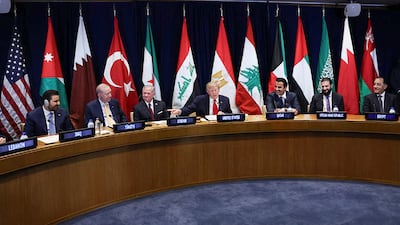

It’s hard to overestimate the impact of the US midterm elections. It wasn’t a defeat for the Republican Party so much as a near-extermination event – even though Donald Trump has more than two years left as President. Democrats won almost every important election across the country, flipping the most unlikely areas, including Mississippi, South Carolina and Texas. Democrats also won most state governments, even where they have been frozen out for over a generation.
Incoming officials will be inaugurated in January, giving everyone some indispensable weeks to adjust to a new power balance in Washington.
Mr Trump is now fully a lame-duck President, and has been badly repudiated. Yet he will retain control over most aspects of foreign policy, and many key congressional decisions will require Senate super-majorities that are unlikely, including to override presidential vetoes on most legislation and to convict and remove from office any official impeached by the House of Representatives.
Nonetheless, Mr Trump may be greatly constrained, potentially by spending restrictions and certainly by regulation and investigations by an aggressive new Democratic Party majority. Washington is not only going to be different than it was before next January, the change is going to look nothing like normal midterm elections in which the president’s party usually suffers a setback.
What has just happened, however, is an off-the-charts demolition. Democrats will believe, and can persuasively argue, that they have a mandate for change given the scope of their nationwide victories, and since most of these elections weren’t remotely close. Republicans not only lost almost every important election, but they didn’t come close in most.
So a newly empowered Democratic Party will pursue a record of tangible achievement, even if they lack the supermajority to overcome presidential vetoes. So US partners in the Middle East will do well to prepare carefully to best cope or even gain advantage from the inevitable changes.
Gulf Arab countries face among the trickiest conundrums. Their overwhelming priority over the past year has, correctly, been to try to prevent a major resurgence of war with Iran, particularly since they will be the main targets of Tehran’s retaliation. This is because attacking them constitutes not just an attack on their residents but the globally economy, too. It also strikes at a model of engagement with the world that is a threatening contrast to the theocratic, closed and belligerent attitude that Iran has adopted since 1979.
The Democrats are likely to want to restrain Mr Trump, and they can mainly do that by restricting funds. But the Gulf countries need the war to end without advantaging Tehran strategically. If Washington simply walks away and lifts its blockade of Iranian ports, the war will probably degenerate into a strategic net positive for Tehran in coming years.
This is unacceptable, and it’s necessary for the regional governments to work closely with the Democrats, especially in the Senate, to avoid both scenarios that are bad for Washington and Gulf countries simultaneously: resuming the war without any serious plan for how to avoid the worst consequences, or walking away – with or without an agreement – that leaves Iran in a far stronger strategic position.
Mr Trump may be tempted to extend the status quo with Iran until he leaves office. This should be acceptable to both the Democrats and the Gulf states in the short run. It is preferable to ending the war to Iran’s advantage or returning to major bombardment without any clear strategic plan (which may not be available at present). So after January, the White House ought to be willing to work with both Democrats and America’s Gulf partners to try to keep up economic pressure on Tehran without intensified bombardment, and even despite limited Iranian provocations.
This is an uncomfortable outcome, but probably the best that can be achieved under given circumstances over the next two years. Meanwhile, an important dialogue with both Democrats and Republicans about what the next president would do, with the support of Congress, is essential.
Other Arab countries have their own delicate priorities. Iraq needs the US and the Gulf countries to continue as bulwarks against overbearing Iranian hegemony.
-
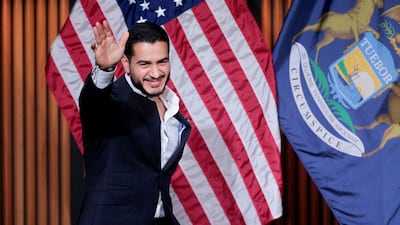
Abdul El-Sayed, who has become the first Muslim to be elected to the US Senate, celebrates his milestone victory in Detroit, Michigan. Reuters -
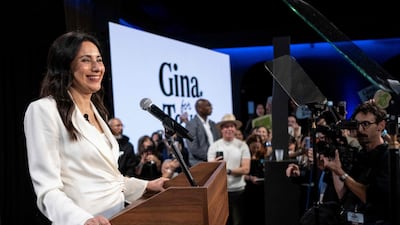
Gina Hinojosa, who has been elected as the first Latina governor of Texas, addresses supporters. AFP -
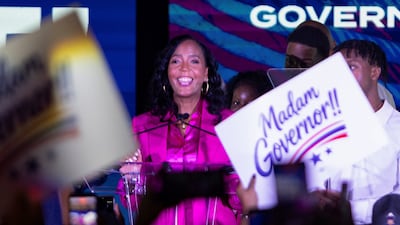
Democrat Keisha Lance Bottoms addresses supporters in Atlanta, Georgia, after becoming the first African American woman to be elected governor of a state. Reuters -
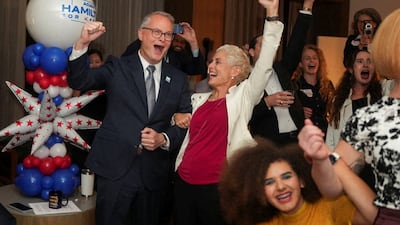
Adam Hamilton, Democratic Senate candidate for Kansas, celebrates in Overland Park as the results pour in. Reuters -
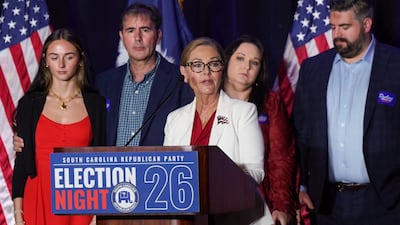
Republican Senator Darline Graham concedes defeat to Annie Andrews in the South Carolina race. AFP -

Annie Andrews, the Democratic Senate candidate for South Carolina, celebrates with her family in Charleston as results pour in. Senate. AFP -
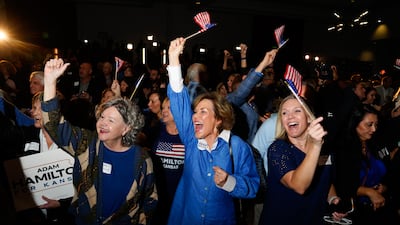
Supporters of Adam Hamilton, the Democratic Senate candidate for Kansas, cheer during an election night event in Overland Park. Bloomberg -

Roy Cooper, Democratic Senate candidate and former North Carolina governor, attends an election night rally. Reuters -
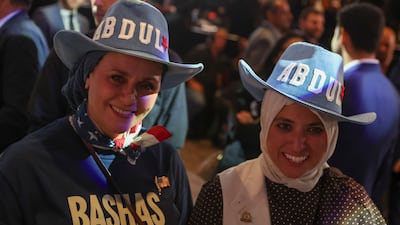
Supporters of US Senate candidate Abdul El-Sayed attend the Michigan Democrats' election night watch party in Detroit. EPA -
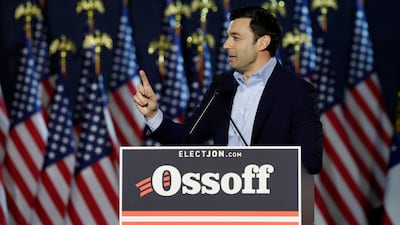
US Senator Jon Ossoff, Democrat from Georgia, speaks in Atlanta after winning re-election. AFP -
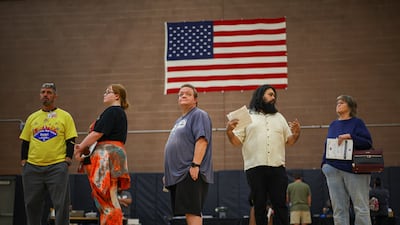
People stand in line to vote in the US midterm elections at Boulder City High School in Boulder City, Nevada. Reuters -
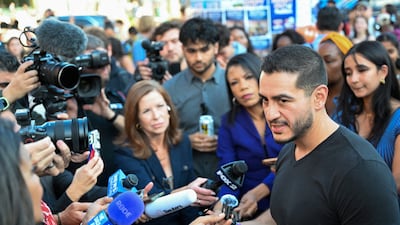
Democratic candidate for US Senate, Abdul El-Sayed, speaks to the media as he visits a polling site in Ann Arbor, Michigan. Reuters -
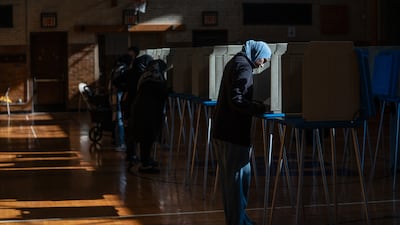
Voter cast their ballots in Dearborn, Michigan. Bloomberg -
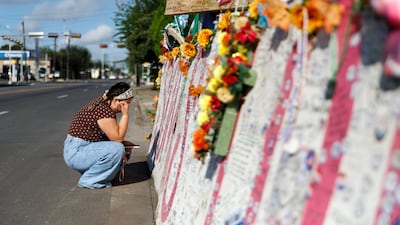
A voter cries after placing their "I Voted" sticker on a memorial for Lorenzo Salgado Araujo, who was shot dead by an Immigration and Customs Enforcement officer in July, in Houston, Texas. Bloomberg -
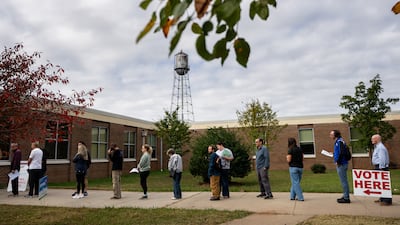
Voters wait in line to cast their ballots in Durham, North Carolina. Bloomberg -
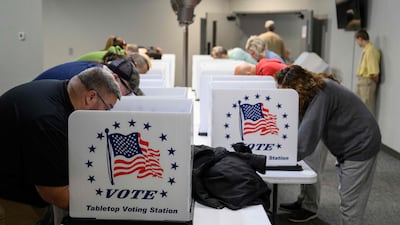
Voters cast their US midterm election ballots at a polling station at the Bridge of Hope Church in Youngstown, Ohio. AFP -
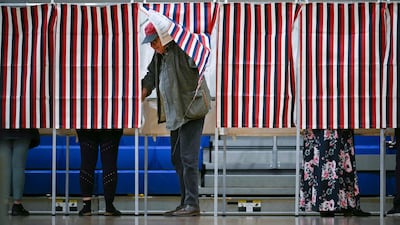
Voters in South Portland, Maine. AFP -
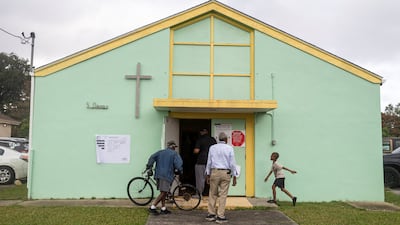
Orleans parish election commissioner Calvin Alexander stands outside St David Baptist Church, as residents arrive to vote in New Orleans, Louisiana. Reuters -
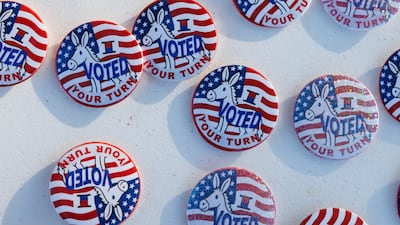
Badges at a polling site in Clayton, North Carolina. Bloomberg -
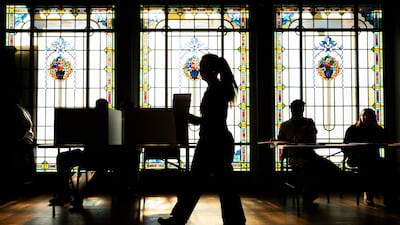
US voters cast their ballots at the Museum of Contemporary Art in Arlington, Virginia. EPA -
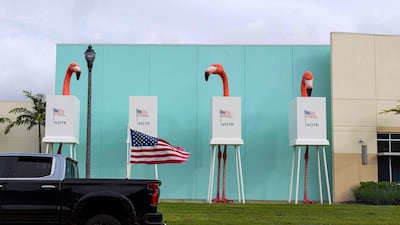
Flamingos created by artist Matthew Mazzotta outside the Supervisor of Elections building in West Palm Beach, Florida. AFP -
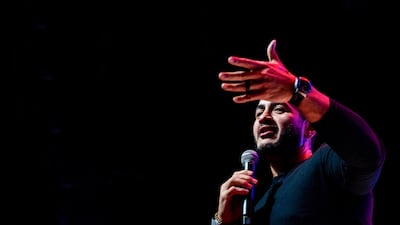
Abdul El-Sayed, Democratic US Senate candidate, from Michigan, speaks during a campaign event at the Majestic Theatre in Detroit. Bloomberg -

Republican Senate candidate Mike Rogers greets supporters as he takes the stage at a campaign rally in Rochester Hills, Michigan. AFP -
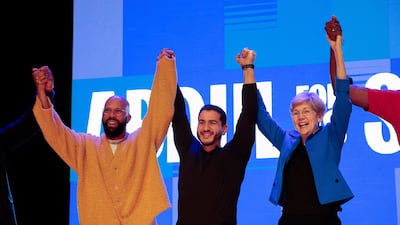
Mr El-Sayed attends a campaign rally with rapper Common and US Senator Elizabeth Warren ahead of the midterm elections, in Detroit, Michigan. Reuters -
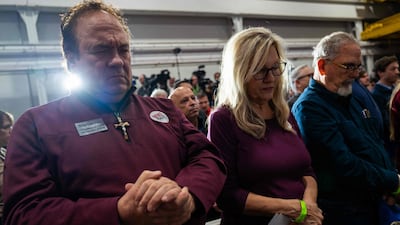
People pray during a rally for Michigan Republican Senate candidate Mike Rogers, in Rochester Hills. AFP -
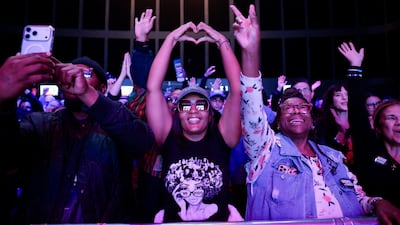
Supporters attend Mr El-Sayed's campaign rally with Common, in Detroit. Reuters -
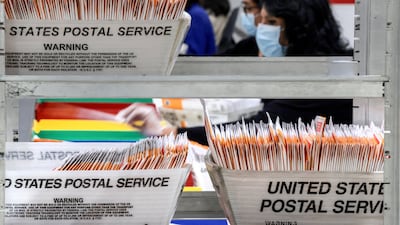
Midterm election ballots are extracted from envelopes at the Los Angeles County Ballot Processing Centre, in City of Industry, California. Reuters -
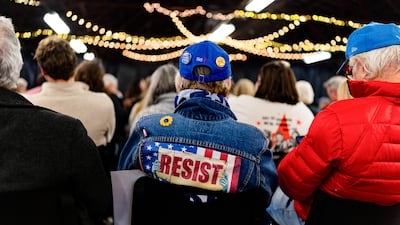
An attendee wears a "Resist" jacket during a campaign event with Abdul El-Sayed, Democratic US Senate candidate from Michigan. Bloomberg -
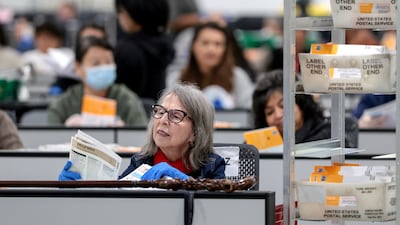
Election staff at work at the LA County Ballot Processing Centre. Reuters -
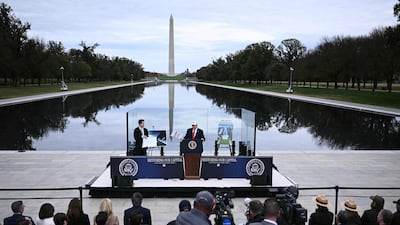
US President Donald Trump delivers a speech marking the end of the midterm election campaign, in Washington DC, the day before voting starts. AFP


Jordan needs continued American and Arab support to maintain the quiet but indispensable balancing role that country serves. The best way to do that is quietly remind all parties why it is so important to everybody that Jordan remain Jordan and keep doing what Jordan does, which is let off a great deal of steam in an otherwise unstable area of the world.
Lebanon desperately needs congressional support for aid to develop its military as it tries to build the capability and political strength to challenge Hezbollah and take control of key areas of the south, which is necessary to end the war with Israel. Both Congress and the White House need to be convinced about how important support for Beirut against the Tehran proxy has become.
But that means cultivating Washington’s pressure against Israel’s overreach in Lebanon. It is essential that both the White House and Congress let the next Israeli government understand that there’s no American support for the madcap scheme of surrounding Israel with buffer zones violently cleansed of their former Arab populations and, in many cases, rendered practically uninhabitable. This applies to not just Lebanon, but also Gaza, Syria and possibly, eventually, probably also parts of the West Bank.
Finally, a large section of the US force posture in the Middle East, and especially the Gulf region, is an anachronism inherited from the era beginning with the 1990 liberation of Kuwait. It’s in everyone’s interest that this US military footprint be right-sized and becomes better suited to the missions likely to be undertaken in coming decades. Many more, but significantly smaller, facilities might be more suitable than the current lumbering structure, which is not terribly effective.
Both Democrats and Republicans, as well as Arabs across the Middle East, should welcome such a US force posture correction. It would actually strengthen US ties to the region and military effectiveness into the medium term.
There is a lot of available common ground going forward, if only all the relevant stakeholders find it together.

