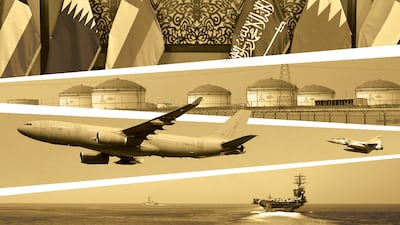

The wars of recent months have exposed a troubling reality: despite a substantial American military presence and decades of close defence co-operation between the US and Arab countries, the security partnerships have neither deterred Iran nor fully shielded the region from its attacks.
Two shortcomings stand out. The first is technical: traditional air defences that the US and its partners used have grappled with Iran’s asymmetric use of large numbers of missiles and inexpensive drones. The second is political: Washington embarked on a war that some of the region’s leaders had warned could have devastating consequences for their countries.
They raise two questions. Can the US and its partners repair the gaps in the security umbrella? And will another costly Middle Eastern war weaken American public and political support for a sustained regional role?
The answers remain uncertain. But enduring US interests make a wholesale withdrawal unlikely. And Arab states are likely to maintain a central strategic partnership with the US while strengthening their own capabilities, adding partners and pursuing diplomacy to reduce the danger of renewed conflict.
Military history is marked by moments when new technologies overturn established assumptions. The widespread use of inexpensive drones, alongside large missile inventories, in Ukraine and the latest war with Iran, has highlighted another such shift. The American umbrella did not fall short because it was not equipped. It did so because it had not anticipated or prepared for the nature of these evolving threats.
Saturation attacks can exhaust interceptors and overwhelm defences; the cost of shooting down a cheap drone may vastly exceed the cost of launching it. The US retains formidable offensive capabilities, as demonstrated by its and Israel’s ability to strike targets in Iran. But the ability to punish an adversary is different from the ability to shield cities, energy installations, airports and ports from retaliation.
American military planners and defence firms are intensifying work on cheaper interceptors, counter-drone systems, directed-energy weapons and AI-assisted detection and targeting. The outcome of that technological race is impossible to predict. In the near term, however, Iran and its partners are likely to retain the capacity to inflict damage, even against sophisticated defences. In the medium term, new technological advances may once again shift the regional balance of power or give regional countries more effective defences.
The military vulnerabilities were compounded by political decisions. The region’s leaders understood that a war perceived as existential by Tehran could prompt attacks on their territory and disruptions to the Strait of Hormuz. They warned against that scenario. Yet US President Donald Trump, encouraged by Israeli Prime Minister Benjamin Netanyahu, chose a military course that exposed America’s partners to precisely those risks.
Mr Trump has subsequently appeared more attentive to regional concerns and has explored a negotiated outcome. But diplomacy has yet to produce a durable settlement, and the risk of renewed large-scale fighting is emerging once again. For the regional governments, the lesson might be concerning: close relations with Washington do not necessarily translate into influence over decisions with existential implications for their security.
-

US Vice President JD Vance looks on next to US President Donald Trump's son-in-law Jared Kushner, as Iran's Foreign Minister Abbas Araqchi shakes hands with Pakistan's Prime Minister Shehbaz Sharif. Getty Images -

US Vice President JD Vance makes an opening statement at the start of the quadrilateral meeting. Reuters -

JD Vance listens to Jared Kushner. AFP -

JD Vance looks on as Pakistan's Prime Minister Shehbaz Sharif speaks while holding the hand of Sheikh Mohammed bin Abdulrahman, Qatar’s Prime Minister and Minister of Foreign Affairs. Getty images -

JD Vance, second left, US special envoy Steve Witkoff, second right, and Jared Kushner, right, meet Pakistani Prime Minister Shehbaz Sharif, centre, and Chief of Army Staff Field Marshal Asim Munir, left. AFP -

Swiss Vice President Ignazio Cassis, right, with Rafael Grossi, director general of the International Atomic Energy Agency. Photo: IAEA -

Iranian Foreign Minister Abbas Araghchi, second left, meets Mr Cassis, who is also Switzerland's Foreign Minister. Reuters -

Mr Cassis speaks with Qatari Prime Minister and Minister of Foreign Affairs, Sheikh Mohammed bin Abdulrahman bin Jassim Al Thani. Photo: FDFA -

Talks are expected to last for several days at the Burgenstock Resort, authorities said. Reuters -

The media centre in the Tennis Hall at Burgenstock. Reuters


There is also a longer-term question. After Iraq and Afghanistan, could another costly Middle East war turn US voters and future presidents against maintaining a substantial regional presence? Washington is likely to reassess its regional posture, favouring a leaner, technologically advanced and less vulnerable deployment, but retrenchment is not the same as disengagement.
The US has enduring interests in keeping Gulf energy flowing to world markets and critical waterways open; preventing Iran from acquiring nuclear weapons or dominating the region; protecting Israel; and sustaining partnerships with Gulf states whose importance now extends beyond hydrocarbons to investment, defence industries, advanced technology and artificial intelligence. Even an energy-producing America remains vulnerable to a global recession caused by a prolonged Gulf supply shock.
Many American politicians from both parties disagree sharply about how the war was launched and prosecuted. Yet disagreement over methods does not amount to a consensus for abandoning these interests. Interestingly, the positions of potential presidential candidates from both parties confirm this view. Future administrations may adopt different strategies, but are unlikely to pull out wholesale from the region; indeed, they will grapple with many of the same dilemmas that have shaped US-Gulf policy since 1979.
The regional states face a demanding agenda. Politically, they are justified in asking why exceptionally warm relations with Washington did not prevent a war they considered dangerous. They will need stronger mechanisms for consultation and greater input into decisions affecting regional escalation, as well as a serious role in shaping any settlement with Iran.
Militarily, there is no other great power currently able to replace the US as most Arab countries’ principal strategic security partner. Hence, they will work with Washington as it rethinks the shape of its future security presence and relationships in the region. But the American partnership, while necessary, is no longer sufficient.

The answer is less a matter of hedging against America than of adding layers to what is likely to remain an American-centred system: stronger national armed forces and industries; more effective intelligence-sharing and integrated air defence; and additional security relationships. Saudi Arabia’s engagement with Turkey and Pakistan points in this direction, as do opportunities to draw on European, Ukrainian, South Korean and other expertise in equipment, training and counter-drone innovation. Some countries will draw closer to Israel.
It is not America or other partners, but America and other partners.
The Gulf is understandably focused on building further resilience into its economies. Protecting energy, water, power, transport and digital infrastructure will require redundancy, dispersed facilities, rapid-repair capacity and strategic reserves. Alternative pipelines, ports and overland corridors – which are already in the works – can reduce dependence on vulnerable maritime chokepoints, even if geography cannot be wished away.
Finally, Arab countries understand that defence needs to be accompanied by energetic diplomacy. Iran is a permanent neighbour, and Gulf states have every reason to pursue de-escalation, crisis-management channels and arrangements that lower the risk of repeated wars. Military deterrence and diplomatic engagement are complementary, not contradictory.
The outcome of the current confrontation remains uncertain. Whether it moves towards another round of escalation or arrives at a limited agreement, the region is likely to be facing years of insecurity. The emerging regional order is unlikely to be a clean rupture with the American security architecture. More plausibly, it will be an evolution towards a flexible, multilayered system: the US still central, but reinforced by stronger Gulf and Arab capabilities, better GCC co-ordination, wider regional and international partnerships, economic resilience and sustained regional diplomacy.
For the region, the challenge is not to replace the American umbrella. It is to make security less dependent on any single umbrella – and to gain greater control over the decisions that determine whether the region goes to war or moves towards de-escalation and co-operation.

