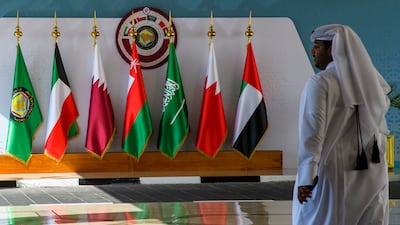

Many of the Gulf countries’ greatest achievements have been built on ambition and an ability to look beyond the limits of geography. During the past half-century, the region and its people have undergone a profound transformation. Small trading ports and pearl-diving communities have become cutting-edge, cosmopolitan cities that serve as global centres for commerce and connection, investment and diplomacy.
Those achievements are real, but, of course, they were also in the shadow of challenges over the years – be they regional or global. Today, ongoing regional conflicts are questioning old assumptions. As trade and shipping routes are disrupted and economies buffeted, several leaders are calling on Gulf countries to build on their considerable common ties to better weather this geopolitical storm.
This was the thinking displayed on Monday when Sheikh Mohammed bin Rashid, Vice President and Ruler of Dubai, emphasised how the bonds between the Gulf nations are too important to be undermined by those who seek to sow division. “The Gulf is a great tree whose branches have multiplied, whose fruits have adorned it, and whose shades have bloomed,” Sheikh Mohamed posted, “but its root is one, and its trunk is one, and its water is one, and its destiny is one, God willing.”
Far from basking in nostalgia or sentiment, however, his message on X was a timely reminder that unity is a source of strength for the Gulf. An aligned approach to critical issues is important at a time when geopolitical tensions and economic uncertainty are testing countries everywhere.
Similarly, Dr Anwar Gargash, diplomatic adviser to UAE President Sheikh Mohamed, earlier this week also called for renewed regional co-ordination. “There is a need to revitalise joint Gulf action, particularly in its security and defence dimensions, and to strengthen the collective security system,” he posted on X.
Often, each member of the GCC has pursued its own development model, shaped by its particular circumstances and ambitions. That is natural, and no-one is arguing that better, targeted regional co-operation has to mean a loss of any autonomy. Each Gulf country has its own institutions and identity, and there is much value in preserving the diversity of approaches that has helped the region soar.
Instead of uniformity, co-operation means recognising that some challenges are better addressed collectively, and that one country’s success can create opportunities for its neighbours. That was a central reason why the GCC was set up in 1981, here in Abu Dhabi. Furthermore, while individual economies carry considerable weight, when co-ordinated, they have the potential to exert an influence that reaches well beyond the sum of their national achievements.
Many of the foundations for such collaboration are already in place. GCC members share maritime routes, have common security concerns and all seek to diversify their economies and develop new industries. Gulf societies are anchored by family ties and a common heritage that predates modern borders. Such connections offer a strong basis for practical partnerships.
National identity and regional solidarity need not compete. The Gulf’s countries remain distinct while recognising the advantages of shared purpose. In a world where influence increasingly depends on partnerships as well as economic strength, this is a strategic imperative. The Gulf’s history demonstrates what determined leadership and a willingness to embrace change can accomplish – its future will do the same.

