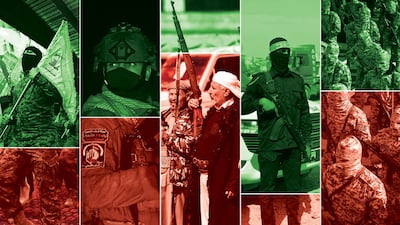

The wars Israel, and later the US, have fought since October 7, 2023 have degraded Iran’s so-called Axis of Resistance and discredited the forward-defence strategy meant to keep fighting away from Iranian territory. But Tehran’s network of armed allies is not irrelevant. Its role in the regime’s strategic calculus has simply been demoted, differentiated and repurposed.
Before October 7, Hezbollah was the crown jewel of Iran’s regional strategy. Built up over decades on Israel’s northern border, it was meant to deter an Israeli or American attack on Iran, backed by strategic depth in Syria, Iraq, Gaza and Yemen, and by Iran’s own missile and drone arsenals. The logic was straightforward: better to confront Iran’s enemies abroad than at home. By threatening devastating retaliation against Israel, the Hezbollah-centred axis was supposed to make an attack on Iran costly.
For years, that strategy appeared to work. But October 7 did not so much disprove the logic of deterrence as change Israel’s calculation of acceptable costs. Deterrence works when the anticipated cost of military action exceeds the perceived threat and the willingness to bear that cost. After October 7, Israel concluded that the threats around it had become close to existential and that eliminating them justified costs it had previously been unwilling to incur.
The result was devastating for Iran. Israel’s subsequent wars degraded Hamas and Gaza, decapitated and devastated Hezbollah, and contributed indirectly to the collapse of Bashar Al Assad’s regime in Syria. With its forward defence weakened, Iran found Israel, and then the US, taking the war directly to its territory last year, and on a much wider scale this year.
The axis failed as a shield. But that does not make it useless as a sword.
Iran’s armed allies continue to give Tehran significant influence. The Houthis have acquired extraordinary leverage around the Bab Al Mandeb strait and against Saudi Arabia. The Iran-aligned Popular Mobilisation Forces in Iraq have helped close Riyadh’s Red Sea energy alternative to the Strait of Hormuz, magnifying Tehran’s leverage over global energy markets. Hezbollah continues to pin down Israeli forces and resources in Lebanon. And Hamas, simply by surviving, frustrates Israel’s ability to declare a definitive victory in Gaza.
What has changed is the hierarchy. Before October 7, the centre of Iran’s deterrence strategy lay in the Levant, particularly Lebanon. That calculation collapsed when Israel showed both a willingness to absorb significant costs and an ability to devastate Hezbollah before the group could deliver the kind of strategic blow Iran had counted on.
The regime has therefore had to re-centre its strategy closer to home. During the direct war, neither Hezbollah nor Iran’s other allies could stop the American and Israeli onslaught. What eventually imposed significant costs were Iran’s own missiles and drones and, above all, its ability to close Hormuz and put pressure on the global economy.
The old strategy was essentially one of insulation: fight enemies abroad, surround Israel with threats and make an attack on Iran so costly that war would never reach Iranian territory. The emerging strategy begins from a harsher premise: if Iran can no longer keep war away from its homeland, it can make the costs of that war spread far beyond it.
Allies become less a defensive perimeter than instruments of regional and global coercion. The aim is no longer simply to threaten unacceptable damage to Israel in retaliation, but to widen the circle of actors who would pay a price for continued war: raising costs for the US, disrupting trade and energy flows, exposing Washington’s Arab partners to risk, thereby pressing the US to limit its own military campaign and restrain Israel.
Iran’s strategic centre of gravity has thus shifted towards the Arabian Gulf and Red Sea, reordering its network of allies.
Before October 7, Hezbollah stood far above the others. Beyond deterring Israel, it trained and supported allied militias, helped preserve the Assad regime and represented the most sophisticated model of Iran’s strategy of building powerful armed movements inside Arab states. Its leader, Hassan Nasrallah, had a high profile in the Arab world and an outsize influence in Tehran.
Today, the Houthis arguably occupy the most valuable position. Their location gives them influence over one of the world’s most important shipping routes, while enabling them to threaten Saudi Arabia. The PMF militias also retain considerable value as they sit astride Iran’s western approaches, complicate the ability of hostile forces to operate through Iraq and can threaten alternative energy routes.
Hezbollah, by contrast, has fallen sharply in relative importance. It can no longer credibly deter Israel; its position has deteriorated following the fall of the Assad regime, the emergence of a more hostile government in Beirut, and expanding Israeli military pressure and occupation in Lebanon. It is also far from the new main battleground. Yet it is hardly irrelevant: it remains the only Iran-aligned force directly pressuring Israel’s north and tying down substantial Israeli resources.
One way of understanding Iran’s new strategic hierarchy is through what might be dubbed as “The Six Hs” in descending order of strategic priority: homeland deterrence, based on Iran’s own missiles and drones; Hormuz, its most powerful weapon against the global economy; the Houthis, with leverage over Bab Al Mandeb and Saudi Arabia; the Hashd Forces (another name for the PMF), which protect Iran’s western flank and can project power into the Gulf; Hezbollah, which directly engages the Israelis; and Hamas, badly weakened but still useful in denying Israel a clean victory and preserving some Iranian influence over the Palestinian-Israeli arena and the future of Arab-Israeli relations.

While this hierarchy puts Iran’s own military capabilities above those of its allies, it also shows how much those allies still matter. As long as the regime believes it is engaged in an existential struggle, the cost-benefit calculation remains straightforward. Its allies can still impose costs on Israel, the US, Washington’s Arab partners and the global economy. They therefore add bargaining leverage both in seeking an end to the current confrontation and in shaping any eventual settlement.
The calculation differs from one ally to another. Hezbollah provided the greatest strategic value but was also extraordinarily expensive. Iran helped finance not only a vast military infrastructure but also a large socioeconomic support network and repeated reconstruction after wars. The Houthis and Iraqi militias do not necessarily impose comparable burdens while now providing considerable strategic leverage.
The future of the axis may become a serious question only in a genuinely post-war environment, when Iran no longer feels existentially vulnerable and moves from a war footing towards economic recovery, foreign investment and better relations with Gulf states. Tehran might then calculate that maintaining heavily armed militias across several Arab states carries more political and economic cost than strategic benefit, and such forces could conceivably become bargaining chips in a broader regional settlement.
But Iran is not there yet. The lesson it appears to have drawn from the past three years is not that its allies have failed and should be discarded, but that the axis has a new role in a different strategy. It failed as a shield, but as Tehran seeks to raise the costs of war for its adversaries, it still has considerable value as a sword.

