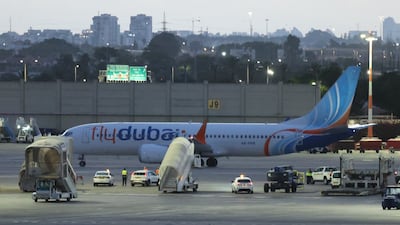

For most passengers, the two pilots seated in the cabin of flydubai flight FZ1073 on Wednesday morning would have gone unnoticed.
They were not operating the service between Dubai and Tel Aviv. Instead, they were travelling as passengers. They were being repositioned for their next assignment – a routine but essential part of the complex choreography that keeps an airline’s network moving.
However, when an incident unfolded in the cockpit of the plane at 34,000ft, a routine journey assumed a far greater significance.
The two off-duty flydubai pilots were among the crew who reached the flight deck and helped bring the aircraft – a Boeing 737 Max 8 – safely to the ground in Tabuk, Saudi Arabia, after the aircraft was diverted from its scheduled route.

Their presence has cast an unusual spotlight on a little-known aspect of airline operations: “deadheading”.
Airlines around the world transport pilots and cabin crew around their networks as passengers so they can report for their next assignment. It is usually a matter of scheduling, logistics and cost. But flight FZ1073 showed what can happen when carefully planned crew movements intersect with an emergency.
The pilot and co-pilot of this fated flydubai flight were injured on Wednesday after an altercation on the flight deck, leading to the plane plunging about 17,400ft in a matter of seconds. That is when reserve crew members from among the passengers took charge and landed the plane in Tabuk.
Much remains unknown about what happened on board. The UAE's General Civil Aviation Authority said it was investigating to “determine the causes and circumstances of the incident”.
What is deadheading?
In aviation, deadheading is when an airline employee – a pilot or a cabin crew member – travels as a passenger rather than working the flight, usually because the airline needs to position them somewhere to operate another flight.
For instance, a pilot in Dubai may need to operate a flight from London the next morning. The airline could put them on a Dubai to London flight as a passenger. That journey is called deadheading.
In simple terms, it means crew positioning. It is a routine part of airlines’ scheduling, allowing them to move staff around their networks.
The Federal Aviation Administration says deadhead transportation is “not considered an assignment involving flight time and is not part of a duty period, and is not considered rest”.
In the global aviation framework governed by the International Civil Aviation Organisation, a deadheading pilot is officially referred to as “positioning” crew, an off-duty pilot who travels as a passenger at the behest of their airline.
Deadhead pilots must travel in uniform while on duty, representing their airline even as passengers.
When approached by The National, flydubai did not comment on the airline’s deadheading crew onboard the Tel Aviv flight on Wednesday.
Why pilots sometimes fly as passengers
This is routine where airlines need additional resources to manage flight hours between staff, as well as for relief or crew repositioning flights, explains Saj Ahmad, chief analyst at StrategicAero Research.
“It's pretty standard and no one normally bats an eyelid. The concept of deadheading is more prominent on longer haul flights rather than short haul, where sometimes the same pilots may fly one short sector several times in a day,” he tells the The National.
Concept more relevant now
While it is a normal part of airline crew planning, a large increase in deadheading can signal that an airline is having to reposition crews more extensively because of schedule disruptions or an uneven network.
Airlines flying through the Middle East have had to rejig their flight paths repeatedly owing to the disruptions owing to the Iran war since it broke out on February 28.
“Deadheading, or crew flying as passengers, has become more prevalent since the US-Iran war given that Gulf airlines have had to shuffle their networks and capacity to better match demand and support routes that have spiked given the summer season,” says Mr Ahmad.
The process helps manage flying disruptions such as cancellations, delays or schedule changes, and allows airlines to help reposition pilots quickly.
“Airlines determine whether a flight needs two, three, or four pilots by applying flight‑time‑limitation rules, fatigue‑risk management, and operational factors. The decision is regulatory, mathematical, and operational – not discretionary,” Mr Ahmad says.
Expensive proposition
Extra flight crews carry a cost, and thus, airlines have to be selective on which routes require more than two pilots, Mr Ahmad points out.
Deadheading means the airline is effectively moving a crew member without that person generating revenue as an operating crew member. It can involve a passenger seat, accommodation and other expenses.
“The commercial aviation industry is already suffering from a lack of pilots anyway, so to have non-flying pilots as passengers means that they are not operating another flight. So, use of resources has to be managed across networks to ensure pilots and crew don’t exhaust their allocated flying hours before a new crew is required.”
For airlines, deadheading is ultimately about getting the right crew to the right place at the right time, while balancing safety, regulations and costs.
Mostly, the pilots and cabin crew travelling as passengers remain just that – passengers who are waiting to report for their next assignment. But on flight FZ1073, that routine positioning took on an entirely different meaning.

