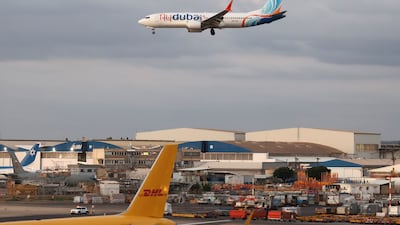

“As long as you are walking out of the aircraft safely, that’s what I want.” Amid all the confusion surrounding Wednesday’s extraordinary events onboard flydubai Flight FZ1073, this sentence from Capt Smit Machchhar, given in an interview last year, reflects the relief of a disaster narrowly averted.
At the time of writing, this is what we know happened: a potentially catastrophic incident on a Dubai-to-Tel Aviv flight ended with the Boeing 737 safely on the ground in Saudi Arabia with its passengers alive and accounted for. Capt Machchhar, despite being injured, helped travellers and crew regain control of the situation. Off-duty flydubai flight crew then helped land the aircraft at Tabuk.
However, for the families and loved ones of those passengers, the ordeal unfolded in a real-time torrent of breaking news reports and social media posts. After the plane plunged – losing thousands of metres of altitude in less than 60 seconds – and distress signals were sent out, information was soon emerging faster than it could be verified. Some reports about what was happening, and even the nationalities of those involved, were simply wrong in too many cases.
Perhaps this is inevitable in an age of instant information but there are strong reasons to resist jumping to premature conclusions. An incident involving a UAE airline, an Israeli destination and a diversion to Saudi Arabia inevitably has implications that reach beyond aviation. Claims and political interpretations have emerged before investigators have established the full picture.
This is why it is important to note that the UAE's General Civil Aviation Authority is investigating the causes and circumstances of the incident, while flydubai has said that the reasons and motives remain subject to a formal investigation. Given the sensitives involved, such caution is warranted. The aviation industry more widely must also examine what happened with the same rigour and restraint.
Despite incidents such as these, passenger flights remain overwhelmingly safe. This is precisely because aviation culture is built around learning from rare failures and near misses. This, however, is no reason for the assumptions that underpin today’s safety regime to remain static. New lessons can and should be learnt, whether they are about cockpit security, crew procedures, pilot recruitment, emergency decision-making or communications.
Perhaps the key lesson from Flight FZ1073 is that safety depends on never assuming that yesterday's procedures will be enough to meet tomorrow's emergency. The flydubai passengers were fortunate to walk away from Wednesday’s incident unscathed. The responsible thing now is to learn everything possible from why they came so close to disaster and to hold those responsible to account.

