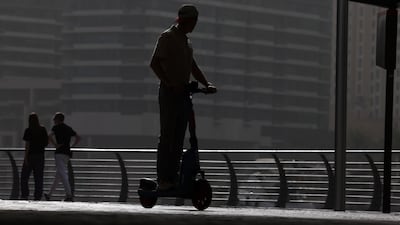

Dubai Police said this week it had seized hundreds of e-scooters and e-bikes for a variety of traffic offences during a road safety drive in one of the emirate’s neighbourhoods. It is the latest action taken to tackle unsafe use of so-called last-mile vehicles.
The same authority said last month that it had confiscated more than 13,000 e-scooters since the beginning of the year for dangerous riding, such as speeding. The authorities noted that accidents, incidents and injuries have risen. Abu Dhabi has this year also issued warnings about improper use of such vehicles, as well as disseminating public safety information videos.
There has not been a nationwide “census” conducted regarding the volume of e-scooters in active use in the country – nor does there need to be one – but e-bikes and e-scooters are now a ubiquitous presence on neighbourhood roads and cycle path networks, helping reduce congestion and pollution in the process. What is becoming obvious is that more scooters and more journeys means, in all likelihood, the potential for more accidents and incidents.
The National reported earlier this year that Ministry of Interior data showed significant e-scooter accidents had increased by 97 per cent last year, from 61 cases to 120. Despite the rapid rise in the headline number, the overall figure is still low. That, of course, provides no comfort to anyone or any family that has been affected by one of those serious accidents. It is in all of our interests to reduce the number of significant incidents to zero, while also recognising we are not sat in the middle of a contagion-level event.
Statistical models produced elsewhere in the world suggest every 100,000 e-scooter rides might result in between 10 and 20 accidents requiring medical support or intervention. A significant contributory factor to that global modelling is alcohol intoxication by the e-scooter user, which may be less of a determinant in this region. World Health Organisation figures also report that road traffic injuries of all forms tend to disproportionately affect young people. Globally, unintentional injury, such as that resulting from vehicle collision, is the leading cause of death for people under 30.
The rules for e-scooters say riders must be at least 16 years old and wear a helmet when using one. The maximum speed permitted by one of those vehicles is 20 kph. Riders are also required to keep a safe distance from pedestrians, are not allowed to carry passengers or use mobile phones while using them. Reflective clothing is also advised, and any vehicle is meant to be equipped with front and rear lights.
Authorities have said they would take action against riders who cross roads dangerously, weave between lanes or ride outside demarcated or approved zones. Improper use leads to confiscation and fines.
Anecdotally, if it is not controversial to say that most road users will have seen an e-scooter rider breach at least one of those rules in day-to-day life. A counter-argument would also say that most drivers break road rules on their daily drives, whether that is speeding, distracted driving, tailgating or another form of anti-social or potentially reckless behaviour.
Few drivers are the paragons of road-using virtue that we may think we are and only a small number of drivers willingly identify themselves as “bad” even if their fellow road users might absolutely attest that they are. It is down to every road user to take a higher level of personal responsibility to keep the roads safe.
So, how can we realistically reach a state of accident-free nirvana?
Education and awareness are key to beating back the rising tide rather than enforcement with last-mile vehicles.
Only the utterly rules-driven among us would advocate for round-the-clock and always-visible enforcement of regulations regarding e-scooters, which would be a drain on resources that could not be justified by the thankfully low volume of incidents and accidents.
-

E-scooters are becoming more popular as designated lanes open up and fleets of rides for rent continue to swell in Abu Dhabi and Dubai. Victor Besa / The National -
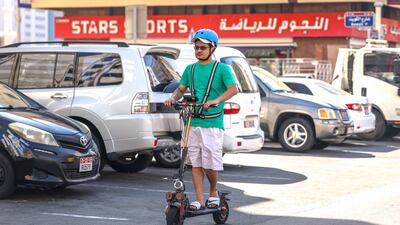
Viewed as a key component of a greener future with lower carbon emissions, the electric-powered scooters have become a familiar sight in Abu Dhabi. Victor Besa / The National -

The value of the global e-scooter market is expected to double from $15.22 billion in 2021 to $31.04 billion by 2028. EPA -

Dubai Police have confiscated 640 bicycles and electric scooters whose riders were found breaching traffic laws and endangering lives. These were seized in 13 days in a traffic campaign this month. Photo: Dubai Police -
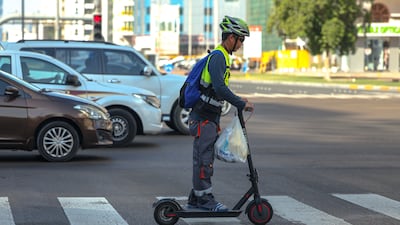
A substantial network of dedicated lanes for e-scooters and bikes aims to connect more residential areas with public transport, to encourage residents to leave cars at home. Victor Besa / The National


Each time authorities share video footage of e-scooter misuse, however, it helps subtly change behaviour and attitudes towards risk.
Road safety campaigns elsewhere in the world on the dangers of driving while intoxicated or failing to use seat belts or child seats have helped change habits and save lives over a prolonged period. Campaigns by Abu Dhabi Police to highlight the dangers of rubber-necking, tailgating and speeding have garnered widespread attention and, inevitably, offer pause for individual reflection and thought. Dubai has set up a unit in relation to e-scooter use to help education and improve safety. All of these things will help.
There is also the question of performance-limiters. E-bikes are typically able to achieve limits far in excess of the permitted maximums for the path network, much in the same way as performance cars have the potential to be driven at more than double the speed permitted on the nation’s motorways. While speed limiters are also common in both performance cars and e-bikes, software has the potential to be overridden. Awareness campaigns about the dangers of speeding and the increased risk of injury to the e-scooter user or pedestrians are the best defence in such circumstances.
A single information video rarely makes a difference on its own, but the drip-drip of persistent messaging does increase the likelihood of bringing about behavioural change and keeping our path and road network safe.