
What people fail to appreciate about Iran’s infiltration of the US and its western allies is that Tehran has developed a template that works – and has put it into practice.
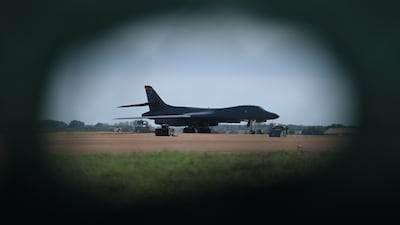
The Iranian regime might consider the US’s recent withdrawal of its bombers from the UK’s RAF Fairford as a success. Reporting from the US indicates that a bizarre escapade on the Fairford perimeter, involving three vans with contraband or stolen fuel and detected at midnight, was in fact a wider plot to swarm the base to inflict damage on American strategic assets.
Answering the inevitable question of how Iran can mete out damage thousands of kilometres away is something that should have been done a long time ago.

For the UK, the sense of emergency remains entirely absent. Whitehall has for decades viewed the Iran file as a diplomatic challenge rather than a security threat. This possibly stems from an attitude among officials to “understand a little more and condemn a little less”. As a result, however, the UK has long been paying the price – and today its humiliation is freshly clear.
The Iranian gameplan is a developed capability that stretches across a number of countries, including the US. But it is the UK where Tehran appears to have found the biggest pool of willing recruits and dupes who are engaged effectively as foot soldiers.
Where I think Tehran is underestimated is that its plots are fully fledged scripted exercises.
Think of the Iranians orchestrating these events with the same approach as the writer or producer of a Netflix drama. The intelligence officials who do the plotting and recruitment from Tehran are not just dabbling in the lower reaches of gaming chat forums and messaging channels. There is methodology behind its recruitment and mobilisations.
The UK courts are facing multiple cases of people who have been arrested for allegedly targeting Jewish communities and Iranian dissidents in the country. There have been a few convictions, too, with more likely to come out. Given the long lead times of the court process in the UK, there is much more to be revealed, but this will be too late to boost deterrence among the public.
Part of the reason is a lot of the Iranian methodology remains hidden because of the rhythm of the courts. In cases where the defendants plead guilty, the facts that are shared in the public domain amount to fewer details than we would expect. We also have slower release because the courts can take up to two years to go to trial.
Nonetheless, it is crucial that authorities in the UK demonstrate a grip on the scope and scale of the Iranian threat. This means recognising the sophistication with which Tehran has built up its operational footprint in countries that should be distanced from the regime’s threat.
Iran has benefitted from the lack of preventive policing in post-Cold War European countries. Russia allegedly hired two people to attack the home of Keir Starmer when the then-British prime minister was living in Downing Street. The prosecution statement after the trial was mechanical and bland, relating how the investigation demonstrated that the pair had conducted reconnaissance and later returned to photograph the damage. This alone strengthened the prosecution’s claim that the offences were planned rather than spontaneous.
“The prosecution made clear that the case did not depend on proving political or ideological motivation, nor on whether the defendants knew the properties were linked to the Prime Minister,” the Crown Prosecution Service statement said after the conviction. I quote this because it demonstrates to me the studied neutrality of the system and its inability to take on the wider security challenge.
Yes, the prosecutors were able to get a conviction on the basis of the criminality of the offences. In narrow terms, they succeeded in their job. But this is the sort of flawed and self-limited response that has seen the UK hamstrung in its response to the spread of targeted hostile activity across the country.
-

The Philippines embassy is among the missions in the UAE offering support as Iranian launches attacks across the region. Victor Besa / The National -

Filipino residents visit their embassy in Abu Dhabi. Victor Besa / The National -

The Filipino embassy has called hailed the UAE for its 'mantle of protection' during the crisis. Victor Besa / The National -

Philippines ambassador Alfonso Ver says residents will be given help. Victor Besa / The National -

Volunteers work at a hotline centre at the Indian consulate in Dubai. Antonie Robertson / The National -

India's consulate is committed to supporting anxious residents and tourists. Antonie Robertson / The National -

Indian ambassador Deepak Mittal has praised the efforts of the UAE authorities. Victor Besa / The National -

India's consulate is working to secure flights for people looking to return home. Antonie Robertson / The National -

Alexi Gunasekera, Sri Lanka’s consul general, has asked citizens to stay in touch with the country's embassy and consulate. The National -

UK ambassador Edward Hobart has praised citizens for the 'sheer grit' shown since Iran launched its attacks. Victor Besa / The National


Iran has exploited Britain’s porous borders to filter its own nationals into the country, using the wave of migration across the English Channel among other routes. It has also been able to tap into divisions in the diaspora, with dual nationals suspected of conducting activities on its behalf.
For wider recruitment, it has used connections with criminal gangs, including the Swedish Foxtrot network, to use lethal force in Europe. And it has tapped a cadre of lower-level criminal or sub-criminal gangs for hire to seed the ground for its operations.
The reason these plots work as scripted operations is that method allows Iran to compose its threat from a matrix of established contacts. The costs of assembling these networks are not very high. Technology is an enabler that allows encrypted communications and payment by cryptocurrency.
The UK has upgraded its laws with new offences targeted at those who work on behalf of a foreign power, even unknowingly. US President Donald Trump said that the UK was successful in the case of RAF Fairford, in disrupting whatever was planned, even if the vans were merely in the wrong place at a time of high alert.
The wider challenge for Washington is that the more exposed the US grows, the more it pulls back from its former strongholds. Iran has found a formula that exploits these gaps, and the rest of the West is well past the point of reading every incident as a wake-up call.

