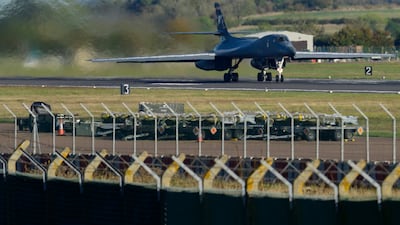
The withdrawal of US bombers from UK military base RAF Fairford will be seen as a “success by Iran”, amid a series of security threats to Britain, former British diplomats have said.
The US Air Force pulled its B-1 bombers out of Fairford on Sunday and redeployed them at bases in America. The move followed the arrests and release of six people by police investigating a suspected terror plot involving the airbase.
US Secretary of State Marco Rubio said on Monday the US still has confidence in UK bases and denied suggestions the withdrawal was linked to the suspected terror attack.

“The Department of War is constantly reallocating resources where they need to be. There's regular rotations that happen as well,” he said. “We've documented what happened last week. I wouldn't directly tie that to the move that was made.”
He added that British officials “couldn't be more co-operative” about the incident last week.
Former diplomat Edmund Fitton-Brown said Iran could interpret the withdrawal as a weakening of the US deterrent and its alliance with Britain.
“From the Iranian point of view, its already a win if they’re driving a wedge between two Nato allies. They might think we need to do more of this,” he told The National.
The withdrawal showed the “weakening of a US defence position by removing assets from a strategically significant base”, Mr Fitton-Brown said.
Peter Ricketts, who served as the UK’s first national security adviser between 2010 and 2012, said: “I think it's hard to conclude anything other than that this will be seen as a success by Iran.
“Whether it was the intention or whether it's the inadvertent outcome, it is certainly the outcome that they have now forced the US into a public bring-back of their forces from one of their allies,” Lord Ricketts told the BBC. “That what we thought were secure areas in the UK can no longer be considered entirely secure.”
Confusion
Prime Minister Andy Burnham has spoken of “strong indications” that Iran could be linked to the security incident near the airbase in Gloucestershire two weeks ago.
But the investigation last week was mired in confusion.
A 25-year-old British-Iranian man was arrested in London on Thursday last week in relation to the incident, with police searching two properties in the area. He was later bailed.
Five British men were arrested after vehicles were seen driving near the base in the early hours of September 27, and released on bail the following day.
One of the men dialled 999 himself, while a farmer living near the base also alerted police to a “large group” of masked men.
Mr Fitton-Brown said the UK’s next steps would be to reassure the Americans that it can handle terrorist threats on British soil, or that the threat represented in this instance was low.

Military analysts have disclosed that the $400 million aircraft, used extensively to bomb Iran this year, did not have any protective cover at the airbase and that plane spotters reported some have been “bombed up” – fully armed – within 20 metres of the base’s wire perimeter fence during the Iran war.
It appears that there was a hurried departure, with the first of four waves of B1s departing just before 9am on Sunday and the last at some point after 1pm, including one jet that had arrived from the US only six days earlier, according to open-source aircraft tracking data.
Other open-source data shows that four KC-135 tankers based around 200km away at RAF Mildenhall in Suffolk took off at the same time as the B-1s.
There are reports that some bombers were not fully fuelled and might have rendezvoused with the tankers mid-Atlantic. While the B-1 has a reported 12,000km range, its most distant base in Texas was 7,700 miles away, and with weather and safety considerations, would probably have required a top-up.
“If this was driven by specific security threats then this could be considered a win for Iran,” said military analyst Francis Tusa. “The fact that they were scrambled to get out of there fast does look strange.”
Mr Tusa, editor of Defence Eye, suggested that another consideration could be that the Pentagon wanted the bombers back for maintenance, with some repair machinery only available at their US bases.
“Someone in the Pentagon likely said ‘let’s get them all back, stand them down and put the crews on leave’. Then they will wait until after midterms and some point next month six B-1s could well arrive back at Fairford.”
But Reuters has reported that Nato military sources believe Iran still presents an “acute threat” to US assets in Britain.
US airbases in the Middle East have been heavily hit, making the air force wary about attacks. They will also be aware of the Ukrainian Operation Spider's Web in which lorries filled with kamikaze drones were driven to airbases to take out a substantial number of Russian bombers.
The USAF has about 44 operational B-1s, with majority being used to bomb Iran.
Iran has been accused of hiring petty criminals and organised criminal networks in the UK and across Europe to conduct attacks on Iranian dissidents, Jewish organisations and Israel-linked businesses.
Last month, Sweden expelled an Iranian diplomat found to have undertaken “activities not in according with the Vienna Convention on Diplomatic Relations”. A Swedish government minister accused Iran of working with criminal networks to conduct attacks in Sweden.
In the UK, there have been several attacks against Iranian opposition groups and Jewish organisations that police have linked to Iran.
The Iranian journalist Pouria Zeraati – a critic of the regime – was stabbed outside his home in London two years ago. British counter-terrorism police arrested two people in London on suspicion of assisting a foreign intelligence service in a case linked to Iran last week.

