
The 2020s are the decade of democratic disruption or perhaps even democratic dysfunction. The evidence is clear and may become more obvious next year because so many democracies have significant elections coming up.
Traditional parties of government are in trouble. Outsiders are in. New parties on the political left and right are chipping away at traditional parties. The common thread is voters seeking something different from “politics as usual” and the losers are generally centrist or moderate parties with the beneficiaries those on the extremes.
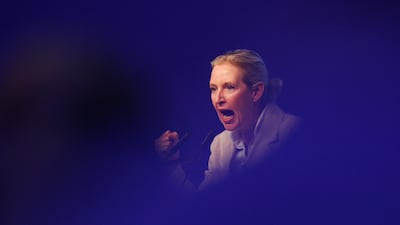
The most recent disruptions came last Sunday in Germany. In the north-east in Mecklenburg-Vorpommern, the far-right AfD became the strongest party. The AfD repeated its successes earlier this month in another region in the east, Saxony-Anhalt, while the hard-left Die Linke led the polls in Berlin. Results benefiting both the hard right and hard left have been described as a “disaster” by German Chancellor Friedrich Merz.
Europe’s political disruption may go much further with the first round of the French presidential election next April. Many French commentators see Marine Le Pen from the National Rally as potentially the favourite to become their next president. The more mainstream parties are clearly concerned, and the radical left candidate for the presidency, Jean-Luc Melenchon, also has his supporters.
Like many populist leaders, he has a simple solution to his country’s problems – just cancel the national debt. As Mr Melenchon put it: “All we have to do is take the 18 per cent held by the Bank of France and chuck it in the fire.” Popular? Possibly. Realistic? Perhaps not.
Of course, in Britain we have our own disrupters and populists after seven prime ministers in 10 years. It’s not clear, however, whether the huge donations to Nigel Farage’s Reform UK party are damaging British democracy or damaging Mr Farage personally, or both. Investigations continue.

But right now, the real focus is on the Disrupter in Chief, US President Donald Trump. The US midterm elections in November are theoretically not a referendum on the President and he is not a candidate, but with voting scheduled for the entire House of Representatives and a third of the Senate, the midterms are a test of support for the way the US is being governed by Maga Republicans.
Mr Trump has also put his own popularity into the mix. He is not on the ballot anywhere but attached himself to the result by speaking in an interview on Fox News with the presenter Trey Gowdy. Mr Trump spoke of himself in the third person: “I see it all the time, that when Trump’s on the ballot, they [Republicans] win. When he’s out of the ballot, the people don’t go to vote, and I’m asking the people … to get out and vote. Pretend I’m on the ballot.”
If Republicans do well in November, Mr Trump can claim that he is the reason for their success. But if Republicans do badly, Democrats will undoubtedly claim that Mr Trump’s words attach him firmly to Republican failures, and that the elections were a kind of referendum on the Trump presidential record.
The big question is whether November’s results will suggest that American populism has peaked and become politically toxic with ordinary voters. And the voters’ answer will be studied not just in the US but also in Europe and elsewhere. What we do know already is that Mr Trump’s war of choice with Iran is unpopular, Americans see petrol prices shooting up and the cost of living also becoming much more expensive.
-

Count Binface, a character created by comedian Jon Harvey, waits with other candidates for the declaration of the results of the Clacton by-election. Getty Images -
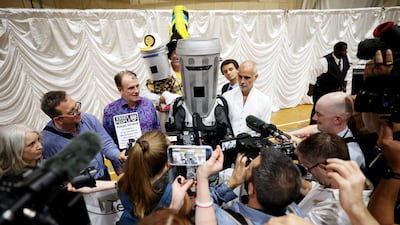
Count Binface speaks to reporters after winning more than a quarter of the votes. Getty Images -
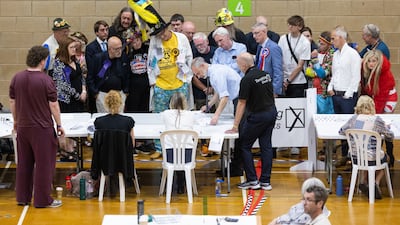
Election candidates and supporters observe spoilt ballot papers being verified. The by-election was won by Reform UK leader Nigel Farage. Bloomberg -
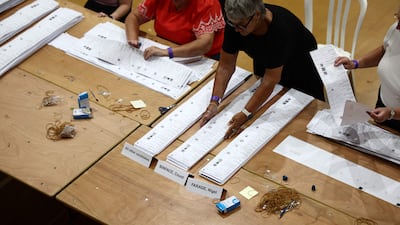
Counters sort the ballot papers, which were the longest in UK electoral history, with a record 34 candidates standing. AFP -
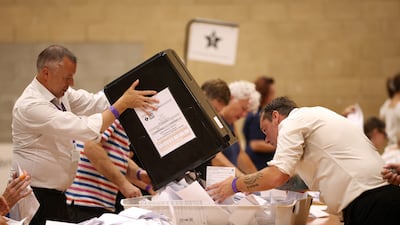
Election workers review ballots after voting closed. The by-election was boycotted by the major political parties. Getty Images -

Nigel Farage leaves a polling station in Walton-on-the-Naze, Essex, after voting. He did not attend the results declaration. Reuters


Mr Trump’s choice as chairman of the Federal Reserve has – despite his own objections – chosen to raise interest rates. The US President has also failed in the Supreme Court to achieve the voting restrictions that he demanded. The courts have also not complied with his demand to have the “Trump” name attached to Washington’s Kennedy Centre. And Mr Trump’s approval rating is a dismal minus 25 per cent – just 35 per cent approval and 60 per cent disapproval.
If potential Republican voters follow Mr Trump’s advice and pretend he is on the ballot in November, then his unpopularity could mean that Republican candidates suffer rather than succeed in the elections. Either way, tying himself personally to the result with the phrase “pretend I’m on the ballot” is, at best, risky and could backfire.
European mainstream parties will, therefore, be watching closely to see if Mr Trump’s Maga movement is running out of steam and has potentially damaged the wider Republican Party that the President has dominated for some years. Moreover, with Mr Trump having his hands so firmly on so many of the levers of power, it is difficult to find anyone else to blame when the war with Iran or the tariff battles with Canada or his other policies prove unpopular.
What is clear is that in democracies worldwide, opposition is easier than governing. Complaining is easier than fixing things. But voters want results, not merely a culture of complaint. And while populists tend to have a genius – as their name suggests – at exploiting problems to become popular, it’s not so easy to translate that genius into actually fixing those same problems.

