Long before biodiversity loss became a global headline, the UAE’s Founding Father, the late Sheikh Zayed bin Sultan Al Nahyan, understood that the prosperity of people and the health of nature could not be separated.
In Abu Dhabi, that belief was never abstract. It shaped the protection of desert landscapes, coastal waters and the species that shared them. It informed institutions, protected areas, scientific monitoring and long-term conservation programmes. It also taught us that nature is not protected by declarations alone. It is protected by patient work, reliable institutions and partnerships that endure.
This is why Abu Dhabi’s renewed framework partnership with the International Union for Conservation of Nature, or IUCN, through the Environment Agency Abu Dhabi, matters.

It is more than just a donor agreement. It is the latest stage in a conservation relationship that began locally, expanded through international species conservation, and now includes renewed framework support for the global implementation of nature commitments.
The world has made important promises to nature. Governments have agreed to halt and reverse biodiversity loss and recognised that climate change, biodiversity, land degradation, food security and human well-being are connected. But the harder task is no longer agreeing that nature matters. It is proving that those commitments can be delivered.
That task has become more difficult. Multilateralism is under pressure. Public budgets are strained. Conflict and instability, including in our own region, are forcing governments to make hard choices. In such moments, environmental action can be treated as secondary, something to be delayed until conditions improve.
That would be a mistake. Nature does not wait for more convenient times. Species continue to disappear. Ecosystems continue to degrade. Communities face the consequences of water insecurity, heat, habitat loss and declining natural resilience. The more unstable the world becomes, the more important it is for countries to protect the natural systems that help societies withstand shocks.
Abu Dhabi’s experience shows what this requires. The Arabian oryx, once on the brink of extinction in the wild, became one of the country’s most important conservation symbols because of decades of vision, breeding, reintroduction, habitat protection and management. The same long-term approach helped support the reintroduction of the Scimitar-horned oryx into Chad. Once listed as Extinct in the Wild, the species is now classified as Endangered. Its recovery remains fragile, but it shows that extinction is not inevitable when science, practice, persistence and visionary leadership come together.
This same belief shaped the Mohamed bin Zayed Species Conservation Fund. For more than 17 years, the Fund has supported conservationists working to protect threatened species in their own landscapes and communities. Its support is direct and practical, helping protect species while strengthening the conservationists and projects working for their survival.
These examples point to the same conclusion. Conservation succeeds when commitments are sustained long enough to become scientific knowledge, strong institutions, practical action and trust. It succeeds when countries act at home, but also support the wider systems that help others act as well.
-

The opening ceremony of the IUCN's World Conservation Congress takes place at Abu Dhabi National Exhibition Centre (Adnec). All photos: Victor Besa / The National -

Sheikh Khaled bin Mohamed, Crown Prince of Abu Dhabi, at the congress -
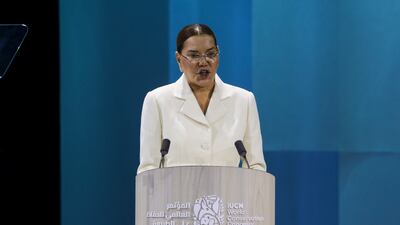
Princess Lalla Hasnaa of Morocco speaking at the event, which aims to raise awareness of pressing environmental challenges and threats to biodiversity -

IUCN President Razan Khalifa Al Mubarak -
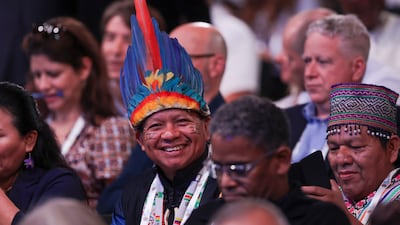
Attendees include leaders from government, science, business and indigenous communities -
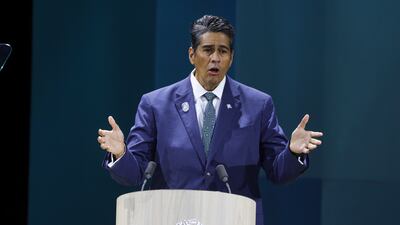
Surangel S Whipps, President of Palau -
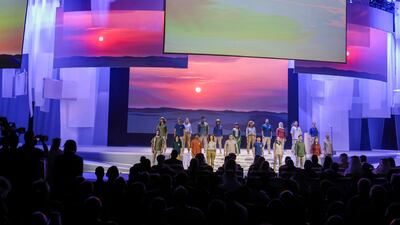
Participants in the opening ceremony. Organisers expect the congress, from October 9-15, to draw 10,000 visitors -
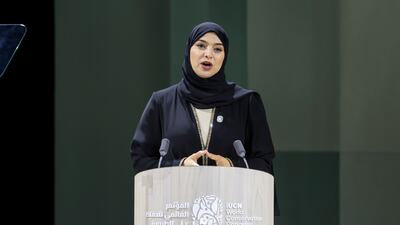
Minister of Climate Change and Environment Dr Amna Al Dahak -

Visitors to the congress have travelled from as far afield as Colombia and Peru -

The UAE has set up a pavilion at the World Conservation Congress -

The Russian pavilion at the event in Abu Dhabi -
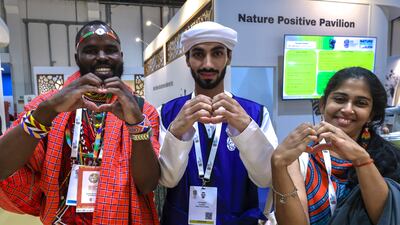
Visitors from Kenya and India at the conservation event


Abu Dhabi’s relationship with IUCN has been built in that spirit. Over many years, EAD has helped bring together the scientists and conservation experts who understand which species are most at risk, what can be done to protect them and where action is most urgent.
The renewed framework partnership is different from earlier support for specific conservation networks and meetings. It gives IUCN flexible funding to strengthen the core work on which governments, NGOs and conservationists rely. That matters because conservation does not only need individual projects. It also needs trusted knowledge, shared standards and practical tools that help people make better decisions for nature.
For example, IUCN helps show which species are most threatened, which ecosystems are under pressure and which places are most important to protect. This may sound technical, but it is the practical foundation of conservation. Without this knowledge, countries and conservationists have less clarity about what is at risk, where to act first and how to measure progress.
That is the larger significance of this agreement. At a time when the world does not need more promises alone, Abu Dhabi is supporting the practical systems that help make delivery possible. It is doing so during a period of regional conflict, economic pressure and heightened demands on national resilience, when it would be easier to treat nature as a later priority. The choice to continue investing in conservation now reflects a deeper understanding: natural resilience is part of national resilience.
This is not a departure from Abu Dhabi’s conservation history. It is the continuation of it. The test facing the international community is whether countries will keep doing the patient work, at home and with others, to turn agreed goals into real progress for nature.