
Live updates: Follow the latest news on US-Iran war
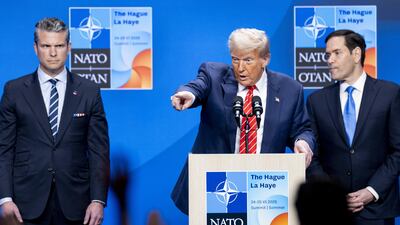
Donald Trump's sights are locked on Iran and the crisis in the Strait of Hormuz, but the US President has made it clear who his next military target will be: Nato.
His fraught relationship with the 32-member defence bloc has been the subject of European and Canadian heartache since Mr Trump's first term, when he regularly harangued allies and forced them to cough up more cash to pay for their collective self-defence.

Ah, the good old days. In his second term, Nato must be feeling positively nostalgic for Mr Trump's complaints about allies not pulling their weight. At least back then, in 2018, he said: “I believe in Nato."
Today, it is clear that is no longer the case. It seems he might want to torpedo the alliance altogether.
Gone is the language of sharing burdens, replaced by a darker tone of vengeance and abandonment. In recent weeks, he has called the alliance “cowards”, a “paper tiger” and suggested it faces a “very bad future”, while brushing aside as almost meaningless the increased costs to which member countries have committed.
He told a Saudi investment summit in Florida last week that the US doesn't “have to be” there for Nato. “Why would we be there for them, if they’re not there for us?” he said.
On Tuesday, shortly before announcing a visit to the US by King Charles and Queen Camilla, he told Britain it must “start learning how to fight for yourself”. He also blasted “unhelpful” France for not allowing US warplanes headed to Israel to use its airspace.
If Mr Trump's regard for Nato was already in the gutter when he threatened to annex Greenland, part of Nato ally Denmark's kingdom, it has gone down the drain now.
The war in Iran has confirmed all of his biases against the transatlantic alliance, after partners hemmed, hawed or refused to get involved because of their own national security interests.
Essentially, Mr Trump is attacking Nato and other partners for not joining a war he didn't even bother to notify them about, and for then having the audacity to ask clarifying questions after the US and Israel had started bombing.
Not that US-led invasion of Iraq in 2003 was a good model for anything, but at least George W Bush went through the formalities of trying to assemble a coalition of partners before invading.
Mr Trump likes to move fast and can't be fussed with protocol or diplomatic niceties, and his rush to strike Iran has highlighted the risks of his impetuous nature. The Strait of Hormuz might reopen soon, or it might not. Either way, it may never have closed if Mr Trump had executed a plan with allies before launching the war.

So the question becomes what is next for Nato? Defence Secretary Pete Hegseth told a news conference on Tuesday that his boss would be making a decision “after this is complete”.
In other words, Mr Trump will fully focus his wrath on Nato once the war with Iran is over. “Never forget," the President warned last week.
Mr Hegseth said: “A lot has been shown to the world about what our allies would be willing to do for the United States of America when we undertake an effort of this scope on behalf of the free world.
“Yet, when we ask for additional assistance … we get questions or roadblocks or hesitations, and the President is pointing out, you don't have much of an alliance if you have countries that are not willing to stand with you when you need them.”
When asked if the US is still committed to Nato's collective defence, Mr Hegseth said: “That's a decision that will be left to the President. But I'll just say a lot has been laid bare.”
Fuelling Mr Trump's anger against Nato is his realisation that the US can't treat its overseas bases as sovereign territory and must still ask permission from the host nations to attack Iran.
For a man who hates to hear "no" as an answer, he must be besides himself that the effete Europeans, with their universal health care and progressive ideals, are telling him what bombs the Pentagon can and cannot fly out of US airbases to attack Iran.
One possible recourse for Mr Trump is to come out swinging against Nato and threaten to pull US troops from Europe, unless American bases are granted something akin to sovereign status or future restrictions are lifted. He has given Russia a pass on Ukraine and its intelligence sharing with Iran to target Americans, so leaving Europe to fend off Moscow by itself might please Mr Trump.
His supporters might argue that Mr Trump is testing Nato and, like diamonds, alliances grow stronger when forced under tremendous pressure. Or perhaps Europe will get its act together and move quickly to form a European army to replace Nato.
I suspect what will end up happening is another transatlantic crisis that is resolved by more mollifying gestures from Europe, perhaps with the promise of more money and for the US to have greater autonomy over its bases.
European leaders will then quietly hope the US midterm elections will deliver a check on Mr Trump's powers.