

Israel finds itself in a diplomatic pickle thanks to a joint Saudi-French initiative to create a roadmap towards Palestinian statehood.
The first step on this path was halting Israel’s ambitions to annex the West Bank and reoccupy Gaza. That circuit-breaker came in the form of a veto from US President Donald Trump, who said he wouldn’t allow Israeli Prime Minister Benjamin Netanyahu to proceed with annexation. Should Mr Trump honour this commitment, it could mark a notable diplomatic victory for the Palestinian cause.
Iran, meanwhile, has swung between bluster and concession, and escalation and retreat – and yet ultimately failed to avert the reimposition of UN sanctions through the “snapback” mechanism tied to the 2015 nuclear deal. While the economic consequences would be suffocating, the political fallout is already evident: deepening isolation and a diminished role in the international mobilisation against Israel’s destruction of the two-state solution.
Today, Riyadh has positioned itself as the principal driver behind Palestinian statehood and the architect of a global coalition to support the Palestinian Authority. It has rallied 159 countries to recognise Palestine and has taken a firm stance against normalisation with Israel as long as the latter’s reoccupation and annexation policies continue.
For its part, Iran has attempted to reassert its influence in the Middle East through its continued intransigence in Lebanon.
Iranian Parliament Speaker Mohammad Bagher Ghalibaf sought to encourage Hezbollah’s defiance of the Lebanese state. He insisted that the group was “more vital than ever” and openly discussed the resumption of Tehran’s missile supplies to its Lebanese proxy. He even urged Hezbollah to strike “100 or 200 kilometres deep into Israel”, warning that any new war wouldn’t be met with restraint.
The timing of these declarations was deliberate. They coincided with the anniversary of Israel’s assassination of former Hezbollah secretary general Hassan Nasrallah as well as Lebanese President Joseph Aoun’s address to the UN General Assembly.
Yet this raises a critical question: why are Iran and Hezbollah effectively inviting Israeli strikes on Lebanon, which they appear to be doing by highlighting Beirut’s failure to disarm the group – a key Israeli demand? Why are they handing Israel the justification it needs to attack Lebanon?
The only logical answer is that Tehran and Hezbollah may be seeking side deals with Israel and, in the process, bypass Beirut’s politicians and military brass. Accepting an Israeli buffer zone in southern Lebanon could already be on the table, possibly in exchange for Israel ignoring Hezbollah operations elsewhere in the country.
This can’t be chalked up to foolishness or miscalculation. Just as Israel once helped create Hamas to weaken Fatah and the Palestinian Authority, and then used the Hamas-led October 7, 2023 attack as a pretext for displacement and atrocities in Gaza, Hezbollah now appears to be enabling Israel’s designs in Lebanon. Iran created Hezbollah in the name of resistance for Palestine, yet the group’s actions have brought parts of Lebanon under renewed Israeli occupation.
-
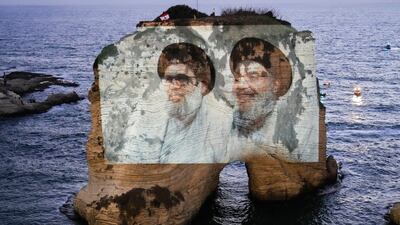
Portraits of former Hezbollah leaders Hassan Nasrallah, right, and Hashem Safieddine, are projected onto the landmark Raouche sea rock during an event commemorating their assassinations, in Beirut. AP -
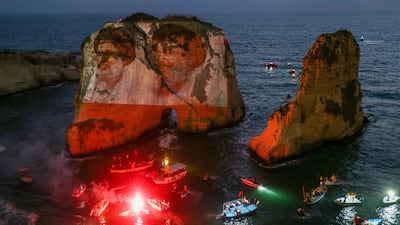
The move came despite an apparent attempt by Lebanon’s Prime Minister Nawaf Salam to halt the planned light show. EPA -
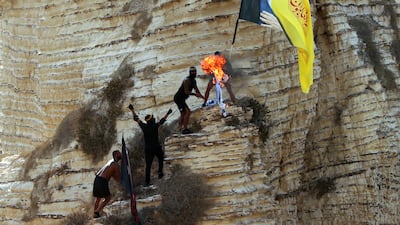
Hezbollah supporters burn an Israeli flag at the Raouche rock. EPA -
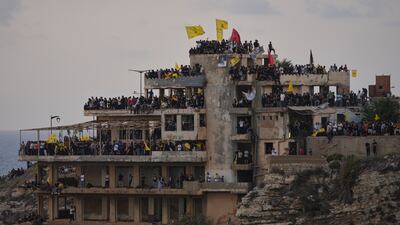
Thousands of Hezbollah supporters gathered at the site on Beirut’s coast to commemorate the killing of the group’s former longtime leader and his successor. AP -
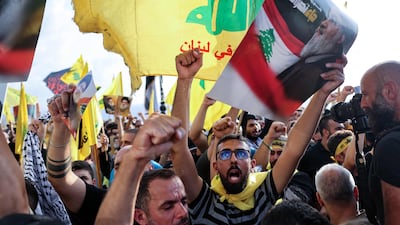
Hezbollah supporters raise the party's yellow flags and pictures of its slain leader Hassan Nasrallah, as they mark the first anniversary of his killing. AFP -
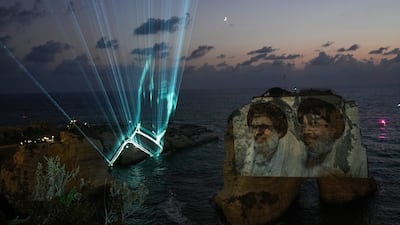
Portraits of the two former Hezbollah leaders are projected onto the landmark. AP -
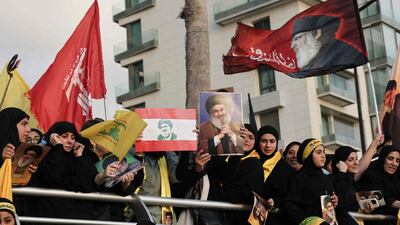
The event was a show of force by the militant group and political party, which suffered serious blows in last year’s war with Israel. AFP -
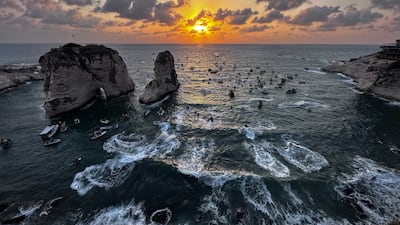
Supporters of Hezbollah sail near Raouche Rock. EPA


Today, Iran, Hezbollah and Hamas find themselves outside the scope of efforts to rescue Palestine from Israel’s aggressive implementation of its expansionist agenda. On the contrary, they help justify Israel’s brutal actions in Palestine and its plans for Lebanon.
Meanwhile, Arab and other Islamic nations, led by Saudi Arabia, are pushing hard to block Israel’s agenda. This task is formidable, but not impossible. The first step came when Mr Trump declared: “I will not allow Israel to annex the West Bank.”
This doesn’t mean Mr Trump’s 21-point peace plan for Gaza revokes his staunch support for Israel, nor does it imply that Arab and Islamic nations are fully on board with it.
There are points of contention, including the Trump administration’s push to have former UK prime minister Tony Blair head an “International Transitional Authority” over Gaza after the hostage release and eventual ceasefire. This de facto international mandate over Gaza is opposed by both European and Arab nations, as critics claim it aims to sideline Palestinians.
Another criticism stems from the involvement of Jared Kushner, Mr Trump’s son-in-law, in the so-called “Middle East Riviera” project, which is reportedly to be built upon the complete destruction of Gaza’s infrastructure and the displacement of its residents.
For these reasons and more, the road ahead is long, trust is precarious, and incrementalism may prove paralysing. But simply halting the Netanyahu administration’s annexation of the West Bank is a foundational step towards blocking the realisation of its biblical designs.
If Mr Trump stays true to his pledge to not indulge the Israelis on these designs, and if he does stymie Mr Netanyahu’s expansionist plans, this would be a significant step on an otherwise treacherous and winding path.
Perhaps the US President’s stated desire to win a Nobel Peace Prize will push him to act seriously and consistently to prevent Israel from reoccupying Gaza, even more so if his motive behind removing Israel’s control over Gaza – the Middle East Riviera project – is strong.

