
At this year’s UN General Assembly, one of the most hotly contested topics is Palestine – specifically, the recognition of a Palestinian state and yet another push for a two-state solution. If, as Karl Marx once famously observed, history repeats itself, first as a tragedy, second as a farce, then we are now at risk of going far beyond farce.
Alongside several other nations, France used the Assembly as a platform to formally recognise Palestine, almost 40 years after one French president, Francois Mitterrand, declared that “the recognition of a Palestinian state poses no problem of principle for France”. Paris had been haranguing other holdouts, most of whom are rich countries in the Global North, to follow its example. In July, at a conference held under the aegis of the UN and sponsored by France and Saudi Arabia, 157 states signed on to the New York Declaration, which upped the ante on rhetorical support for Palestinian statehood, declaring their backing for what can only be described as an optimistic plan to achieve a demilitarised and sovereign Palestine within 15 months.
But the push among governments to recognise a Palestinian state should be seen as a starting point rather than a hallmark achievement. Nonetheless, it is a good if somewhat rudimentary start, because the process of recognising Palestinian rights and ending Israel’s occupation has to begin somewhere. And if not now, then when? Delay would only give Israel more time to undermine Palestinian presence in the occupied territories. Recognition also reaffirms the international community’s support of the two-state solution, in which it has made a substantial investment both in terms of diplomatic energy and financial support for the Palestinian Authority as the core of a future national administration.
Further, recognition will rectify the flaw in the Oslo Accords that effectively gave Israel veto power over a future Palestinian state. It allows Palestinians, as a party to international treaties, to pursue legal remedy for the occupation in international courts. It also strengthens moderates within the national movement and give Palestinians a political horizon to focus on as an alternative to armed resistance, which many currently see as the only means to push back against Israeli impunity.
However, western countries now need to combine recognition with effective pressure to reverse the steps Israel has taken to undermine Palestinian sovereignty. Diplomatic pressure alone is unlikely to accomplish much beyond provoking Israel, which is protected by the veto of its US ally.
Thus far, other states in the Global North have refused to impose economic sanctions or arms embargoes against Israel. They have, instead, opted to continue the policy of “engagement” that has seen little significant success over the past 30 years. Palestinians have long wondered if there are limits to what Israel’s western allies would let it get away with, and they now have their answer: a definitive “no”.
According to the UN’s special committee tasked with investigating Israel’s practices in Palestinian territories, its methods of warfare in Gaza are “consistent with the characteristics of genocide”. Meanwhile, hardliners in its Cabinet crow that their brazen plans to massively expand settlements in the West Bank will “bury the idea of a Palestinian state” – the very cornerstone of its western allies’ plans for peace.
If these allies don’t change the constraints they are imposing, directly and indirectly, on Palestine by tolerating Israel’s encroachments on its sovereignty, then their vocal support for the two-state solution will become a sleight of hand.
As it is conceived at present, it is unlikely to ever be viable. From the time of the Oslo Accords, which were supposed to lead eventually to peace and a viable Palestinian state, statehood has been predicated on Israeli security. In other words, Palestinians get a state if they can guarantee Israel’s security. But how is that a sustainable trade-off when Israel routinely and systematically undermines Palestinian security?
How can the two-state solution be viable after Israel has repeatedly violated its commitments under Oslo to freeze settlement expansion? The population of settlers has grown from 115,700 in 1993, when Israel signed the accords, to 750,000 today, carving huge chunks of land out of what was supposed to become the future Palestinian state and critically undermining its territorial integrity.
What kind of attenuated sovereignty will a future Palestinian state enjoy if it will never have control over critical resources in its territory, like water, or for that matter its own borders, land, sea and airspace?
And, realistically, how can a demilitarised Palestinian state exist in the face of the unremitting hostility and active opposition to its existence from its much stronger neighbour, which has never acknowledged its right to exist and is apparently unencumbered by any ethical considerations or international laws in the pursuit of its own narrow self-interests?
Under these circumstances, the notion of the two-state solution risks becoming a convenient fiction. It is precisely because it sounds meaningful that it would be a useful deflection from the truth, which is that Palestinians do not have, as things stand, a realistic prospect of achieving statehood in a substantial sense. Some have pointed out that, by playing along with the diplomatic gestures of recognising a Palestinian state, Israel’s western allies avoid pressure to actually do something to reign in Israel’s rapacity.
The English-speaking countries who recognised Palestine during UNGA – Canada, the UK and Australia – had framed recognition as a “reward” Palestinians had to “earn” by implementing democratic reforms. The notion that, in recognising Palestine, these allies – with the notable exception of the US – are putting meaningful pressure on Israel is risible.
The US, for its part, revoked or refused to issue visas for the Palestinian leadership to attend the UN session “to hold the PLO and PA accountable for not complying with their commitments, and for undermining the prospects for peace”. According to one proposal reportedly circulated in the White House, the US would administer Gaza, half of the territory promised to a future Palestinian state, for at least a decade after the “voluntary” displacement of its population and turning it into a tourism and manufacturing hub.
Meanwhile, Israel is advancing its own plans by forcing one million starving Palestinians to evacuate Gaza City and find shelter in the ruins of the southern part of the Gaza Strip. In the West Bank, it has approved construction of the controversial E1 settlement block that the EU has already described as a “red line” because it will destroy the territorial contiguity of any future Palestinian state.
There are also indications that Israel is only going to double down on its recent incursions into Syria and Lebanon, and several of its leading politicians, including Prime Minister Benjamin Netanyahu, have expressed commitment to a “Greater Israel”, a concept that stretches Israel’s borders into several neighbouring states.
Critics will say that the diplomatic manoeuvring around recognition is political theatre – distracting and dramatic, to be sure, but of little actual substance. And in the context of the current events, a conversation in a vacuum that gets bogged down in recognition or non-recognition would be a setback for Palestinians and for peace in the region.
-

Palestine's ambassador to the UK, Husam Zomlot, at the flag-raising ceremony in London. Getty Images -
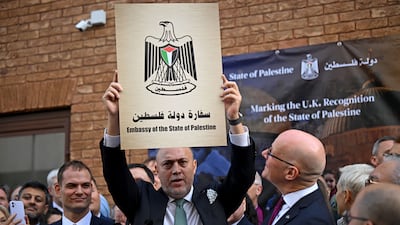
Hussam Zomlot lifts the new plaque of the embassy of Palestine alongside the Scottish First Minister John Swinney, right. Getty Images -

The Palestinian flag is raised at the country's mission in London. Reuters -

Husam Zomlot arrives at the Palestinian mission in west London. AFP -

Husam Zomlot speaks alongside John Swinney during the flag-raising ceremony to mark the UK's recognition of a Palestinian state. Getty Images -
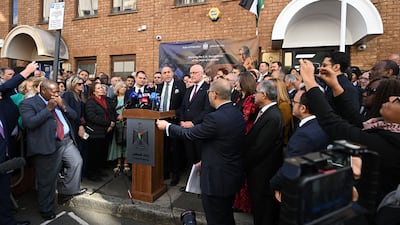
Husam Zomlot speaks alongside John Swinney during the flag-raising ceremony in London. Getty Images


On the ground, Oslo’s promise – and all subsequent international commitments to Palestinian statehood – rings as hollow as the promises of the Balfour Declaration that Jewish settlement would not “prejudice the civil and religious rights of the existing non-Jewish communities”.
Recognition without the reality of a sovereign state would make Palestine into Schrodinger’s state, so to speak – one that both exists and does not exist for as long as that ambiguity remains convenient for others.
And yet, a Schrodinger’s state is still an improvement over the political and moral vacuum in which Palestinians exist now. Recognition – albeit hemmed in by politics, conditionality and uncertainty – is a move in the right direction in an intractable conflict that hasn’t seen any substantial progress towards peace and a viable settlement in over a decade and a half.
Significantly, the international diplomatic push for recognition, for the first time, serves the interest of Palestinians rather than Israelis. It is a first step towards rebalancing the scales in a protracted conflict characterised by a marked asymmetry of power.

