

Live updates: Follow the latest on Trump's Gulf trip
All eyes will be on Riyadh as US President Donald Trump makes his first planned overseas trip – once again, as in his first term – to Saudi Arabia. This time around, the backdrop in the kingdom looks quite different. The country is nine years into the execution of its Vision 2030 programme and has made significant strides in diversifying its economy away from hydrocarbons, investing in key sectors such as tourism, mining and technology.
The President will face a more confident Crown Prince Mohammed bin Salman, at the helm of a Saudi Arabia that has positioned itself as a key global diplomatic player, including hosting talks between Russia and the US about ending the war in Ukraine; a summit to discuss post-war reconstruction in Gaza; and a high-level meeting to discuss support and the way forward for post-Assad Syria. At the same time, the country is facing economic headwinds with a growing budget deficit and oil prices below breakeven. With his own “America First” agenda in mind, Mr Trump will be focused on one thing and one thing only: deals.
Earlier this year, Crown Prince Mohammed announced a planned investment of $600 billion in the US over the next four years, a figure Mr Trump has said should increase to $1 trillion. While the numbers and headlines appear impressive, it’s also important to dig deeper and understand the longer-term economic and business implications of Mr Trump’s broader trip, which will include stops in Qatar and the UAE.
From the conversations my colleagues and I at DGA Group, a global advisory firm, have had with senior American and Gulf officials, there are three areas that will continue to shape ties between the US and the region: an increased supply of oil, potentially as a result of a US deal with Iran; easing of US export controls in key sectors; and increased American pressure on countries to align with the US against China.
The Trump administration appears closer to reaching a deal with Iran, one that will likely resemble the 2015 nuclear deal negotiated under president Barack Obama, but which will potentially encounter less pushback from Gulf countries that have developed more pragmatic relations with Iran in recent years. Anticipation of an agreement is already being reflected in energy markets, with expectations that increased Iranian oil production – likely around 1 million barrels per day within three to six months of a final deal – will lead to further downward pressure on oil prices.
Lower oil prices would affect Gulf budgets, potentially delaying planned investments, projects and national development plans. The price of oil is likely to remain a point of tension and discussion between Mr Trump and his Gulf counterparts.
In a delicate balancing act, the President is juggling between pleasing American consumers and keeping prices high enough to not starve American domestic oil producers, while countries like Saudi Arabia want prices low enough to support global growth but high enough to be able to fund their diversification drive. During Mr Trump’s trip, he will likely engage partners in the region on what a deal with Iran would look like, and strategies to manage its impact on oil markets.
Many of the anticipated deal announcements will require relaxing US export controls far beyond what previous American administrations have been willing to accept. Ahead of the visit, the Trump administration is expected to announce more than $100 billion in potential defence sales to Saudi Arabia, including aircraft, advanced munitions, missile defence systems, unmanned drones and naval assets.
The administration is also reportedly discussing a potential “123 agreement” with Saudi Arabia. This refers to Section 123 of the US Atomic Energy Act of 1954 and would enable the US government and companies to support the development of a Saudi nuclear energy programme. Despite historical congressional scrutiny of such co-operation, the priority now appears to be advancing business deals at the expense of considering the broader issue of potential nuclear proliferation.
-
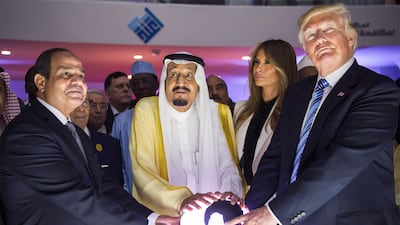
US President Donald Trump, first lady Melania Trump, Saudi Arabia's King Salman bin Abdulaziz and Egyptian President Abdel Fattah El Sisi place their hands on an illuminated globe during the inauguration ceremony of the Global Centre for Combating Extremist Ideology in Riyadh. Getty Images -

Front row, left to right, President Sheikh Mohamed, Mr Trump, King Salman, and Jordan's King Abdullah II, with Qatar's Emir, Sheikh Tamim, far left, at the Arab-Islamic-American Summit in Riyadh. Reuters -

King Salman and Mr Trump. Reuters -

Saudi Arabia's Crown Prince Mohammed bin Salman, Mr Trump and former White House senior advisor Jared Kushner. Reuters -

Mr Trump and Israel's Prime Minister Benjamin Netanyahu, right, as their wives Sara Netanyahu and Melania Trump walk behind, in Tel Aviv. Reuters -

Mr Trump meets with Bahrain's King Hamad bin Isa Al Khalifa in Riyadh. Reuters -

Saudi Crown Prince Mohammed with Mr Kushner and his wife Ivanka Trump at the Global Centre for Combatting Extremist Ideology in Riyadh. Reuters -

Mr and Mrs Trump board Air Force One to depart for Israel from King Khalid International Airport in Riyadh. Reuters


AI-related deals are another area that will dominate headlines during this visit. The UAE, for example, announced it would commit $1.4 trillion in the US over the next decade in AI infrastructure, and I expect Saudi Arabia to announce a similar commitment during President Trump’s visit. Gulf countries’ ambitions to enhance their leadership in the AI ecosystem will, of course, require greater access to American technology.
In our firm’s conversations with senior US officials, they’ve argued that granting this access – rather than enforcing restrictive measures – will provide Washington with more influence with Gulf partners in shaping their co-operation with China. While the exact updates that the Trump administration will make to former president Joe Biden’s “AI diffusion rule”, which caps the number of AI chips that can be exported to US trade partners, remain unclear, it is increasingly apparent that Gulf countries will not be left empty-handed when it comes to their AI aspirations.
Beyond AI, the Trump administration will also be concerned about Gulf partners’ economic and technological ties with Beijing. US policy on China is increasingly a bipartisan issue in Washington, and the idea that Gulf countries can balance economic ties with Beijing while relying on Washington for security guarantees is increasingly problematic for many American lawmakers.
I expect the upcoming Gulf trip to be a key moment for Mr Trump to begin to force this issue, perhaps by bringing US concerns about China into conversations about future defence and security co-operation with Gulf partners. As Mr Trump aims to highlight his convening power and strength of Gulf alliances during the upcoming trip, any exhortations regarding China may remain tactical at this stage, but in the long term they will serve to reinforce America’s desire to be the region’s main partner.

