Since his return to power in January, US President Donald Trump has indulged in an unconventional approach to resolving the world’s outstanding issues. Niceties have given way to blunt and loud diplomacy from the White House.
While the final outcomes of these issues remain uncertain – notably the wars in Ukraine and Gaza – one thing is clear: regardless of how crude the US President’s methods are, shaking up the status quo was necessary. This wasn’t just about trying to end the world’s two most critical conflicts; it was also an attempt to issue wake-up calls to all relevant stakeholders in Europe and the Middle East.
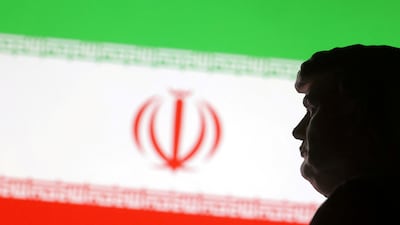
In recent days, Mr Trump has shifted his focus to Iran. He has offered Tehran a deal to normalise ties with Washington, end sanctions and reclaim its global standing in return for two things: abandon its nuclear weapons programme and stop using proxy militias to destabilise sovereign states.
As expected, Tehran has publicly rejected Mr Trump’s offer given that these programmes are the cornerstones of its foreign policy. While it perceives its nuclear ambitions as ensuring regime survival, its reliance on proxies helps to impose its primacy over large parts of the Middle East.
Trump’s approach to Iran has been less provocative than his confrontational stance towards the US’s European allies on the Ukraine war
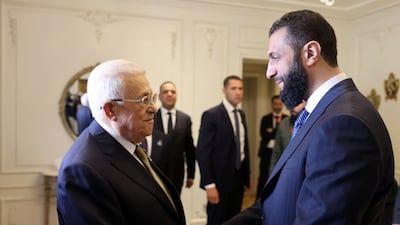
However, Iran’s influence has been greatly reduced in recent months by the fall of Bashar Al Assad’s government in Syria last year. Interim President Ahmad Al Shara is determined to push back against this influence in his country, while competing regional powers such as Turkey and Israel have moved swiftly to block any form of Iranian resurgence in the broader region.
Mr Trump’s messaging to Iran couldn’t be clearer: it is encircled in the region and needs to adapt. He is not demanding regime change but leaving Tehran with a choice between recalibrating its ideology on the one hand, and facing relentless economic strangulation and possibly even US-backed Israeli military strikes to dismantle its nuclear infrastructure on the other.
The US President has infused his Iran policy with overt respect for the country, its history and its people. He has paired this approach with the threat of military action – not just against its military installations, but against its proxies. Could Washington’s wave of air strikes on the Iran-backed Houthi rebels in Yemen on Saturday – citing the group’s attacks on shipping in the Red Sea – have been a signal to the leadership in Tehran?
Meanwhile, even as Hezbollah, Iran’s most powerful proxy in the region, struggles to recover from its decapitation after Israel’s recent war in Lebanon, Mr Trump has sought to pressure the Israeli government to finalise land border demarcation, blocking its territorial claims on Lebanese land. At the same time, Washington has warned that it will reject any attempt by Iran to use Hezbollah as leverage in these negotiations. Indeed, Tehran will not be allowed to continue to weaponise its proxies as bargaining chips.
Mr Trump’s approach to Iran has been less provocative than his confrontational stance towards the US’s European allies on the Ukraine war – except when it comes to Tehran’s support for Hamas in Gaza. But Iran, fearing the repercussions, has distanced itself from the group, avoiding any obstruction to Arab diplomatic efforts to counter Mr Trump’s outrageous proposals for the Palestinian territory. The Iranian government’s priority, at least for now, is Iran – not the Palestinian cause.
This brings us to Mr Trump’s evolving stance on Gaza. He initially called for mass displacement of Palestinians from their homeland, envisioning the enclave’s coastline as the “Riviera of the Middle East”. But last week, he declared that no one is forcing Palestinians to leave and that no one will be expelled from the land.
This is, in large part, the outcome of a calculated strategy employed by key Arab states, in demonstrating to Mr Trump how his Gaza plan could undermine his own ambition of bringing the Arab world and Israel closer together. Pushback from many of the region’s key leaders and their proposal of an alternative for the enclave have nudged the US President to moderate his rhetoric without forcing him to climb down.
Of course, much needs to be done to start the process of rebuilding Gaza. Talks to sustain the ceasefire between Israel and Hamas are still ongoing, and it would be a mistake to assume that Mr Trump has completely abandoned his broader vision for the territory. Reports that Washington is directly negotiating with Hamas for the release of several hostages in its custody should not be misinterpreted as a strategic shift towards recognising the group’s rule over the enclave.
This is all part of Mr Trump’s unconventional approach to geopolitics. It is an approach that has led Arab leaders to reassess the Palestinian-Israeli crisis with renewed urgency. But given that Israel continues to wield influence on the US President’s thinking, it is incumbent upon Arab countries to persist with their own newfound strategy to dealing with him.

Afcon 2019
SEMI-FINALS
Senegal v Tunisia, 8pm
Algeria v Nigeria, 11pm
Matches are live on BeIN Sports
Scoreline
Bournemouth 2
Wilson 70', Ibe 74'
Arsenal 1
Bellerin 52'
Scoreline
Al Wasl 1 (Caio Canedo 90 1')
Al Ain 2 (Ismail Ahmed 3', Marcus Berg 50')
Red cards: Ismail Ahmed (Al Ain) 77'
AWARDS
%3Cp%3E%3Cstrong%3EBest%20Male%20black%20belt%3A%20%3C%2Fstrong%3ELucas%20Protasio%20(BRA)%3Cbr%3E%3Cstrong%3EBest%20female%20black%20belt%3A%20%3C%2Fstrong%3EJulia%20Alves%20(BRA)%3Cbr%3E%3Cstrong%3EBest%20Masters%20black%20belt%3A%3C%2Fstrong%3E%20Igor%20Silva%20(BRA)%3Cbr%3E%3Cstrong%3EBest%20Asian%20Jiu-Jitsu%20Federation%3A%3C%2Fstrong%3E%20Kazakhstan%3Cbr%3E%3Cstrong%3EBest%20Academy%20in%20UAE%3A%20%3C%2Fstrong%3ECommando%20Group%2C%20Abu%20Dhabi%3Cbr%3E%3Cstrong%3EBest%20International%20Academy%3A%3C%2Fstrong%3E%20Commando%20Group%2C%20Abu%20Dhabi%3Cbr%3E%3Cstrong%3EAfrican%20Player%20of%20the%20Year%3A%20%3C%2Fstrong%3EKatiuscia%20Yasmira%20Dias%20(GNB)%3Cbr%3E%3Cstrong%3EOceanian%20Player%20of%20the%20Year%3A%20%3C%2Fstrong%3EAnton%20Minenko%20(AUS)%3Cbr%3E%3Cstrong%3EEuropean%20Player%20of%20the%20Year%3A%3C%2Fstrong%3E%20Rose%20El%20Sharouni%20(NED)%3Cbr%3E%3Cstrong%3ENorth%20and%20Central%20American%20Player%20of%20the%20Year%3A%20%3C%2Fstrong%3EAlexa%20Yanes%20(USA)%3Cbr%3E%3Cstrong%3EAsian%20Player%20of%20the%20Year%3A%20%3C%2Fstrong%3EZayed%20Al%20Katheeri%20(UAE)%3Cbr%3E%3Cstrong%3ERookie%20of%20the%20Year%3A%3C%2Fstrong%3E%20Rui%20Neto%20(BRA)Rui%20Neto%20(BRA)%3C%2Fp%3E%0A
The Sand Castle
Director: Matty Brown
Stars: Nadine Labaki, Ziad Bakri, Zain Al Rafeea, Riman Al Rafeea
Rating: 2.5/5
The rules on fostering in the UAE
A foster couple or family must:
- be Muslim, Emirati and be residing in the UAE
- not be younger than 25 years old
- not have been convicted of offences or crimes involving moral turpitude
- be free of infectious diseases or psychological and mental disorders
- have the ability to support its members and the foster child financially
- undertake to treat and raise the child in a proper manner and take care of his or her health and well-being
- A single, divorced or widowed Muslim Emirati female, residing in the UAE may apply to foster a child if she is at least 30 years old and able to support the child financially
The%20specs
%3Cp%3E%3Cstrong%3EEngine%3A%20%3C%2Fstrong%3E2.9-litre%20twin-turbo%20V6%0D%3Cbr%3E%3Cstrong%3ETransmission%3A%20%3C%2Fstrong%3E8-speed%20auto%0D%3Cbr%3E%3Cstrong%3EPower%3A%20%3C%2Fstrong%3E536hp%20(including%20138hp%20e-motor)%0D%3Cbr%3E%3Cstrong%3ETorque%3A%20%3C%2Fstrong%3E750Nm%20(including%20400Nm%20e-motor)%0D%3Cbr%3E%3Cstrong%3EPrice%3A%20%3C%2Fstrong%3EFrom%20Dh1%2C380%2C000%0D%3Cbr%3E%3Cstrong%3EOn%20sale%3A%20%3C%2Fstrong%3Enow%3C%2Fp%3E%0A
%20Ramez%20Gab%20Min%20El%20Akher
%3Cp%3E%3Cstrong%3ECreator%3A%3C%2Fstrong%3E%20Ramez%20Galal%3C%2Fp%3E%0A%3Cp%3E%3Cstrong%3EStarring%3A%3C%2Fstrong%3E%20Ramez%20Galal%3C%2Fp%3E%0A%3Cp%3E%3Cstrong%3EStreaming%20on%3A%20%3C%2Fstrong%3EMBC%20Shahid%3C%2Fp%3E%0A%3Cp%3E%3Cstrong%3ERating%3A%20%3C%2Fstrong%3E2.5%2F5%3C%2Fp%3E%0A
VEZEETA PROFILE
Date started: 2012
Founder: Amir Barsoum
Based: Dubai, UAE
Sector: HealthTech / MedTech
Size: 300 employees
Funding: $22.6 million (as of September 2018)
Investors: Technology Development Fund, Silicon Badia, Beco Capital, Vostok New Ventures, Endeavour Catalyst, Crescent Enterprises’ CE-Ventures, Saudi Technology Ventures and IFC
Mercer, the investment consulting arm of US services company Marsh & McLennan, expects its wealth division to at least double its assets under management (AUM) in the Middle East as wealth in the region continues to grow despite economic headwinds, a company official said.
Mercer Wealth, which globally has $160 billion in AUM, plans to boost its AUM in the region to $2-$3bn in the next 2-3 years from the present $1bn, said Yasir AbuShaban, a Dubai-based principal with Mercer Wealth.
“Within the next two to three years, we are looking at reaching $2 to $3 billion as a conservative estimate and we do see an opportunity to do so,” said Mr AbuShaban.
Mercer does not directly make investments, but allocates clients’ money they have discretion to, to professional asset managers. They also provide advice to clients.
“We have buying power. We can negotiate on their (client’s) behalf with asset managers to provide them lower fees than they otherwise would have to get on their own,” he added.
Mercer Wealth’s clients include sovereign wealth funds, family offices, and insurance companies among others.
From its office in Dubai, Mercer also looks after Africa, India and Turkey, where they also see opportunity for growth.
Wealth creation in Middle East and Africa (MEA) grew 8.5 per cent to $8.1 trillion last year from $7.5tn in 2015, higher than last year’s global average of 6 per cent and the second-highest growth in a region after Asia-Pacific which grew 9.9 per cent, according to consultancy Boston Consulting Group (BCG). In the region, where wealth grew just 1.9 per cent in 2015 compared with 2014, a pickup in oil prices has helped in wealth generation.
BCG is forecasting MEA wealth will rise to $12tn by 2021, growing at an annual average of 8 per cent.
Drivers of wealth generation in the region will be split evenly between new wealth creation and growth of performance of existing assets, according to BCG.
Another general trend in the region is clients’ looking for a comprehensive approach to investing, according to Mr AbuShaban.
“Institutional investors or some of the families are seeing a slowdown in the available capital they have to invest and in that sense they are looking at optimizing the way they manage their portfolios and making sure they are not investing haphazardly and different parts of their investment are working together,” said Mr AbuShaban.
Some clients also have a higher appetite for risk, given the low interest-rate environment that does not provide enough yield for some institutional investors. These clients are keen to invest in illiquid assets, such as private equity and infrastructure.
“What we have seen is a desire for higher returns in what has been a low-return environment specifically in various fixed income or bonds,” he said.
“In this environment, we have seen a de facto increase in the risk that clients are taking in things like illiquid investments, private equity investments, infrastructure and private debt, those kind of investments were higher illiquidity results in incrementally higher returns.”
The Abu Dhabi Investment Authority, one of the largest sovereign wealth funds, said in its 2016 report that has gradually increased its exposure in direct private equity and private credit transactions, mainly in Asian markets and especially in China and India. The authority’s private equity department focused on structured equities owing to “their defensive characteristics.”
The Specs
Price, base Dh379,000
Engine 2.9-litre, twin-turbo V6
Gearbox eight-speed automatic
Power 503bhp
Torque 443Nm
On sale now
The%C2%A0specs%20
%3Cp%3E%0D%3Cstrong%3EEngine%3A%20%3C%2Fstrong%3E6-cylinder%2C%204.8-litre%20%0D%3Cbr%3E%3Cstrong%3ETransmission%3A%20%3C%2Fstrong%3E5-speed%20automatic%20and%20manual%0D%3Cbr%3E%3Cstrong%3EPower%3A%20%3C%2Fstrong%3E280%20brake%20horsepower%20%0D%3Cbr%3E%3Cstrong%3ETorque%3A%20%3C%2Fstrong%3E451Nm%20%0D%3Cbr%3E%3Cstrong%3EPrice%3A%20%3C%2Fstrong%3Efrom%20Dh153%2C00%0D%3Cbr%3E%3Cstrong%3EOn%20sale%3A%20%3C%2Fstrong%3Enow%3C%2Fp%3E%0A
Our legal consultant
Name: Hassan Mohsen Elhais
Position: legal consultant with Al Rowaad Advocates and Legal Consultants.
Desert Warrior
Starring: Anthony Mackie, Aiysha Hart, Ben Kingsley
Director: Rupert Wyatt
Rating: 3/5